Download The Rasayanam App & Accelerate Your Exam Success Journey
📱 Live & Recorded Learning
🎯Complete Exam Preparation
✅Practice Batches & Test Series
📚 Premium Study Materials
👨🏫 Expert Faculty & Doubt Support
📈 Performance Analysis & Progress Tracking
Download App
Best Blog fo
PGT Chemistry Coaching in Delhi: 7 Best Options (2026 Guide)
If you're searching for PGT Chemistry coaching in Delhi, you already know the competition is brutal. PGT Chemistry posts in KVS, DSSSB, Delhi government schools, and private institutions attract thousands of applicants for a handful of seats every year. Picking the right coaching, one that actually builds subject depth instead of just handing out photocopied notes, can be the difference between another failed attempt and a confirmed appointment letter.
Delhi has no shortage of coaching options, from decades-old classroom institutes near Mukherjee Nagar to newer app-based platforms. Below is an honest, exam-focused roundup of the best places Delhi-based PGT Chemistry aspirants are turning to right now, starting with the one gaining the fastest traction for its teaching-exam-only focus.
The Rasayanam: Best PGT Chemistry Coaching (Live Online, Pan-India Faculty)
The Rasayanam is an online cum offline coaching platform for PGT chemistry coaching that's been gaining attention among Delhi aspirants preparing for PGT, TGT, and LT Grade Chemistry. It runs entirely through live and recorded classes on its app, which means the physical location doesn't really factor in, students in Delhi attend the same sessions as students anywhere else, without needing to commute to a Mukherjee Nagar or Laxmi Nagar classroom.
The faculty team is built specifically around Chemistry rather than general science:
Dr. Avdhesh Sir (IIT BHU), Dr. Sudhakar Sir (IIT Bombay), founder Dr. Shailesh Sir (CSIR-NET/GATE/IIT-JAM qualified)
Priyanka Ma'am, and N.K. Sir (former BARC/ONGC Scientist).
Courses are organised around specific exams: TGT, PGT, LT Grade, KVS, NVS, DSSSB, STET, alongside CSIR-NET, GATE, and IIT-JAM for those keeping other options open. Live classes, recordings, test series, study material, and doubt support sit in one app rather than being spread across separate groups and downloads, and test results come with basic performance tracking.
As with any online-only program, it's worth sitting in on a free demo class first to judge teaching pace and style before committing: batch previews are posted on their YouTube channel
Mukherjee Nagar remains Delhi's traditional hub for TGT/PGT and other teacher-recruitment coaching. Dozens of small and mid-sized institutes here run classroom batches for DSSSB and KVS exams across subjects, including Chemistry. The advantage is peer study culture and access to a large local library and hostel ecosystem. The downside: most of these institutes teach Chemistry as one subject among many, faculty quality varies widely between centres, and batch sizes can be large, which limits individual doubt-solving.
UNIFOX (Saket, South Delhi)
UNIFOX has historically run dedicated classroom batches for KVS PRT, TGT, and PGT Chemistry candidates out of its Saket centre. It's a reasonable option if you specifically want an in-person classroom near South Delhi and prefer KVS-pattern practice papers over a broader teaching-exam syllabus. It's worth confirming current batch schedules directly with the centre, as timings and faculty can change between cycles.
Para Classes
Known primarily for JEE and NEET Chemistry coaching in Delhi, Para Classes has built a strong reputation around conceptual teaching. It isn't a dedicated PGT-exam coaching centre, but some aspirants who are also brushing up on core undergraduate-level Chemistry concepts use it as a supplementary resource for fundamentals before pivoting to PGT-specific test series elsewhere.
ABC Chemistry, Dwarka
ABC Chemistry in Dwarka positions itself around Class 11-12, JEE, NEET, and CUET Chemistry, with some coverage extending toward CSIR-NET, GATE, IIT-JAM, and BARC/TIFR-level preparation. For West Delhi students who want a local, chemistry-only tutor for building strong basics, it's worth a look — though again, it isn't built around the PGT recruitment exam pattern specifically.
General DSSSB/TGT/PGT Multi-Subject Institutes
A number of Delhi-based institutes run general DSSSB TGT/PGT/PRT batches covering all subjects under one roof. These can work if you want general exam strategy, current affairs, and teaching-aptitude coverage alongside your subject, but Chemistry depth is usually shallower since faculty time is split across many subjects and aspirants.
Self-Study with Test Series Subscriptions
Some Delhi aspirants, especially those who've already cleared the conceptual portion once and are reattempting, skip full coaching and instead subscribe only to test series and mock papers from various platforms, relying on NCERT and standard reference books for revision. This works only if you already have strong fundamentals and mainly need practice and analytics rather than teaching from scratch.
How to Choose the Right PGT Chemistry Coaching in Delhi
Before you enroll anywhere, check for these four things:
Chemistry-specialist faculty, not generalists covering five subjects at once
Exam-specific batches for PGT/TGT/KVS/DSSSB rather than a generic "teacher exam" course
A structured test series with performance analytics, not just PDFs
Flexibility, live classes plus recordings, so a missed class in a Delhi traffic jam doesn't cost you a topic
Final Word
If you value classroom camaraderie, Mukherjee Nagar's institutes or a local centre like UNIFOX are worth visiting in person. If flexibility and Chemistry-focused faculty matter more to you than physical proximity, an online-first option like The Rasayanam is worth sitting in on a demo class for. Either way, the right fit comes down to trying a session and seeing how the teaching style matches how you actually learn.
📱 WhatsApp/Call: +91-8285162819 ✉️ The Rasayanam ▶️ YouTube: @therasayanam 📲 App: Available on Google Play (Android) and via the Classplus app (iOS)
UP TGT PGT Exam Pattern 2026: Syllabus Released, Negative Marking Introduced & Major Pattern Changes
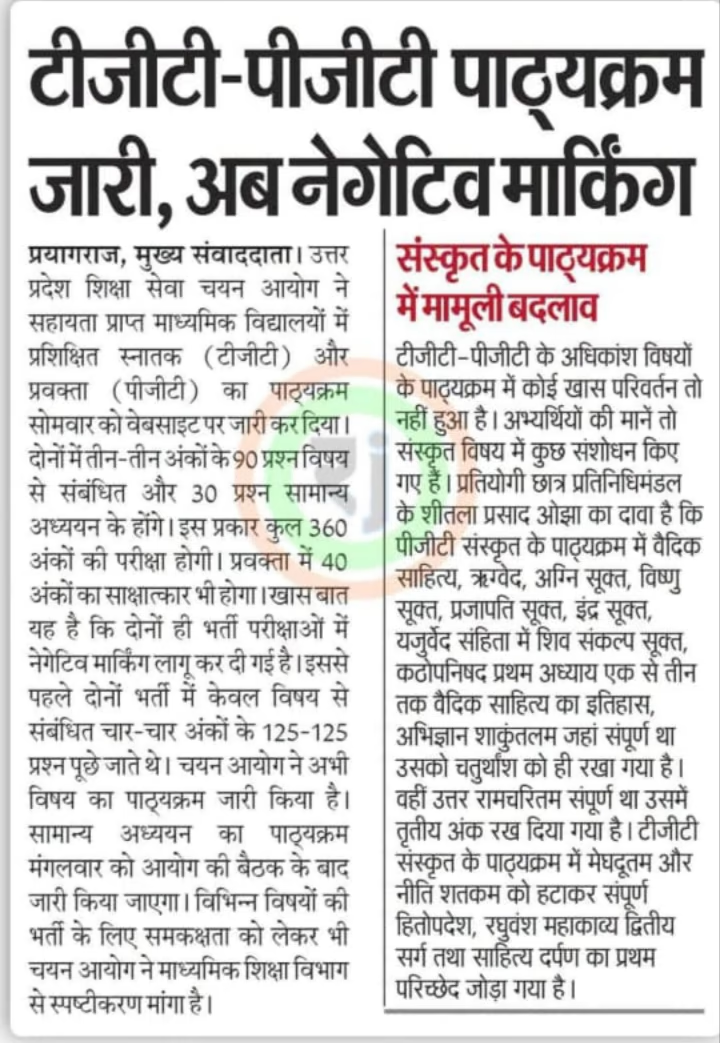
The Uttar Pradesh Secondary Education Service Selection Board (UPSESSB) has officially released the updated exam pattern and syllabus for the Trained Graduate Teacher (TGT) and Post Graduate Teacher (PGT) recruitment examinations.
If you are preparing for UP TGT PGT 2026, this announcement brings major structural changes that directly affect your preparation strategy. Most notably, negative marking has been introduced for the first time, alongside a revamped paper pattern and minor syllabus modifications in specific subjects like Sanskrit.
Here is a complete breakdown of the official notification, updated syllabus guidelines, marks distribution, and strategic tips to help you adapt.
Direct Summary of UP TGT PGT Exam Changes
For quick reference, here are the key updates from the official notification:
Negative Marking: Now applicable to both TGT and PGT written examinations.
Total Written Exam Marks: 360 Marks (120 Questions total).
Interview Round: 40 Marks (Only applicable for PGT candidates).
Subject Changes: Minor topic revisions in Sanskrit; General Studies detailed syllabus to be published following board review.
New UP TGT PGT Exam Pattern & Marking Scheme
Previously, the UP TGT and PGT recruitment exams consisted of 125 subject-specific questions worth 4 marks each, totaling 500 marks, with no penalty for wrong answers. Under the revised pattern, the examination structure has been overhauled to evaluate candidates on both core subject proficiency and general awareness.
Written Exam Structure (TGT & PGT)
Section
Number of Questions
Marks per Question
Total Marks
Section A: Core Subject
90
3 Marks
270 Marks
Section B: General Studies
30
3 Marks
90 Marks
Total
120 Questions
—
360 Marks
PGT Interview Weightage
For Post Graduate Teacher (PGT) posts, candidates who clear the written stage will proceed to an interview round evaluated out of 40 marks.
Introduction of Negative Marking: What It Means for Candidates
The introduction of negative marking is the most critical update in this notification.
In previous selection cycles, candidates could attempt all questions without the risk of deduction. With negative marking active, accurate selection and strategic skipping will be essential.
Key Implications:
Accuracy Over Guesses: Indiscriminate guessing can significantly lower your score. Focus on precision.
Time Management: Allocate extra time to verify questionable answers before marking them on the answer sheet.
General Studies Impact: Since 30 questions (90 marks) are dedicated to General Studies, mastering foundational GS concepts can give you a decisive edge.
Syllabus Updates: Subject-Wise Breakdown
While the core syllabus for most subjects remains consistent, the board has introduced specific revisions to certain subjects, along with a dedicated General Studies paper.
1. General Studies (GS) Syllabus
The board will release the full itemized General Studies syllabus following an upcoming administrative meeting. The GS section will account for 25% of the written exam (30 out of 120 questions).
2. Syllabus Revisions in Sanskrit
According to candidate representatives and board details, Sanskrit has received key topic updates:
The Selection Board has formally requested clarification from the Secondary Education Department regarding subject equivalency criteria for various positions to streamline eligibility verification.
How to Adapt Your Preparation Strategy
Prioritize Concept Clarity: Because negative marking is active, superficial learning will lead to avoidable errors. Ensure your fundamental understanding of core subject topics is thorough.
Build a Daily GS Routine: Treat the General Studies section as a core scoring component. Practice general knowledge, static concepts, and current affairs regularly.
Take Negative Marking Mock Tests: Practice with simulated full-length tests that include negative marking penalties to build accuracy and test-taking discipline.
.svg)

.png)
.avif&w=1920&q=75)

.avif)
.avif)
.avif)
.avif)
.avif)
.avif)
 UPESSC
 PGT TGT
 STET/BPSC
 PGT
PGT TGT
TGT UP LT Grade
 IIT JAM Chemistry