Download The Rasayanam App & Accelerate Your Exam Success Journey
📱 Live & Recorded Learning
🎯Complete Exam Preparation
✅Practice Batches & Test Series
📚 Premium Study Materials
👨🏫 Expert Faculty & Doubt Support
📈 Performance Analysis & Progress Tracking
Download App
Leclanché Cell and Lead Storage Battery: An Important UP TGT Science Topic
Electrochemical cells are an important part of Electrochemistry and an important area to study for the UP TGT Science Exam
Two important examples are the Leclanché cell and the lead storage battery. Understanding their components, electrodes, electrolytes, EMF and working can help you solve both direct and conceptual questions.
Let's understand these two cells in detail.
What Is a Leclanché Cell?
The Leclanché cell is a type of primary electrochemical cell.
Its important components include:
Electrolyte: NH₄Cl
Anode: Zinc (Zn)
Depolarizer: MnO₂
Approximate EMF: 1.5 V
These are important facts for exam preparation because questions can directly ask about the electrolyte, electrode, function of MnO₂ or EMF of the cell.
What Is the Role of MnO₂ in a Leclanché Cell?
MnO₂ acts as a depolarizer in the Leclanché cell.
Therefore, remember:
Leclanché Cell → MnO₂ → Depolarizer
What Is the EMF of a Leclanché Cell?
The approximate EMF of a Leclanché cell is:
1.5 V
This is an important fact that can appear as a direct MCQ.
What Is a Lead Storage Battery?
A lead storage battery is a secondary cell, which means it can be recharged.
Its important components are:
Positive electrode: PbO₂
Negative electrode: Pb
Electrolyte: H₂SO₄
Approximate EMF: 2.0 V per cell
Unlike a primary cell, a lead storage battery can be recharged by supplying electrical energy.
Why Is a Lead Storage Battery Called a Secondary Cell?
A lead storage battery is called a secondary cell because its electrochemical reactions can be reversed during charging.
During discharge, the battery produces electrical energy. During charging, electrical energy is supplied to restore the active materials.
Therefore:
Leclanché Cell → Primary Cell
Lead Storage Battery → Secondary Cell
What Happens During Discharge of a Lead Storage Battery?
During discharge, the lead storage battery supplies electrical energy to an external circuit.
An important change during discharge is the formation of PbSO₄ at both electrodes. The practice material provided for this topic specifically tests the formation of PbSO₄ during discharge.
At the negative electrode, the reaction can be represented as:
Pb + SO₄²⁻ → PbSO₄ + 2e⁻
At the positive electrode, PbO₂ also undergoes a reaction resulting in the formation of PbSO₄.
The key point to remember is:
During discharge → PbSO₄ is formed at both electrodes.
What Happens to H₂SO₄ During Discharge?
The concentration of H₂SO₄ decreases during discharge.
This is an important conceptual point for UP PGT Chemistry preparation and is directly tested in the supplied practice material.
Remember:
Discharge of lead storage battery → H₂SO₄ concentration decreases
What Happens During Charging?
A lead storage battery can be recharged by supplying electrical energy.
During charging, the discharge process is reversed and the active materials are restored.
In simple terms:
Discharge → Chemical energy → Electrical energy
Charging → Electrical energy → Chemical energy
Understanding this difference is important when answering questions about primary and secondary cells.
EMF of a Lead Storage Cell
The approximate EMF of one lead storage cell is:
2.0 V
This value is important for direct questions as well as numerical applications.
For example, if six lead storage cells are connected in series:
6 × 2 V = 12 V
Therefore:
Six cells in series → Approximately 12 V
The supplied practice material includes this type of question.
Leclanché Cell vs Lead Storage Battery
Feature
Leclanché Cell
Lead Storage Battery
Type
Primary cell
Secondary cell
Electrolyte
NH₄Cl
H₂SO₄
Electrode
Zn
Pb and PbO₂
Depolarizer
MnO₂
—
Approx. EMF
1.5 V
2.0 V per cell
Rechargeable
No
Yes
Important discharge product
—
PbSO₄
This comparison can help you quickly revise the most important differences between the two cells.
Important Points for UP PGT Chemistry
Leclanché Cell
Primary cell
NH₄Cl is the electrolyte
Zn acts as the anode
MnO₂ acts as the depolarizer
Approximate EMF: 1.5 V
Lead Storage Battery
Secondary cell
Pb and PbO₂ are the electrodes
H₂SO₄ is the electrolyte
Approximate EMF: 2.0 V per cell
PbSO₄ forms during discharge
H₂SO₄ concentration decreases during discharge
Six cells connected in series give approximately 12 V
These are the major concepts covered in the supplied 20-question practice material.
Practice Questions: Leclanché Cell & Lead Storage Battery
Now that you have studied the concepts, test your understanding with the 20-question practice set based on Leclanché Cell and Lead Storage Battery.
The practice set covers electrolytes, electrodes, EMF, primary and secondary cells, discharge and charging reactions, PbSO₄ formation, H₂SO₄ concentration and series connection of cells.
Try answering the questions yourself before checking the answer key.
Lead Storage Battery: Pb/PbO₂ → Electrodes H₂SO₄ → Electrolyte 2.0 V → Approximate EMF per cell PbSO₄ → Formed during discharge H₂SO₄ concentration → Decreases during discharge 6 cells in series → Approximately 12 V
A clear understanding of these points, followed by regular MCQ practice, can make this part of Electrochemistry much easier to revise for the UP PGT Chemistry exam.
Prepare for UP TGT Science with The Rasayanam
Want structured guidance for your UP TGT Science preparation?
Join The Rasayanam today and prepare with focused study material, practice questions, PYQs, and exam-oriented guidance to help you crack the UP TGT Science exam.
Start your preparation with The Rasayanam today.
Along with video lectures and practice questions, choosing the right study material is important for effective preparation.
📱 WhatsApp/Call: +91-8285162819 ✉️ The Rasayanam: therasayanam@gmail.com ▶️ YouTube: @therasayanam 📲 App: Available on Google Play (Android) and via the Classplus app (iOS)
Best Books for UP PGT Chemistry Preparation: A Complete Booklist
If you're preparing for UP PGT Chemistry, you've probably already asked yourself which books to pick up. Bookstores and online lists throw dozens of titles at you, and it's easy to end up buying more books than you can realistically finish. The truth is, you don't need a mountain of material, you need the right combination of NCERT textbooks, a few standard reference books, and consistent practice.
This post walks you through six books that consistently work for UP PGT Chemistry aspirants, how to use each one, and how to sequence your preparation so you're not just collecting books but actually finishing your syllabus with confidence.
NCERT Chemistry Class 11 & 12
Best for: Building strong Chemistry fundamentals
Every serious UP PGT Chemistry preparation starts with NCERT. These textbooks explain fundamental concepts clearly and are the fastest way to revise important reactions, definitions, properties, and formulas before an exam.
Pay close attention to these topics while going through NCERT:
Atomic structure
Chemical bonding
Thermodynamics
Equilibrium
Electrochemistry
Chemical kinetics
Coordination compounds
Organic Chemistry reactions
Periodic properties
p-block and d-block elements
If your fundamentals in any of these areas feel shaky, resist the urge to jump straight to reference books. Finish the relevant NCERT chapters first, then move to more advanced material. Skipping this step is one of the most common reasons students struggle later with reference books that assume a base level of understanding.
O.P. Tandon: Physical Chemistry
Best for: Physical Chemistry concepts and problem-solving
Physical Chemistry rewards students who combine conceptual clarity with regular numerical practice, and O.P. Tandon's Physical Chemistry is built for exactly that combination.
The book covers:
Atomic structure
States of matter
Thermodynamics
Chemical equilibrium
Ionic equilibrium
Electrochemistry
Chemical kinetics
Solutions
Solid state
Surface chemistry
You don't need to work through every page. Match the chapters to your UP PGT Chemistry syllabus and use the book specifically where you need extra conceptual clarity or more numerical practice than NCERT provides.
R.C. Mukherjee: Numerical Chemistry
Best for: Physical Chemistry numerical practice
If numericals are where you keep losing marks, R.C. Mukherjee's Numerical Chemistry is worth prioritizing. It gives you extensive Physical Chemistry problem sets that sharpen:
Calculation speed
Accuracy
Formula application
Problem-solving approach
Conceptual understanding of numerical topics
The most effective approach is to first understand a topic and its formulas, then attempt questions from that specific chapter, rather than solving the book front to back without a plan. Pick questions according to what's actually in the UP PGT Chemistry syllabus instead of attempting everything randomly.
O.P. Tandon: Inorganic Chemistry
Best for: Inorganic Chemistry preparation
Inorganic Chemistry mixes conceptual understanding with a large amount of factual recall, which makes systematic revision essential. O.P. Tandon's Inorganic Chemistry is a solid resource for:
Periodic properties
Chemical bonding
s-block elements
p-block elements
Transition elements
Coordination compounds
Metallurgy
Qualitative analysis
Important inorganic compounds and reactions
While studying this section, maintain short notes on reactions, exceptions, trends, and properties as you go. These notes become extremely valuable during your final revision, when you won't have time to reread full chapters.
If topics like Inorganic Chemistry trends and exceptions feel hard to retain on your own, The Rasayanam app has structured video lectures and topic-wise practice tests for UP PGT Chemistry that break these patterns down step by step, available on Google Play and via the Classplus app.
Morrison & Boyd: Organic Chemistry
Best for: Organic Chemistry concepts and reaction mechanisms
Organic Chemistry gets difficult fast if you try to memorize reactions without understanding why they happen. Morrison & Boyd is the standard reference for building that deeper understanding of mechanisms and reasoning.
It's useful for:
Hydrocarbons
Aromatic compounds
Alcohols and phenols
Aldehydes and ketones
Carboxylic acids
Amines
Stereochemistry
Reaction mechanisms
Important organic reactions
You don't need to read this book cover to cover for UP PGT preparation. Focus on the chapters relevant to your syllabus, and spend extra time on the mechanisms rather than just the final products of reactions, mechanism-based questions are where many candidates lose marks despite knowing the reactions themselves.
J.D. Lee: Concise Inorganic Chemistry
Best for: Deeper understanding of Inorganic Chemistry
J.D. Lee's Concise Inorganic Chemistry works well once you want to go beyond O.P. Tandon for a particular topic. It helps with:
Periodic trends
Chemical bonding
Coordination chemistry
Transition elements
Main-group chemistry
Organometallic chemistry
Inorganic reactions
Treat this as a reference book rather than something to memorize completely. Use it selectively when a concept from O.P. Tandon or NCERT needs more depth or a clearer explanation.
Which books should you prioritize?
You don't need to study all six books cover to cover. A practical way to divide your effort:
Purpose
Recommended Book
Basic concepts
NCERT Chemistry Class 11 & 12
Physical Chemistry
O.P. Tandon
Physical Chemistry numericals
R.C. Mukherjee
Inorganic Chemistry
O.P. Tandon
Organic Chemistry
Morrison & Boyd
Advanced Inorganic reference
J.D. Lee
NCERT should remain your foundation throughout. The other five books come in as targeted support based on your individual strengths and weaknesses — not as a fixed list everyone must finish equally.
Other resources you should use along with these books
Books alone won't get you through UP PGT Chemistry. Along with the recommended titles, build these two habits into your preparation:
Previous-Year question papers (PYQs)
Previous-year questions show you the exact pattern, weightage, and difficulty level of the exam. Use them to identify:
Frequently tested concepts and high-yield topics
Your individual weak areas
Time management and pacing issues
Solve topic-wise previous-year questions right after finishing a chapter rather than saving them all for the end.
Once you've covered a major portion of the syllabus, start taking full-length timed mock tests. After each test, categorize your errors into four buckets:
Conceptual mistakes: You need to re-read and understand the core concept.
Memory mistakes: You forgot a specific formula, named reaction, or periodic trend.
Calculation mistakes: The concept was correct, but numerical execution failed.
Careless mistakes: You misread the question or options under pressure.
Reviewing your performance this way highlights exact preparation gaps far better than endlessly attempting tests without analysis.
How to use these books for UP PGT chemistry preparation
Step 1: Start with the UP PGT Chemistry syllabus. Before picking chapters from any reference book, go through the syllabus carefully and mark what you're already comfortable with versus what needs more work.
Step 2: Build your foundation with NCERT. Read the relevant chapters and make short notes containing formulas, reactions, definitions, trends, and exceptions.
Step 3: Use reference books for difficult topics only. If you understand Chemical Equilibrium from NCERT but struggle with the numericals, go to O.P. Tandon or R.C. Mukherjee for that specific gap, not the entire book.
Step 4: Practice previous-year questions after each topic. This tests whether you can apply what you've studied, not just recall it.
Step 5: Revise regularly. Chemistry, especially Organic and Inorganic, needs repeated revision. Keep your notes short enough to go through multiple times before the exam.
Step 6: Take mock tests once most of the syllabus is done. Track your score over time and pay attention to topics where mistakes repeat.
Final booklist for UP PGT chemistry
If you want a short answer to which books matter most for UP PGT Chemistry preparation, start here:
NCERT Chemistry Class 11 & 12 — for fundamentals
O.P. Tandon — Physical Chemistry — for concepts and practice
R.C. Mukherjee — Numerical Chemistry — for numerical problems
O.P. Tandon — Inorganic Chemistry — for Inorganic Chemistry
Morrison & Boyd — Organic Chemistry — for Organic Chemistry
J.D. Lee — Concise Inorganic Chemistry — for deeper Inorganic Chemistry concepts
Add previous-year question papers, practice sets, and mock tests around these six books, and your preparation strategy is complete.
Final takeaway
Completing more books does not automatically mean better preparation. Start with NCERT, use standard reference books to strengthen the specific topics where you're weak, practice questions consistently, and revise multiple times before your exam. Focus on one goal: understanding the UP PGT Chemistry syllabus well enough to solve questions accurately and confidently on exam day.
If you'd like structured guidance while working through this booklist — video lectures mapped to the syllabus, topic-wise tests, and doubt support from faculty who've cleared these exams themselves — The Rasayanam offers dedicated UP PGT Chemistry batches designed around exactly this kind of preparation. You can explore the courses and faculty athttps://www.therasayanam.com/
📱 WhatsApp/Call: +91-8285162819 ✉️ The Rasayanam: therasayanam@gmail.com ▶️ YouTube: @therasayanam 📲 App: Available on Google Play (Android) and via the Classplus app (iOS)
Which YouTube Channel Is Best for UP PGT Chemistry Preparation?
If you're preparing for UP PGT Chemistry, you've probably already discovered the problem: YouTube has too many Chemistry channels, and not all of them are built for your exam. Full syllabus lectures, one-shot revisions, PYQ marathons, mock test walkthroughs, the content is everywhere, but not all of it is exam-specific.
This post breaks down which channels actually serve UP PGT Chemistry aspirants and how to use them without wasting your revision time.
Why isn't subscriber count the right filter?
It's tempting to pick the channel with the biggest numbers, but subscriber count tells you nothing about syllabus alignment. For UP PGT Chemistry specifically, you need three things from a channel: content mapped to the actual UP PGT/GIC syllabus, sufficient MCQ and PYQ practice, and a teaching pace that matches how the exam is structured.
A channel with lakhs of subscribers teaching generic NET-level Chemistry won't help you the way a smaller, exam-focused channel will.
Quick Comparison of YouTube Channel for UP PGT Chemistry
Channel
What You'll Find
The Rasayanam
UP PGT Chemistry strategy, PYQs, practice, revision
MadChem Classes
UP PGT Chemistry classes, MCQs, PYQs, model papers
CY Competition Classes
PYQs, solved papers, test series
Chemophilic Academy
Conceptual Chemistry lectures, prep guidance
TCS Academy
Prep strategy, general competitive Chemistry content
Don't try to follow all five at once. Pick one as your primary channel and use the rest only when you need a second explanation of a specific topic.
Studying for UP PGT Chemistry but Still Forgetting What You Studied? Here's Why
You revise Coordination Chemistry for three hours, feel confident, move on to Chemical Kinetics, and a week later, half of what you studied has quietly disappeared. If this sounds familiar, you're not doing anything unusual.
Most UP PGT Chemistry aspirants hit this wall at some point, and the reason is rarely "I'm just bad at remembering things." It's almost always a mismatch between how you're studying and how memory for a subject like Chemistry actually works.
Let's break down the real causes and what to do about each one.
Reason 1: You're reading, not recalling
The biggest mistake when preparing for PGT Chemistry is confusing understanding something with actually knowing it. When you read a topic like Crystal Field Theory, it makes sense in the moment, so your brain tricks you into thinking, "I know this." But recognizing an answer in a book is very different from recalling it on your own during an exam months later.
Students who only highlight and re-read their notes usually perform worse than those who test themselves from memory. Re-reading trains recognition, but the exam tests recall.
Passive reading creates a false sense of confidence without building the strong memory pathways needed for exam day.
The Fix: After finishing a topic, close your book and write down everything you remember on a blank page. Then check your notes to see what you missed. This simple switch to active recall is the single best way to boost long-term retention in Chemistry.
Reason 2: You study physical, organic, & inorganic chemistry separately & never connect them
The PGT exam does not keep subjects completely separate. A single question might link Inorganic Chemistry (like crystal field theory) with Physical Chemistry (like bonding or magnetic properties). If you study each branch on its own, your brain fails to build the connections needed to remember the material.
Isolated facts fade fast. Connected facts, where one idea reminds you of three others, are much harder to forget.
The Fix: After finishing a topic, ask yourself: "Where else have I seen this idea?" For example, after learning hybridization in Inorganic Chemistry, link it back to bond angles in Organic Chemistry (like in benzene).
Reason 3: No revision, you study once & expect it to stick
Most students study Organic Chemistry in July, feel good about it, move to Physical Chemistry in August, and do not look at Organic Chemistry again until right before the exam. By then, they have forgotten most of it and have to relearn everything under stress.
Memory fades quickly if you do not review what you learn. Toppers retain more simply because they schedule regular revisions.
The Fix: Revise using a simple timeline:
1 day after studying
3 days later
10 days later
30 days later Track these dates in a notebook. Forcing your brain to recall information at spaced intervals keeps it fresh.
Reason 4: You are not solving enough previous year question papers
Reading theory is passive; solving Previous Year Questions (PYQs) forces your brain to retrieve and apply what you learned. PGT questions often test how you apply a concept rather than asking for direct definitions.
The Fix: Start solving PYQs as soon as you finish a topic, not at the very end of your preparation. Use them as a daily learning tool.
If you are also preparing for combined science paper requirements or testing your problem-solving speed under exam conditions, practicing with aUP PGT Physics Mock Test can help refine your overall exam strategy and time management.
Reason 5: You are learning passively. Watching instead of doing
Watching a lecture on video feels productive, but listening alone creates weak memories. This is especially true for math-heavy topics like Thermodynamics or Electrochemistry, where watching someone solve a problem is very different from solving it yourself.
The Fix: For every hour you spend watching a class or reading, spend 30–40 minutes doing:
Solve problems on your own.
Write summaries from memory.
Teach the concept out loud to an imaginary student.
Reason 6: Lack of sleep & rest keeps your brain from storing information
Your brain converts short-term memories into long-term retention while you sleep. Cutting sleep to study more actually harms your memory and leads to lower retention per hour spent.
The Fix:
Get 6 to 7 hours of sleep every night.
Study in focused 45–50 minute blocks, taking short breaks in between to keep your mind fresh.
Ready to transform your prep?
Forgetting what you study for UP PGT Chemistry is rarely a matter of hard work—most students put in long hours. It is simply a matter of strategy.
Passive reading, studying topics in isolation, skipping spaced revision, and avoiding PYQs will hurt your retention, no matter how many hours you sit at your desk. Fixing these common mistakes will dramatically improve how much information you actually remember on exam day using the exact same amount of study time.
Future teachers, secure your selection with The Rasayanam
If you want a structured, hassle-free system to crack the UP PGT Chemistry exam, The Rasayanam is built for you. Our specialized courses eliminate the guesswork by providing:
Built-in spaced revision: Expert schedules designed to automate your review cycles.
Topic-wise PYQ practice: Tests that train you to handle complex, application-based questions.
PGT Chemistry Coaching in Delhi: 7 Best Options (2026 Guide)
If you're searching for PGT Chemistry coaching in Delhi, you already know the competition is brutal. PGT Chemistry posts in KVS, DSSSB, Delhi government schools, and private institutions attract thousands of applicants for a handful of seats every year. Picking the right coaching, one that actually builds subject depth instead of just handing out photocopied notes, can be the difference between another failed attempt and a confirmed appointment letter.
Delhi has no shortage of coaching options, from decades-old classroom institutes near Mukherjee Nagar to newer app-based platforms. Below is an honest, exam-focused roundup of the best places Delhi-based PGT Chemistry aspirants are turning to right now, starting with the one gaining the fastest traction for its teaching-exam-only focus.
The Rasayanam: Best PGT Chemistry Coaching (Live Online, Pan-India Faculty)
The Rasayanam is an online cum offline coaching platform for PGT chemistry coaching that's been gaining attention among Delhi aspirants preparing for PGT, TGT, and LT Grade Chemistry. It runs entirely through live and recorded classes on its app, which means the physical location doesn't really factor in, students in Delhi attend the same sessions as students anywhere else, without needing to commute to a Mukherjee Nagar or Laxmi Nagar classroom.
The faculty team is built specifically around Chemistry rather than general science:
Dr. Avdhesh Sir (IIT BHU), Dr. Sudhakar Sir (IIT Bombay), founder Dr. Shailesh Sir (CSIR-NET/GATE/IIT-JAM qualified)
Priyanka Ma'am, and N.K. Sir (former BARC/ONGC Scientist).
Courses are organised around specific exams: TGT, PGT, LT Grade, KVS, NVS, DSSSB, STET, alongside CSIR-NET, GATE, and IIT-JAM for those keeping other options open. Live classes, recordings, test series, study material, and doubt support sit in one app rather than being spread across separate groups and downloads, and test results come with basic performance tracking.
As with any online-only program, it's worth sitting in on a free demo class first to judge teaching pace and style before committing: batch previews are posted on their YouTube channel
Mukherjee Nagar remains Delhi's traditional hub for TGT/PGT and other teacher-recruitment coaching. Dozens of small and mid-sized institutes here run classroom batches for DSSSB and KVS exams across subjects, including Chemistry. The advantage is peer study culture and access to a large local library and hostel ecosystem. The downside: most of these institutes teach Chemistry as one subject among many, faculty quality varies widely between centres, and batch sizes can be large, which limits individual doubt-solving.
UNIFOX (Saket, South Delhi)
UNIFOX has historically run dedicated classroom batches for KVS PRT, TGT, and PGT Chemistry candidates out of its Saket centre. It's a reasonable option if you specifically want an in-person classroom near South Delhi and prefer KVS-pattern practice papers over a broader teaching-exam syllabus. It's worth confirming current batch schedules directly with the centre, as timings and faculty can change between cycles.
Para Classes
Known primarily for JEE and NEET Chemistry coaching in Delhi, Para Classes has built a strong reputation around conceptual teaching. It isn't a dedicated PGT-exam coaching centre, but some aspirants who are also brushing up on core undergraduate-level Chemistry concepts use it as a supplementary resource for fundamentals before pivoting to PGT-specific test series elsewhere.
ABC Chemistry, Dwarka
ABC Chemistry in Dwarka positions itself around Class 11-12, JEE, NEET, and CUET Chemistry, with some coverage extending toward CSIR-NET, GATE, IIT-JAM, and BARC/TIFR-level preparation. For West Delhi students who want a local, chemistry-only tutor for building strong basics, it's worth a look — though again, it isn't built around the PGT recruitment exam pattern specifically.
General DSSSB/TGT/PGT Multi-Subject Institutes
A number of Delhi-based institutes run general DSSSB TGT/PGT/PRT batches covering all subjects under one roof. These can work if you want general exam strategy, current affairs, and teaching-aptitude coverage alongside your subject, but Chemistry depth is usually shallower since faculty time is split across many subjects and aspirants.
Self-Study with Test Series Subscriptions
Some Delhi aspirants, especially those who've already cleared the conceptual portion once and are reattempting, skip full coaching and instead subscribe only to test series and mock papers from various platforms, relying on NCERT and standard reference books for revision. This works only if you already have strong fundamentals and mainly need practice and analytics rather than teaching from scratch.
How to Choose the Right PGT Chemistry Coaching in Delhi
Before you enroll anywhere, check for these four things:
Chemistry-specialist faculty, not generalists covering five subjects at once
Exam-specific batches for PGT/TGT/KVS/DSSSB rather than a generic "teacher exam" course
A structured test series with performance analytics, not just PDFs
Flexibility, live classes plus recordings, so a missed class in a Delhi traffic jam doesn't cost you a topic
Final Word
If you value classroom camaraderie, Mukherjee Nagar's institutes or a local centre like UNIFOX are worth visiting in person. If flexibility and Chemistry-focused faculty matter more to you than physical proximity, an online-first option like The Rasayanam is worth sitting in on a demo class for. Either way, the right fit comes down to trying a session and seeing how the teaching style matches how you actually learn.
📱 WhatsApp/Call: +91-8285162819 ✉️ The Rasayanam ▶️ YouTube: @therasayanam 📲 App: Available on Google Play (Android) and via the Classplus app (iOS)
UP PGT Chemistry 2022 Question Paper: Full Breakdown, Download PDF
The UP PGT Chemistry 2022 paper is a different animal from the TGT Science paper we broke down earlier. Where TGT Science splits its 125 questions between Physics and Chemistry at a foundation level, this is a 125-question, Chemistry-only paper written at postgraduate depth.
Quantum chemistry, statistical thermodynamics, coordination chemistry, and bioinorganic chemistry all show up here alongside the usual organic and physical chemistry staples. Our faculty went through it question by question to map out exactly where the difficulty sits.
Bilingual (Hindi + English), all 125 questions, official format — available via The Rasayanam app.
Paper Snapshot: What Candidates Actually Faced
Particular
Detail
Subject
Chemistry only (no Physics/Biology)
Exam Year
2022
Total Questions
125 MCQs
Booklet Length
36 pages
Question Format
Bilingual, 4 options each, sequential 1–125
Unlike the TGT paper, there's no subject-mixing here to worry about — every single question is Chemistry. What replaces that complexity is depth.
This paper draws comfortably from an M.Sc. syllabus, not just NCERT-plus.
Numerical questions expect real constants plugged into real formulas — NMR field strengths, mass defects, osmotic pressure.
Conceptual questions lean hard on the assertion-reason format, which separates rote learners from candidates who understand the mechanism behind the fact.
Where the Marks Actually Were
Going through all 125 questions, the paper splits almost evenly across the three core branches — no single branch dominates the way Chemistry did in the TGT Science paper.
Branch
Approx. Share
Representative Topics Asked
Physical Chemistry
~33%
NMR field-strength calculation, mass defect and binding energy per nucleon, osmotic pressure and colligative properties, Langmuir adsorption isotherm, Gibbs–Duhem and Gibbs–Helmholtz equations, statistical thermodynamics (partition function), Debye–Hückel limiting law, quantum yield in photochemistry, kinetic theory and mean free path, Bragg's equation
Inorganic Chemistry
~33%
Crystal field theory (CFSE, spectrochemical series), EAN calculation for coordination complexes, lanthanide/actinide magnetic moments and oxidation states, periodic trends (Allred–Rochow electronegativity, ionization enthalpy of transition series), anomalous behaviour of beryllium, bioinorganic chemistry (oxidation states of iron in hemoglobin, myoglobin, methemoglobin), Born–Haber cycle, silicate classification
Organic Chemistry & Biochemistry
~33%
Aromaticity of heterocycles (furan, thiophene, pyrrole vs. benzene), reaction mechanisms (benzyne intermediate, Grignard + CO₂, hyperconjugation, resonance stability), carbohydrate chemistry (epimerization, Kiliani–Fischer, Ruff/Wohl degradation), essential amino acids, vitamins and hormones (nomenclature and pairing), medicinal chemistry (primaquine, PAS, DDT, chloroquine), named reactions and dye synthesis (alizarin, malachite green, fluorescein)
A Few Questions Worth Flagging
A few questions we'd flag as genuinely postgraduate-level rather than routine recall:
A quantitative NMR question. Candidates had to calculate the magnetic field strength needed to observe the ¹⁹F resonance at 60 MHz, given the nuclear g-factor and nuclear magneton. Not a definition question — a direct application of the resonance condition equation, the kind of calculation you'd expect in an M.Sc. spectroscopy lab, not a school-level exam.
An applied colligative-properties question. How many grams of glucose per litre are needed to match blood's osmotic pressure for an IV injection? Dressed up as clinical chemistry, but really testing whether candidates can invert the van't Hoff equation correctly under exam pressure.
An assertion-reason question on actinide oxidation states. It pairs the observation that actinides show a wider range of oxidation states with the reasoning that their 5f, 6d, and 7s orbitals are of comparable energy. This rewards candidates who understand why actinide chemistry behaves differently from lanthanide chemistry, not just that it does.
A cluster of bioinorganic questions on hemoglobin, myoglobin, and methemoglobin. Candidates had to track the spin state and oxidation state of iron across oxy-, deoxy-, and met- forms — genuinely advanced content that blends inorganic coordination chemistry with physiology, tested more than once in this paper.
Why This Matters More Than a Generic Score Calculation
For a PGT-level paper, the gap between "knows the topic" and "can apply it under exam conditions" is wider than at TGT level. It tends to show up in a few specific ways:
Formula recall without derivation confidence. Questions like the NMR field-strength or mass-defect calculations aren't hard once you know the formula — but candidates who've only memorised the formula without practising the algebra under time pressure lose these marks routinely.
Assertion-reason questions dominate the conceptual half of this paper. Getting both statements right individually but misjudging whether the reason actually explains the assertion (rather than just being a true, unrelated statement) is the single most common way strong candidates drop marks on questions they technically "knew."
Bioinorganic and biochemistry content is often under-revised. Candidates preparing heavily from classical inorganic/organic texts sometimes treat hemoglobin, vitamins, and hormone chemistry as a low-priority afterthought — this paper treats it as a full, separately testable block.
Cross-branch integration. Several questions (the bioinorganic set, the drug-chemistry set) don't fit neatly into "pure" Physical, Inorganic, or Organic — they require connecting concepts across branches, exactly the kind of synthesis a postgraduate-level exam is designed to test.
How to Analyse Your Own Copy of This Paper
Separate your score by branch, not by question number. Given how evenly split this paper is, a candidate weak in one branch can still post a mediocre overall score while being completely blind to where the actual gap is.
Flag every assertion-reason question separately and re-check why you got it right or wrong. This format punishes partial understanding more than any other question type in this paper.
Re-derive every numerical answer from scratch rather than just matching it to the answer key. If you can't reproduce the NMR field-strength or mass-defect calculation without looking, that's a revision gap, not a "silly mistake."
Treat bioinorganic/biochemistry as its own study block. Don't let it hide inside your Organic or Inorganic revision — the hemoglobin/vitamin/hormone questions in this paper show it's tested with real specificity.
File objections only with a standard reference. J.D. Lee for inorganic, Atkins or McQuarrie for physical/quantum, Morrison & Boyd or Clayden for organic, and Lehninger for the biochemistry-adjacent questions. Commissions reject unreferenced objections outright.
The Rasayanam's Take
This paper confirmed what we've been telling our PGT Chemistry batches for a while now: at this level, the exam stops rewarding memorised facts and starts rewarding the ability to apply core principles — quantum mechanical reasoning, thermodynamic derivations, coordination chemistry theory — under time pressure.
The even three-way split across Physical, Inorganic, and Organic Chemistry (with Biochemistry woven through the last of these) means there's no branch you can afford to deprioritise.
Our faculty run a live, question-by-question discussion of every major Chemistry teaching exam paper, working through the reasoning behind each answer rather than just confirming the correct option.
Faculty: Dr. Avdhesh Sir (IIT BHU), Dr. Shailesh Sir (Founder — CSIR-NET/GATE/IIT-JAM qualified), Dr. Sudhakar Sir (IIT Bombay), Priyanka Ma'am, and N.K. Sir (former BARC/ONGC Scientist).
📍 In front of DJ Hostel, Church Ln, Tagore Town, Prayagraj, UP 211002 📱 WhatsApp/Call: +91-8285162819 ✉️ therasayanam@gmail.com ▶️ YouTube: @therasayanam 📲 App: Available on Google Play (Android) and via the Classplus app (iOS)
UP PGT Chemistry Syllabus 2026 and Exam Pattern
Are you preparing for UP PGT Chemistry? Especially in chemistry? Then you're probably already aware of the latest news about Uttar Pradesh's new teaching selection board. If not, read about it here.
This blog will break down the UP PGT Chemistry Syllabus 2026 and the exam pattern in detail, and provide some helpful preparation tips to ensure you're ready for the big day. Once you know the full syllabus, structured revision becomes much easier.
UP PGT Chemistry Exam Overview
The UP PGT exam will be conducted by Uttar Pradesh's new teacher selection board. Chemistry requires a solid understanding of both theoretical concepts and practical applications at the graduate and postgraduate levels. Before diving into preparation, it's essential to get familiar with the complete syllabus so you know exactly what to study and how to structure your revision. Let's dive into what you need to know.
What is the UP PGT Chemistry Syllabus 2026?
The UP PGT Chemistry Syllabus 2026 is divided into three core areas:
Inorganic Chemistry
Organic Chemistry
Physical Chemistry
Here's a quick rundown of what you'll be studying under each branch:
Branch of Chemistry
Topics
Inorganic Chemistry
Atomic Structure, Chemical Bonding, Elements of S-block, Elements of P-block, Elements of D-block, Chemistry of Coordination Compounds, Elements of F-block, Organometallic Chemistry, Bio-Inorganic Chemistry
Organic Chemistry
General Organic Chemistry, Reaction Mechanism, Aromatic Compounds, Stereochemistry, Organic Synthesis, Polymers, Carbohydrates, Heterocyclic Compounds, Alicyclic Compounds, Reactive Intermediates, Chemistry in Everyday Life (Drugs and Medicines), Vitamins and Hormones
Physical Chemistry
Thermodynamics and Thermochemistry, Electrochemistry, Chemical Kinetics, Surface Chemistry/Adsorption, Gaseous State, Liquid State, Solid State, Colloidal State, Molecular Structure and Spectroscopy, Molecular/Statistical Thermodynamics, Physical Photochemistry, Solution, Nuclear Chemistry, Chemical Equilibrium, Phase Equilibrium, Ionic Equilibrium
Get detailed info about the UP PGT Physics Syllabus and the Chemistry syllabus in English.
Once you understand the exam pattern, try the Free Mock Test to check your preparation.
UP PGT Chemistry Exam Pattern 2026
The exam is split into a written test, an interview, and additional qualification-based weightage. You'll need to perform well across all three to secure a teaching position.
Written Examination
Mode: Offline (Pen and Paper)
Type of Questions: Multiple Choice Questions (MCQs)
Total Marks: 500 (425 for the written exam, 50 for the interview, and 25 for extra weightage like B.Ed and PhD)
Number of Questions: 125 questions, each carrying 3.4 marks
Duration: 2 hours
Negative Marking: None, so make sure to attempt all questions.
Tips for Preparing for the UP PGT Chemistry Exam
Understand the Syllabus: Break it into smaller sections and create a study plan with dedicated revision time.
Use Standard Textbooks: Reference reliable books like J.D. Lee for Inorganic Chemistry and Morrison and Boyd for Organic Chemistry.
Practice Past Papers: Solving previous years' papers will familiarize you with the exam pattern and improve time management.
Focus on Concepts: Prioritize understanding over memorization, especially in Physical and Organic Chemistry.
Regular Revision: Consistently review key topics such as reaction mechanisms and periodic trends.
Take Mock Tests: Mock tests will help you assess your preparation and highlight areas for improvement.
Stay Updated on Current Affairs: Keep up with general knowledge, particularly in education and science.
Also, download ourbrochure for more details on the program and contact us with any queries.
Download the Syllabus
Before working on the mock tests, ensure you know the entire syllabus inside out. Understanding the topics in detail will help you prioritize your studies and focus on the areas that carry more weight.
Mock test papers are a powerful resource in your UP PGT Chemistry preparation. They give you valuable practice, help build confidence, and improve your exam-taking strategy. Regularly solving these tests, alongside a thorough understanding of the syllabus, will give you a strong command over the subject and help you overcome the challenges of time management and accuracy during the real exam.
Now you can get all the latest news about UP teaching selection examinations like UP PGT TGT, syllabus, previous year question papers, and all the latest updates atThe Rasayanam, India's best coaching center for TGT, PGT, LT, GIC, KVS, NVS, DSSSB, STET, BPSC, IIT-JAM, CSIR-NET, JRF, CUET (PG), and other competitive exams.
Start practicing today and get closer to your goal of clearing the UP PGT Chemistry exam!
Good luck!
UP TGT PGT Exam Pattern 2026: Syllabus Released, Negative Marking Introduced & Major Pattern Changes
The Uttar Pradesh Secondary Education Service Selection Board (UPSESSB) has officially released the updated exam pattern and syllabus for the Trained Graduate Teacher (TGT) and Post Graduate Teacher (PGT) recruitment examinations.
If you are preparing for UP TGT PGT 2026, this announcement brings major structural changes that directly affect your preparation strategy. Most notably, negative marking has been introduced for the first time, alongside a revamped paper pattern and minor syllabus modifications in specific subjects like Sanskrit.
Here is a complete breakdown of the official notification, updated syllabus guidelines, marks distribution, and strategic tips to help you adapt.
Direct Summary of UP TGT PGT Exam Changes
For quick reference, here are the key updates from the official notification:
Negative Marking: Now applicable to both TGT and PGT written examinations.
Total Written Exam Marks: 360 Marks (120 Questions total).
Interview Round: 40 Marks (Only applicable for PGT candidates).
Subject Changes: Minor topic revisions in Sanskrit; General Studies detailed syllabus to be published following board review.
New UP TGT PGT Exam Pattern & Marking Scheme
Previously, the UP TGT and PGT recruitment exams consisted of 125 subject-specific questions worth 4 marks each, totaling 500 marks, with no penalty for wrong answers. Under the revised pattern, the examination structure has been overhauled to evaluate candidates on both core subject proficiency and general awareness.
Written Exam Structure (TGT & PGT)
Section
Number of Questions
Marks per Question
Total Marks
Section A: Core Subject
90
3 Marks
270 Marks
Section B: General Studies
30
3 Marks
90 Marks
Total
120 Questions
—
360 Marks
PGT Interview Weightage
For Post Graduate Teacher (PGT) posts, candidates who clear the written stage will proceed to an interview round evaluated out of 40 marks.
Introduction of Negative Marking: What It Means for Candidates
The introduction of negative marking is the most critical update in this notification.
In previous selection cycles, candidates could attempt all questions without the risk of deduction. With negative marking active, accurate selection and strategic skipping will be essential.
Key Implications:
Accuracy Over Guesses: Indiscriminate guessing can significantly lower your score. Focus on precision.
Time Management: Allocate extra time to verify questionable answers before marking them on the answer sheet.
General Studies Impact: Since 30 questions (90 marks) are dedicated to General Studies, mastering foundational GS concepts can give you a decisive edge.
Syllabus Updates: Subject-Wise Breakdown
While the core syllabus for most subjects remains consistent, the board has introduced specific revisions to certain subjects, along with a dedicated General Studies paper.
1. General Studies (GS) Syllabus
The board will release the full itemized General Studies syllabus following an upcoming administrative meeting. The GS section will account for 25% of the written exam (30 out of 120 questions).
2. Syllabus Revisions in Sanskrit
According to candidate representatives and board details, Sanskrit has received key topic updates:
The Selection Board has formally requested clarification from the Secondary Education Department regarding subject equivalency criteria for various positions to streamline eligibility verification.
How to Adapt Your Preparation Strategy
Prioritize Concept Clarity: Because negative marking is active, superficial learning will lead to avoidable errors. Ensure your fundamental understanding of core subject topics is thorough.
Build a Daily GS Routine: Treat the General Studies section as a core scoring component. Practice general knowledge, static concepts, and current affairs regularly.
Take Negative Marking Mock Tests: Practice with simulated full-length tests that include negative marking penalties to build accuracy and test-taking discipline.
UP TGT Question Paper 2022 Out, Free Download Subject Wise PDF
The UP TGT 2022 exam was conducted offline in OMR mode by the Uttar Pradesh Education Service Selection Commission (UPESSC) . Our faculty at The Rasayanam have gone through the actual Science paper, question by question. Not just to list what was asked, but to show you how a Chemistry-first mind should read it. This is that breakdown.
The Science paper is a single composite test covering Physics and Chemistry together, 125 objective MCQs, bilingual (Hindi and English side by side), 120 minutes, no negative marking.
Particular
Detail
Subject
Science (Physics + Chemistry)
Total Questions
125 MCQs
Marks per Question
4 (General), 3.72 (Shiksha Mitra)
Total Marks
500
Duration
120 minutes
Negative Marking
None
What stands out immediately to anyone who has taught this exam before: the split between Physics and Chemistry is close to even, but Chemistry's share leans on conceptual application rather than direct recall, a pattern that catches under-prepared candidates off guard.
Chemistry in This Paper: Where the Marks Actually Were
Going question by question, roughly half the paper sits squarely in Chemistry, spread fairly evenly across all three branches rather than clustering in one. Here's the real distribution we found:
Branch
Approx. Share of Chemistry Questions
Representative Topics Asked
Physical Chemistry
~35%
pH of strong acid solutions, gaseous combustion stoichiometry (Gay-Lussac's Law), thermodynamic spontaneity (ΔH/ΔS sign conditions), law of definite/multiple/reciprocal proportions, molar conductivity, vapour-liquid equilibrium
Inorganic Chemistry
~35%
Oxidation states, ionic radii comparison, isomorphism, paramagnetism/diamagnetism of transition ions, inert pair effect, standard electrode potential, semiconductor doping, azimuthal quantum number
Organic Chemistry
~30%
Tautomerism, electromeric effect, geometrical and optical isomerism, aromaticity vs resonance, structure identification (vanillin), oxidation of alcohols to ketones
A few questions we'd flag as genuinely well-designed rather than routine recall:
A stoichiometry question built around the combustion of an unknown gaseous hydrocarbon with oxygen, where candidates had to derive the molecular formula from given volumes of CO₂ produced, a classic "know the method, not the formula" trap.
A structure-elimination question on tautomerism, asking which of four drawn cyclic structures does not show keto-enol tautomerism, this rewards candidates who understand why tautomerism requires an α-hydrogen, not just those who've memorised examples.
An assertion-reason question on molar heat capacity, pairing the ³⁄₂R value for a monoatomic gas with the reasoning about translational degrees of freedom, a favourite examiner format for testing whether students actually understand kinetic theory or just remember the number.
A question on the inert pair effect, asking which group shows it most prominently, a topic candidates often learn as a fact ("Group 14/15 heavy elements") without understanding the underlying relativistic and shielding explanation, which is exactly what trips people on the harder variants.
Why This Matters More Than a Generic Score Calculation
Most exam portals will tell you to match your OMR responses against the answer key and stop there. That tells you what you got wrong. It doesn't tell you why, and for Chemistry specifically, the "why" almost always falls into one of these:
Concept confused with formula. The hydrocarbon combustion question above cannot be solved by recalling a formula; it requires setting up mole ratios from first principles. Candidates who "know" the general combustion equation but haven't practised deriving unknowns from volume data lose this every time.
Fact memorised without mechanism. Inert pair effect, paramagnetism, and standard electrode potential questions are frequently answered correctly by rote — until the examiner rephrases the same concept from a different angle, which UPESSC does often.
Assertion-Reason format specifically punishes partial understanding. Getting the assertion right and the reasoning wrong (or vice versa) is the single most common way strong candidates lose marks they "should" have gotten. This paper had multiple such questions across both Physics and Chemistry.
How to Analyse Your Own Copy of This Paper
Separate Chemistry questions from Physics before scoring anything. Don't calculate one combined percentage, it hides which subject is actually dragging your rank down.
Within Chemistry, tag every question by branch (Physical / Inorganic / Organic) as shown in the table above, and score each branch separately as a percentage of its own total.
For every wrong answer, write one line on why you got it wrong, concept gap, careless error, or genuinely ambiguous question. Don't skip this step; it's the difference between a scoresheet and a study plan.
File objections only with a textbook reference. NCERT for foundational topics, and a standard reference (J.D. Lee for inorganic, Morrison & Boyd or Atkins for organic/physical) for anything at the edge of the syllabus. Commissions reject unreferenced objections outright.
Compare your branch-wise score, not your total score, against previous cutoff trends, a candidate strong in Physical and weak in Organic needs a different next 60 days than one who's weak everywhere.
The Rasayanam's Take
This paper rewarded candidates who could apply core Chemistry principles under time pressure rather than those who had simply memorised NCERT lines. That's consistent with what we've seen across UP TGT, BPSC PGT Chemistry, and DSSSB papers over the last few cycles, the shift toward assertion-reason and derivation-based MCQs is not going away.
Our faculty run a live, question-by-question discussion of every major Chemistry teaching exam paper within 48 hours of release, working through exactly this kind of branch-wise breakdown with the reasoning behind each answer — not just which option is correct.
Faculty: Dr. Avdhesh Sir (IIT BHU), Dr. Shailesh Sir (Founder — CSIR-NET/GATE/IIT-JAM qualified), Dr. Sudhakar Sir (IIT Bombay), Priyanka Ma'am, and N.K. Sir (former BARC/ONGC Scientist).
📍 In front of DJ Hostel, Church Ln, Tagore Town, Prayagraj, UP 211002 📱 WhatsApp/Call: +91-8285162819 ✉️ therasayanam@gmail.com ▶️ YouTube:
📲 App: Available on Google Play (Android) and via the Classplus app (iOS)
UP TGT PGT Eligibility Criteria 2026: Age Limit, Qualification & Full Details
The Uttar Pradesh Secondary Education Service Selection Board (UPSESSB), headquartered in Prayagraj, is responsible for recruiting Trained Graduate Teachers (TGT) and Post Graduate Teachers (PGT) for government-aided schools across Uttar Pradesh. With a fresh recruitment cycle on the horizon, thousands of aspirants, especially Chemistry, Physics, Biology, and Science graduates, are actively checking the UP TGT PGT Eligibility Criteria 2026 before they begin their preparation.
This guide breaks down everything you need to know: educational qualifications for every subject, age limit rules, application process basics, and, since Chemistry is one of the toughest and most competitive PGT/TGT subjects, a dedicated section on how to prepare for it the right way.
Quick Overview: UP TGT PGT Eligibility Criteria 2026
Particulars
Details
Conducting Body
UPSESSB (Uttar Pradesh Secondary Education Service Selection Board)
Posts
Trained Graduate Teacher (TGT), Post Graduate Teacher (PGT)
Minimum Age
21 years
Maximum Age
60 years (varies by advertisement; check official notification)
Nationality
Indian citizen (domicile of UP not always mandatory — check notification)
TGT Qualification
Relevant subject graduation + B.Ed.
PGT Qualification
Relevant subject post-graduation + B.Ed.
Selection Process
Written Exam + Document Verification (+ Interview for some cycles)
Application Mode
Online at the official UPSESSB portal
UP TGT Eligibility Criteria 2026
To sit for the UP TGT exam, a candidate needs a bachelor's degree in the relevant teaching subject along with a B.Ed. degree from a university recognized by law in India. Candidates who hold a 4-year integrated degree combining the subject and B.Ed. are also eligible, as per the qualifications listed in the UP Secondary Education Act, 1921.
Below is the subject-wise essential qualification structure. A B.Ed./L.T. degree, M.Ed., or a Ph.D./D.Phil. from a recognized university generally counts as a preferential (bonus) qualification across all TGT subjects.
Subject
Core Essential Qualification
Science
B.Sc. with Physics and Chemistry + B.Ed.
Biology
B.Sc. with Zoology and Botany + B.Ed.
Mathematics
B.Sc. with Mathematics + B.Ed.
Hindi
B.A. Hindi (with Sanskrit at Intermediate level) + B.Ed.
Sanskrit
B.A. with Sanskrit + B.Ed.
English
B.A. English Literature + B.Ed.
Social Science
B.A. with two of History/Political Science/Geography/Economics + B.Ed.
Commerce
B.Com + B.Ed.
Home Science
Bachelor's in Home Science + B.Ed.
Agriculture
B.Sc. Agriculture + B.Ed.
Physical Education
Relevant graduation + C.P.Ed. or equivalent
Art
Art Masters Training Certificate / Technical Arts qualification
Urdu
B.A. Urdu + B.Ed.
Sewing
Intermediate with stitching qualification
Music (Vocal & Instrumental)
High School + Music Elaborate Examination from Bhatkhande Sangeet Vidyapeeth, Lucknow
Note: Exact clause numbers and appendix references are notified separately for each recruitment cycle. Always cross-check the subject-wise qualification annexure in the official UPSESSB advertisement before applying, since minor wording changes (equivalent degrees, NCTE norms, etc.) are common.
UP PGT Eligibility Criteria 2026
For PGT posts, candidates need a post-graduate degree (M.A./M.Sc./M.Com.) in the relevant subject, in addition to graduation and a B.Ed. degree, both from a university recognized by law in India.
Subject
Core Essential Qualification
Chemistry
Graduation + M.Sc. Chemistry + B.Ed.
Physics
Graduation + M.Sc. Physics + B.Ed.
Biology
Graduation + M.Sc. Botany/Zoology + B.Ed.
Mathematics
Graduation + M.A./M.Sc. Mathematics + B.Ed.
English
Graduation + PG in English + B.Ed.
Hindi
M.A. Hindi + B.A. with Sanskrit
Sanskrit
Graduation + M.A. Sanskrit + B.Ed.
History
Graduation + M.A. History + B.Ed.
Geography
Graduation + M.A. Geography + B.Ed.
Civics/Political Science
Graduation + M.A. Political Science + B.Ed.
Economics
Graduation + M.A. Economics + B.Ed.
Sociology
Graduation + M.A. Sociology + B.Ed.
Commerce
Graduation + M.Com. + B.Ed.
Psychology
Graduation + M.A. Psychology + B.Ed.
Home Science
Graduation + M.Sc. Home Science + B.Ed.
Agriculture
Graduation + M.Sc. Agriculture + B.Ed.
Education
Graduation + M.A. Education + B.Ed.
Music (Vocal/Instrumental)
Graduation + M.A. Music
Art
Graduation + PG in relevant Art discipline
Physical Education
Graduation + Diploma in Physical Education
Military Science
Graduation with Military Science elective + 1-year commission
As with TGT, a B.Ed./L.T., M.Ed., or Ph.D./D.Phil. is treated as a preferential qualification for nearly every PGT subject, which can strengthen a candidate's profile during selection.
Special Focus: UP PGT Chemistry Eligibility
Since Chemistry consistently draws one of the highest applicant pools among PGT science subjects, here's what aspiring PGT Chemistry teachers specifically need:
A graduate degree from a recognized Indian university
An M.Sc. in Chemistry from a recognized university
A B.Ed. degree (essential in most cycles, or as a strong preferential qualification depending on the exact notification)
Optional but advantageous: M.Ed., Ph.D./D.Phil. in Chemistry, or NET/GATE/SET qualification, which many candidates pursuing CSIR-NET or GATE Chemistry alongside PGT prep already hold
This overlap is exactly why many PGT Chemistry aspirants prepare for UP PGT alongside other Chemistry-based teaching exams like TGT/LT Chemistry, BPSC PGT Chemistry, KVS, and DSSSB, the syllabus and core subject knowledge carry over significantly.
UP TGT PGT Age Limit 2026
Category
Age Limit
Minimum Age
21 years
Maximum Age (General)
60 years
Age relaxation is applicable for reserved categories (SC/ST/OBC/EWS/PwD/Ex-servicemen) as per Uttar Pradesh government norms. Since relaxation slabs are revised from notification to notification, candidates should always verify the exact age-relaxation table published with the official UPSESSB advertisement rather than relying on a fixed figure.
Documents Required for UP TGT PGT Application
High School and Intermediate marksheets/certificates
Graduation and Post-graduation marksheets/degree (as applicable)
B.Ed. degree certificate
Category certificate (SC/ST/OBC/EWS), if applicable
Domicile/residence certificate (if required by the notification)
Valid photo ID proof
Recent passport-size photograph and signature (scanned as per specifications)
UP TGT PGT Selection Process 2026
Online Application – Registration, form filling, and fee payment on the official UPSESSB portal
Written Examination – Objective-type paper covering the subject concerned, General Knowledge, and Pedagogy/Teaching aptitude (TGT: 500 marks; PGT: 425 marks in recent cycles, with no negative marking)
Document Verification – Shortlisted candidates must produce original certificates
Final Merit List – Prepared based on written exam performance (and DV), subject to category-wise reservation norms
How The Rasayanam Helps You Crack UP TGT/PGT Chemistry
Eligibility is only the first hurdle — clearing the UPSESSB written exam is where real preparation matters. The Rasayanam, based in Prayagraj and built specifically around Chemistry-focused teaching and science exams, offers:
Live and recorded classes for TGT/PGT/LT Grade Chemistry, alongside KVS, NVS, DSSSB, STET, IIT-JAM, CSIR-NET, and GATE
Structured practice batches and full-length test series mapped to the UPSESSB exam pattern
Premium study material curated by faculty with strong academic pedigrees, including alumni of IIT BHU and IIT Bombay, and a former BARC/ONGC scientist
Doubt-clearing support and performance tracking so you always know where you stand
Whether you're targeting UP PGT Chemistry, TGT Science, or preparing for multiple Chemistry-based teaching exams in parallel, The Rasayanam's all-India batches are designed to get you exam-ready with subject depth that goes beyond just passing marks.
📱 Download the app or visit our website to explore current batches, or reach out on WhatsApp at +91-8285162819 for guidance on which batch fits your goals.
Frequently Asked Questions
Q1. What is the minimum qualification for UP TGT?
A relevant subject bachelor's degree along with a B.Ed. degree from a recognized university.
Q2. What is the minimum qualification for UP PGT Chemistry?
Graduation, followed by an M.Sc. in Chemistry, along with a B.Ed. degree from a recognized university.
Q3. What is the age limit for UP TGT PGT 2026?
Generally 21 to 60 years, with age relaxation for reserved categories as per UP government rules — always confirm against the latest notification.
Q4. Is B.Ed. compulsory for UP TGT and PGT?
Yes, in most subject categories B.Ed. is either an essential requirement or a strong preferential qualification. Candidates should check the specific subject's qualification clause carefully.
Q5. Where is UP TGT PGT recruitment conducted from?
The recruitment is conducted by UPSESSB, headquartered in Prayagraj, Uttar Pradesh.
Q6. Does qualifying CSIR-NET or GATE Chemistry help for UP PGT Chemistry?
It isn't a mandatory eligibility requirement, but it strengthens a candidate's subject command and is often treated as a valuable add-on, especially for interview-stage confidence and future eligibility for lecturer-level posts.
Disclaimer: Eligibility criteria, age limits, and vacancy numbers are subject to change with each UPSESSB notification. Candidates are strongly advised to cross-verify all details from the official UPSESSB website before applying.
If you're preparing for the UP TGT (Trained Graduate Teacher) exam, one question comes up again and again in every batch discussion and doubt session: "Sir, is there negative marking in UP TGT?" It's a fair question, the answer changes how boldly you attempt the paper on exam day. In this post, we break down the complete UP TGT exam pattern, the exact marking scheme, and clear up the negative marking confusion once and for all.
UP TGT 2026: Quick Overview
The Uttar Pradesh Education Service Selection Commission (UPESSC), formerly UPSESSB, conducted the UP TGT 2026 written examination on 3rd and 4th June 2026 for 3,539 Trained Graduate Teacher posts across the state. The exam was held in offline, pen-and-paper (OMR-based) mode across 15 subjects, including Chemistry, Physics, Biology, Mathematics, Hindi, English, and others.
Whether you're revising for a future cycle or reviewing this year's paper before results, understanding the exact pattern is the first step to a solid strategy.
UP TGT Exam Pattern 2026: The Basics
Detail
Information
Conducting Body
UPESSC (Uttar Pradesh Education Service Selection Commission)
Mode of Exam
Offline (Pen & Paper, OMR-based)
Number of Questions
125
Question Type
Objective (MCQ)
Total Marks
500
Marks per Question
4
Exam Duration
2 hours
Negative Marking
None
The paper is divided into four broad sections: General Awareness, General English, Quantitative Aptitude, and the Concerned Subject (the subject you're applying to teach, such as Chemistry). Among these, the Concerned Subject carries the maximum weightage, so most of your preparation time should go there.
Marking Scheme Explained
Here's the part that trips up first-time aspirants: the marking scheme is refreshingly simple.
Correct Answer: +4 marks
Incorrect Answer: 0 marks (no deduction)
Unattempted Question: 0 marks
With 125 questions carrying 4 marks each, the paper totals exactly 500 marks. There's a small variation for Shiksha Mitra (ad hoc teacher) candidates, where the total weightage differs slightly (around 85%, with marks per question adjusted to approximately 3.72), so if you fall into this category, double-check the official notification for your exact scheme.
Is There Negative Marking in UP TGT? The Direct Answer
No — there is no negative marking in the UP TGT exam. This has been consistently confirmed across UPESSC notifications and official exam patterns for the 2026 cycle. You lose zero marks for a wrong answer, and you gain zero marks for a question left blank.
Practically, this changes everything about your exam-day strategy:
Attempt all 125 questions. Since there's no penalty, leaving a question blank only guarantees you zero marks on it, attempting it, even with an educated guess, gives you a real shot at 4 marks.
Elimination-based guessing pays off. If you can rule out two of the four options, take the guess. The expected value is always in your favor when there's no negative marking.
Don't get stuck. Since blank and wrong answers cost the same (nothing), it's better to mark your best guess and move on rather than losing precious minutes overthinking a single question in your 2-hour window.
This is a key difference from exams like GATE or CSIR-NET, which do carry negative marking. So, if you're preparing for multiple exams simultaneously, make sure your attempt strategy shifts accordingly for each one.
Section-Wise Weightage: Where to Focus
While the exact number of questions per section can vary slightly by subject and notification, the general structure is:
Concerned Subject (Chemistry, Physics, etc.): Highest weightage; this is where subject depth and conceptual clarity matter most.
General Awareness: Covers current affairs, history (with special focus on Uttar Pradesh), polity, and general science.
General English: Grammar, comprehension, and language usage.
Quantitative Aptitude: Basic numerical ability and reasoning.
For Chemistry aspirants specifically, since the concerned subject carries the maximum marks, a strong grip on core Chemistry concepts, previous year questions, and UP-specific syllabus areas will do more for your score than spreading preparation too thin across every section equally.
How to Use This Marking Scheme to Your Advantage
Time management over accuracy paranoia. With no negative marking, your biggest enemy isn't wrong answers, it's unattempted questions. Budget your 2 hours so every question gets a fair shot, even if it means a calculated guess.
Attempt in two passes. First pass: answer everything you're confident about. Second pass: go back and attempt every remaining question using elimination, since there's genuinely nothing to lose.
Prioritize the Concerned Subject. Since it holds the highest weightage, strengthening this section has the biggest impact on your final score.
Practice full-length mock tests in the actual 2-hour window. This builds the pacing instinct you'll need to comfortably attempt all 125 questions without rushing the last section.
Also, download ourbrochure for more details on the program and contact us with any queries.
Final Thoughts
The UP TGT exam pattern is refreshingly straightforward once you know the rules, 125 questions, 500 marks, 2 hours, and zero negative marking. The absence of a penalty for wrong answers is a genuine advantage for well-prepared candidates: it rewards attempting every question and punishes only hesitation, not honest effort.
At The Rasayanam, our Chemistry-focused batches for TGT, PGT, and LT Grade aspirants are built around exactly this kind of exam-specific strategy, pairing strong conceptual teaching with practice tests that mirror the real UPESSC pattern. If you're preparing for UP TGT Chemistry or any other teaching exam, explore our live and recorded batches, test series, and premium study material designed to get you exam-ready.
Have questions about your preparation strategy? Reach out to us on WhatsApp at +91-8285162819 or email therasayanam@gmail.com, our faculty team is here to help.
How to Start Preparing for PGT Physics Exam in the Next 60 Days
Sixty days to prepare for the PGT Physics exam is a short runway for a subject that spans mechanics, electromagnetism, quantum theory, and everything in between at a postgraduate level.
But a short timeline isn't the same as an impossible one. What decides whether you clear PGT Physics in 60 days isn't how many hours you put in, it's whether those hours are spent on the right topics, in the right order, with enough practice built in.
This blog lays out a practical, phase-wise 60-day plan built around what the PGT Physics exam actually tests, so your limited time goes toward what actually moves your score, not scattered, unfocused revision.
Step 1: Know Exactly What PGT Physics Tests
PGT (Post Graduate Teacher) Physics exams, whether conducted by state boards, KVS, NVS, DSSSB, or other recruiting bodies, generally test candidates well beyond Class 12 level. Expect questions rooted in undergraduate and sometimes early postgraduate Physics, along with a pedagogy section on teaching methodology.
Broadly, the paper structure includes:
Classical Mechanics: Newtonian mechanics, Lagrangian and Hamiltonian formulations, rigid body dynamics
Thermodynamics and Statistical Mechanics: laws of thermodynamics, kinetic theory, statistical distributions
Optics and Waves: wave optics, interference, diffraction, polarization
Solid State Physics and Electronics: crystal structure, semiconductors, basic circuit theory
Nuclear and Particle Physics: nuclear models, radioactivity, fundamental particles
Mathematical Physics: vector calculus, differential equations, special functions
Pedagogy of Physics Teaching: teaching methods, curriculum design, evaluation and assessment techniques
General Knowledge and Reasoning (varies by exam body)
Action for Day 1: Pull the official syllabus and the last 3 to 5 years of question papers for the specific exam you're targeting (state PGT, KVS, DSSSB, etc). Mark which topics repeat most often. PGT Physics papers tend to be fairly predictable year to year in terms of weightage, and knowing this early will shape your entire 60-day plan.
Step 2: Split Your 60 Days Into Three Phases
Trying to cover the entire graduation-level Physics syllabus with equal depth in 60 days isn't realistic. Instead, work in phases with clearly different goals.
Phase 1 (Days 1-25): Core Concept Building
This phase is about rebuilding strong fundamentals across all major branches of Physics, at a level suitable for postgraduate-level questions.
Rotate between Mechanics, Electromagnetism, Quantum Mechanics, and the remaining branches daily rather than finishing one before starting another
Use standard graduation-level textbooks for depth, but keep NCERT handy for quick concept refreshers, especially for building intuition before tackling harder derivations
Make short, formula-heavy notes as you study rather than long paragraphs you won't revisit
Solve chapter-end and previous year numericals as soon as a topic is done, Physics rewards problem-solving practice far more than passive reading
Phase 2 (Days 26-45): Practice, Mock Tests, and Weak Area Repair
By this stage, you should have a working sense of which topics and problem types trip you up. Shift focus from learning to applying that knowledge under exam conditions.
Join a structured test series and attempt at least two full-length mocks per week
Go through every mock test question by question, not just checking your score
Keep an ongoing "error log" of formulas, derivations, or numerical types you repeatedly get wrong
Revise pedagogy through previous year and practice questions rather than only reading theory, since this section is largely scenario and application-based
Phase 3 (Days 46-60): Revision, Speed, and Final Simulation
No new topics in this phase. This is purely about consolidation and exam-day readiness.
Revise strictly from your own notes and error log, not full textbooks
Take 5-6 full-length mocks under strict timed, exam-like conditions
Focus on speed for numerical-heavy sections like mechanics and electromagnetism, which are common time-drains
Do a final formula sheet revision in the last 3-4 days only
Step 3: A Daily Schedule That's Sustainable
Sixty days of intense, unstructured studying often leads to burnout by week three. A steady, repeatable daily routine works better than irregular long sessions:
Morning (2-3 hours): New concept study, rotating across Mechanics, Electromagnetism, and Quantum Mechanics
Afternoon (1-2 hours): Numerical practice on that day's topics
Evening (1 hour): Pedagogy and General Knowledge
Night (30-45 minutes): Quick revision of notes and updating your error log
Five to six focused hours daily, done consistently for 60 days, will outperform inconsistent long study marathons every time.
Step 4: Branch-Wise Priorities for the 60-Day Window
Classical Mechanics
Newton's laws, work-energy theorem, and conservation principles
Lagrangian and Hamiltonian mechanics (frequently tested at PGT level)
Rigid body dynamics and rotational motion
Practice derivations alongside numericals, not just one or the other
Electromagnetism
Electrostatics and Gauss's law
Magnetostatics and Ampere's law
Maxwell's equations and electromagnetic wave propagation
This branch is numerical-heavy, prioritize regular problem practice
Quantum Mechanics
Wave-particle duality and the Schrodinger equation
Angular momentum and spin
Atomic structure and quantum numbers
Conceptual clarity matters here as much as calculation, many questions test understanding over computation
Thermodynamics and Statistical Mechanics
Laws of thermodynamics and entropy
Kinetic theory of gases
Basic statistical distributions (Maxwell-Boltzmann, Bose-Einstein, Fermi-Dirac at a conceptual level)
Nuclear models, radioactivity, and basic particle physics
These sections are often high-scoring if prepared with focused, targeted revision rather than deep-diving into every sub-topic
Step 5: Don't Prepare Alone, Use Structured Guidance
A common mistake in short preparation windows is spending too much time deciding what to study instead of actually studying it. Structured guidance, in the form of live classes, curated notes, and a proper test series, removes that guesswork and lets you focus purely on execution.
This is where a dedicated coaching platform like The Rasayanam can help. Built specifically for teaching and science competitive exam aspirants preparing for PGT, TGT, LT Grade, KVS, NVS, DSSSB, and STET, the platform offers live and recorded classes, practice batches, test series, and doubt support designed to keep your preparation structured and on track, rather than scattered across random sources.
Instead of piecing together content from multiple places across your 60 days, a single structured batch with performance tracking lets you spend your time solving problems and closing gaps, not searching for what to study next.
Step 6: Mock Tests Are Not Optional
PGT Physics papers are dense and time-pressured, especially in sections involving derivations and multi-step numericals. Even candidates with strong subject knowledge often underperform simply because they've never practiced solving 100+ questions within a strict time limit.
From Day 26 onward, treat every mock test like the real exam:
Attempt them at the same time of day as your likely exam slot
No pausing, no distractions, no looking up formulas mid-test
Review immediately after, while the questions are still fresh in memory
Step 7: Protect Your Mental Bandwidth
A 60-day sprint through postgraduate-level Physics content is demanding, both conceptually and mathematically. Planning for rest isn't optional, it's part of the strategy.
Take one half-day off each week, fully off, no guilt
Sleep 6-7 hours minimum, tired revision doesn't stick, especially for derivation-heavy topics
Avoid comparing your pace to others online, everyone's starting point differs
Track small wins, a cleared topic, an improved mock score, rather than fixating only on the exam date
A Sample 60-Day Snapshot
Days
Focus
1-5
Syllabus mapping, Classical Mechanics basics
6-15
Electromagnetism core topics, continued Mechanics
16-25
Quantum Mechanics, Thermodynamics, pedagogy first pass
26-35
Full-length mocks (2/week), error log building
36-45
Weak-area targeting, second full syllabus revision
46-55
Daily mocks, speed drills, formula sheet revision only
56-60
Light revision, rest, exam-day logistics prep
Download the Rasayanam App
To access live classes, recorded lectures, test series, and study material on the go, download coaching institutes for teaching exams, The Rasayanam app. It's available on the Google Play Store for Android users, and iOS users can access it through the Classplus app. With the app, you can attend live sessions, revisit recorded classes, take mock tests, track your performance, and clear doubts directly from your phone, making it easier to stay consistent throughout your 60-day preparation window.
You can also check out demo classes and batch updates on their YouTube channel @therasayanam, or reach out directly at +91-8285162819 / therasayanam@gmail.com to check current course offerings and get guidance on your preparation.
Final Word
Sixty days is enough time to give yourself a genuine shot at clearing the PGT Physics exam, provided you treat it as a focused sprint rather than an open-ended study period. Prioritize depth over breadth in your first pass, practice numericals relentlessly instead of only reading theory, and let mock tests drive your final revision.
Sixty days, one clear plan, consistent execution, that's what it takes to walk into the PGT Physics exam prepared and confident.
How to Start Preparing for PGT Chemistry Exam in the Next 60 Days
Sixty days to prepare for the PGT Chemistry exam can feel tight, especially when you know the paper goes deeper than school-level Chemistry and expects graduation-level command over the subject.
But a tight timeline isn't a losing hand if you play it right. What separates aspirants who clear PGT Chemistry in a short window from those who don't isn't raw hours put in, it's how those hours are structured.
This blog lays out a practical, phase-wise 60-day plan built specifically around what the PGT Chemistry exam actually demands, so you spend your limited time where it counts instead of studying everything with equal, and often wasted, effort.
Step 1: Know Exactly What PGT Chemistry Tests
PGT (Post Graduate Teacher) Chemistry exams, whether conducted by state boards, KVS, NVS, DSSSB, or other recruiting bodies, generally test candidates at a level well beyond Class 12 NCERT. Expect questions rooted in undergraduate and sometimes early postgraduate Chemistry, along with a pedagogy section focused on teaching methodology.
Broadly, the paper structure includes:
Physical Chemistry: thermodynamics, chemical kinetics, electrochemistry, quantum chemistry, spectroscopy
Organic Chemistry: reaction mechanisms, stereochemistry, named reactions, spectroscopy of organic compounds
Pedagogy of Chemistry Teaching: teaching methods, curriculum design, evaluation and assessment techniques
General Knowledge and Reasoning (varies by exam body)
Action for Day 1: Pull the official syllabus and the last 3 to 5 years of question papers for the specific exam you're targeting (state PGT, KVS, DSSSB, etc). Mark topics that repeat most often. PGT Chemistry papers tend to be fairly consistent year to year in terms of which chapters carry weight, and knowing this upfront will shape your entire 60-day plan.
Step 2: Split Your 60 Days Into Three Phases
Attempting to revise the entire graduation-level Chemistry syllabus with equal depth in 60 days is unrealistic. Instead, work in phases with clearly different objectives.
Phase 1 (Days 1-25): Core Concept Building
This phase is about rebuilding strong fundamentals across all three branches of Chemistry, at a level suitable for postgraduate-level questions.
Rotate between Physical, Organic, and Inorganic Chemistry daily rather than finishing one branch before starting another
Use standard graduation-level textbooks (not just NCERT) for depth, but keep NCERT handy for quick concept refreshers
Make short, formula and reaction-heavy notes as you study, not lengthy paragraphs you won't revisit
Solve chapter-end and previous year questions as soon as a topic is done
Phase 2 (Days 26-45): Practice, Mock Tests, and Weak Area Repair
By this stage, you should have a working sense of which topics need more attention. Shift focus from learning to applying that knowledge under exam conditions.
Join a structured test series and attempt at least two full-length mocks per week
Go through every mock test question by question, not just checking your score
Keep an ongoing "error log" of concepts, reactions, or numericals you repeatedly get wrong
Revise pedagogy through previous year and practice questions rather than only reading theory, since this section is largely scenario and application-based
Phase 3 (Days 46-60): Revision, Speed, and Final Simulation
No new topics in this phase. This is purely about consolidation and exam-day readiness.
Revise strictly from your own notes and error log, not full textbooks
Take 5-6 full-length mocks under strict timed, exam-like conditions
Focus on speed for organic reaction mechanism questions and numerical-heavy physical chemistry problems, which are common time-drains
Do a final formula and named-reaction revision in the last 3-4 days only
Step 3: A Daily Schedule That's Sustainable
Sixty days of intense, unstructured studying often leads to burnout by week three. A steady, repeatable daily routine works better than irregular long sessions:
Morning (2-3 hours): New concept study, rotating across Physical, Organic, and Inorganic Chemistry
Afternoon (1-2 hours): Practice questions and numericals on that day's topics
Evening (1 hour): Pedagogy and General Knowledge
Night (30-45 minutes): Quick revision of notes and updating your error log
Five to six focused hours daily, done consistently for 60 days, will outperform inconsistent long study marathons every time.
Step 4: Branch-Wise Priorities for the 60-Day Window
Physical Chemistry
Thermodynamics and chemical equilibrium
Chemical kinetics and reaction rates
Electrochemistry (a frequently tested, numerical-heavy area)
Quantum chemistry and atomic structure basics
Practice numericals daily rather than only reading derivations
Named reactions, these show up often and are high-yield if memorized systematically
Spectroscopy basics for structure identification
Inorganic Chemistry
Coordination compounds and bonding theories (VBT, CFT)
Periodic properties and trends
Organometallic chemistry basics
Bonding and structure of common inorganic compounds
Pedagogy
Methods and approaches specific to teaching Chemistry
Curriculum planning and lesson design
Assessment and evaluation techniques
Practice previous year pedagogy questions since this section rewards application over rote learning
Step 5: Don't Prepare Alone, Use Structured Guidance
A common mistake in short preparation windows is spending too much time deciding what to study instead of actually studying it. Structured guidance, in the form of live classes, curated notes, and a proper test series, removes that guesswork and lets you focus purely on execution.
This is where coaching institutes for teaching exams ,The Rasayanam fits in. With faculty from IIT BHU and IIT Bombay, along with CSIR-NET, GATE, and IIT-JAM qualified educators and a former BARC/ONGC scientist, the platform's courses are built specifically for Chemistry-focused teaching exam aspirants preparing for PGT, TGT, LT Grade, KVS, NVS, DSSSB, and STET. Since Chemistry is the core specialty here, the depth of coverage and quality of doubt support tend to be sharper than generalist coaching options.
Instead of piecing together content from scattered sources across your 60 days, a single structured batch with doubt support and performance tracking lets you spend your time solving problems and closing gaps, not searching for what to study next.
Step 6: Mock Tests Are Not Optional
PGT Chemistry papers are dense and time-pressured. Even candidates with strong subject knowledge often underperform simply because they've never practiced solving 100+ questions within a strict time limit.
From Day 26 onward, treat every mock test like the real exam:
Attempt them at the same time of day as your likely exam slot
No pausing, no distractions, no looking up answers mid-test
Review immediately after, while the questions are still fresh in memory
Step 7: Protect Your Mental Bandwidth
A 60-day sprint through postgraduate-level Chemistry content is demanding. Planning for rest isn't optional, it's part of the strategy.
Take one half-day off each week, fully off, no guilt
Avoid comparing your pace to others online, everyone's starting point differs
Track small wins, a cleared topic, an improved mock score, rather than fixating only on the exam date
A Sample 60-Day Snapshot for UP PGT Chemistry Exam Prep
Days
Focus
1-5
Syllabus mapping, Physical Chemistry basics
6-15
Organic Chemistry core topics, continued Physical Chemistry
16-25
Inorganic Chemistry, pedagogy first pass
26-35
Full-length mocks (2/week), error log building
36-45
Weak-area targeting, second full syllabus revision
46-55
Daily mocks, speed drills, formula and reaction revision only
56-60
Light revision, rest, exam-day logistics prep
Join the Right Batch and Test Series with The Rasayanam
A structured 60-day plan works best when it's paired with expert-designed courses and real exam-pattern practice, rather than self-assembled study material. The Rasayanam offers dedicated courses built specifically for PGT Chemistry aspirants:
UP PGT Chemistry Test Series: Practice with exam-pattern mock tests to sharpen speed and accuracy in the final stretch of your preparation.
PGT/GIC Chemistry Live Batch: Learn directly from experienced faculty through live classes, doubt-solving sessions, and structured coverage of the full syllabus.
PGT Chemistry Practice Batch: Reinforce your concepts with focused practice sessions and topic-wise question sets.
Depending on where you currently stand, whether you need full syllabus coverage, focused practice, or just a strong test series to sharpen speed, choosing the right batch can meaningfully change what's achievable within 60 days.
Download the Rasayanam App
To access live classes, recorded lectures, test series, and study material on the go, download The Rasayanam app. It's available on the Google Play Store for Android users, can access it through the Classplus app. With the app, you can attend live sessions, revisit recorded classes, take mock tests, track your performance, and clear doubts directly from your phone, making it easier to stay consistent throughout your 60-day preparation window.
You can also check out demo classes and batch updates on their YouTube channel @therasayanam, or reach out directly at +91-8285162819 / therasayanam@gmail.com for guidance on choosing the right course.
Final Word
Sixty days is enough time to give yourself a genuine shot at clearing the PGT Chemistry exam, provided you treat it as a focused sprint rather than an open-ended study period. Prioritize depth over breadth in your first pass, practice relentlessly instead of only reading, and let mock tests drive your final revision.
Sixty days, one clear plan, consistent execution, that's what it takes to walk into the PGT Chemistry exam prepared and confident.
How to Start Preparing for TGT Science Exam in the Next 60 Days
If you've just decided to prepare for the TGT Science exam and you're staring at a 60-day window, take a breath first. Sixty days is not a lot of time, but it is enough time, if you stop treating it like a marathon and start treating it like a sprint with checkpoints. Most aspirants waste the first two weeks deciding "where to start," and by the time they settle on a plan, a third of their runway is gone.
This blog is meant to be that decision, made for you. Below is a phase-wise strategy that has worked for TGT Science aspirants, whether you're targeting UP TGT, DSSSB, KVS, NVS, or any state-level Teacher Eligibility route that tests Physics, Chemistry, Biology, and Pedagogy together.
Step 1: Understand What "TGT Science" Actually Tests
Before opening a single book, spend half a day just reading the exact syllabus and previous year's paper pattern of the exam you're appearing for. TGT Science exams are not identical across states or bodies. UP TGT, KVS, NVS, and DSSSB all have different weightage, different question counts, and different cut-off trends. What stays common is the broad structure:
Physics, Chemistry, Biology, subject content up to Class 10/12 level, occasionally extending into graduation-level depth for certain sections
Language sections (Hindi/English, depending on the exam)
Chemistry-heavy questions often carry disproportionate weight in these papers, especially in state PGT/TGT exams, which is exactly why building strong fundamentals in Chemistry pays off across multiple exams, not just one attempt.
Action for Day 1: Download the latest official notification and the last 3 years' question papers. Highlight recurring topics. This single exercise will save you at least a week of directionless studying.
Step 2: Divide Your 60 Days Into Three Clear Phases
Trying to "cover everything evenly" across 60 days is the most common mistake aspirants make. Instead, break your preparation into three distinct phases with different goals.
Phase 1 (Days 1-25): Foundation and First Pass
This phase is about building or refreshing your core concepts across Physics, Chemistry, and Biology at the NCERT (Class 9-12) level, along with a first read-through of pedagogy topics.
Cover 2 subjects a day in short, focused sessions rather than one subject for an entire day
Prioritize NCERT textbooks over bulky reference books; TGT papers are largely NCERT-rooted, especially for foundational questions
Make concise notes as you go, don't just read passively
Solve topic-wise questions immediately after each topic, not weeks later
Phase 2 (Days 26-45): Practice, Test Series, and Weak Area Targeting
By now you should have a rough sense of which subjects and topics feel shaky. This phase shifts from learning to applying.
Start a structured test series, full-length mock tests under timed conditions, at least twice a week
Analyze every mock test in detail: not just your score, but why you got specific questions wrong
Maintain an "error log," a running list of concepts you keep getting wrong, reviewed every 3-4 days
Revise pedagogy topics through practice questions rather than re-reading theory, since pedagogy is largely application-based in most papers
Phase 3 (Days 46-60): Revision, Speed, and Exam Simulation
The final stretch is not for learning new content, it's for consolidation and speed.
No new topics after Day 50. Resist the temptation.
Revise from your own notes and error log only, not from full textbooks
Take at least 5-6 full-length mock tests in exam-day conditions (same timing, same environment, no distractions)
Work specifically on time management per section. Science papers often lose candidates marks not due to lack of knowledge, but due to running out of time on lengthy numerical or reasoning sections
Step 3: Build a Realistic Daily Schedule
Sixty days sounds long until you map it against a normal day. Here's a schedule structure that balances depth with sustainability. Adjust the hours to your own availability, but keep the ratio similar:
Morning (2-3 hours): New concept study, Physics/Chemistry/Biology, rotating daily
Afternoon (1-2 hours): Practice questions on what you studied that morning
Evening (1 hour): Pedagogy or General Knowledge
Night (30-45 minutes): Quick revision of the day's notes plus error log update
Consistency matters far more than marathon study sessions. A steady 5-6 hours daily for 60 days will consistently outperform sporadic 10-hour days followed by burnout.
Step 4: Subject-Wise Priorities for the 60-Day Window
1. Chemistry
Chemistry tends to carry strong weightage in TGT-level science papers and is often the subject candidates either love or fear the most. Focus on:
Periodic table trends and properties (high-frequency topic)
Numerical-based physical chemistry topics like mole concept and equilibrium
Because Chemistry is often the differentiator subject in these exams, investing slightly more time here, with guided coaching or curated study material, tends to yield disproportionate returns on the overall score.
2. Physics
Mechanics and laws of motion
Electricity and magnetism
Optics and waves
Keep formula sheets handy and drill numericals daily rather than only reading theory
3. Biology
Human physiology and diseases
Genetics and evolution basics
Ecology and environment (frequently tested, high scoring if prepared well)
Step 5: Don't Study in Isolation, Use Structured Guidance
One of the biggest time-wasters in self-study is spending hours figuring out what's important instead of actually studying it. This is where structured guidance, live classes, curated notes, and a proper test series, makes a measurable difference, especially within a tight 60-day window.
This is exactly the gap coaching institutes for teaching exams like The Rasayanam are built to close. With a faculty team that includes IIT BHU, IIT Bombay, and CSIR-NET/GATE/IIT-JAM qualified educators, along with a former BARC/ONGC scientist, the platform's live and recorded classes, practice batches, and dedicated test series are designed specifically for TGT, PGT, LT Grade, KVS, NVS, DSSSB, and STET aspirants, with particular strength in Chemistry-based teaching exams. If Chemistry is the subject that worries you most, having access to specialists who've been through these exact exams themselves can shortcut weeks of trial and error.
Instead of hunting across YouTube videos and random PDFs for 60 days, a single structured batch with doubt support and performance tracking lets you spend your limited time actually solving problems and closing gaps, not searching for what to study next.
Step 6: Mock Tests Are Non-Negotiable
No matter how well you know the theory, TGT Science exams are ultimately about performing under time pressure. Aspirants who skip full-length mocks consistently underperform their preparation level on the actual exam day, simply because they've never practiced managing 90-100 questions within a strict time limit.
From Day 26 onward, treat mock tests as seriously as the real exam:
Sit for them at the same time of day as your actual exam slot, if known
No pausing, no phone, no shortcuts
Review immediately after, ideally within the same day, while the questions are still fresh
Step 7: Manage the Mental Game
A 60-day sprint can be mentally exhausting if you don't plan for rest. Burnout in week 4 or 5 is common and avoidable.
Take one half-day off per week, full rest, no guilt
Sleep 6-7 hours minimum, sleep-deprived revision retains far less than people assume
Avoid comparing your daily progress to others online, everyone's starting point and syllabus depth differs
Track small wins (a completed topic, an improved mock score) rather than only the distant exam date
Biology + continued Physics/Chemistry, daily practice questions
16-25
Pedagogy first pass, topic-wise tests begin
26-35
Full-length mocks (2/week), error log building
36-45
Weak-area targeting, second full syllabus revision
46-55
Daily mocks, speed drills, formula/notes revision only
56-60
Light revision, rest, exam-day logistics prep
Join the Right Batch and Test Series with The Rasayanam
A structured 60-day plan works best when it's backed by expert-designed courses and real exam-pattern practice, instead of piecing things together on your own. The Rasayanam offers dedicated courses built specifically for Chemistry-focused teaching exam aspirants:
UP PGT Chemistry Test Series: Practice with exam-pattern mock tests to sharpen speed and accuracy in the final stretch of your preparation.
PGT/GIC Chemistry Live Batch: Learn directly from experienced faculty through live classes, doubt-solving sessions, and structured coverage of the full syllabus.
PGT Chemistry Practice Batch: Reinforce your concepts with focused practice sessions and topic-wise question sets.
Choosing the right batch based on where you are in your preparation, whether you need full syllabus coverage, focused practice, or just a strong test series, can make a real difference within a 60-day timeline.
Download the Rasayanam App
To access live classes, recorded lectures, test series, and study material on the go, download The Rasayanam app. It's available on the Google Play Store for Android users. You can access it through the Classplus app. With the app, you can attend live sessions, revisit recorded classes, take mock tests, track your performance, and clear doubts directly from your phone, making it easier to stay consistent throughout your 60-day preparation window.
You can also check out demo classes and batch updates on their YouTube channel
, or reach out directly at +91-8285162819 / therasayanam@gmail.com for guidance on choosing the right course.
Final Word
Sixty days is enough time to clear a TGT Science exam if you treat it as a structured sprint rather than an open-ended study period. Know the syllabus cold, prioritize NCERT-level clarity over scattered reference material, practice relentlessly instead of just reading, and use mock tests as your primary revision tool in the final stretch.
Sixty days, one clear plan, consistent execution, that's really all it takes to give yourself a genuine shot at clearing the TGT Science exam.
Uttar Pradesh’s New Teacher Selection Board: A Big Relief for Aspiring Teachers
There are aspiring teachers in Uttar Pradesh who are trying to get fit into their desired teaching role. But many of them are not aware of the Uttar Pradesh government’s decision on merging the existing board into a common solo entity.
Many UP aspirants have been facing confusion and delays in the recruitment process. With two separate boards responsible for teacher selections with its own rules—many applicants, especially newcomers, are unsure about which one to follow.
The new selection board, called as, New Education Services Selection Commission. It will combine the work of both previous boards to simplify and expedite the teacher recruitment process.
The Old Teacher Selection Boards
Before the decision to merge, teacher recruitment was handled by two key boards:
UP Higher Education Services Commission (UPHESC): Responsible for recruiting assistant professors and other posts in higher educational institutions across the state.
UP Secondary Education Services Selection Board (UPSESSB): Focused on hiring TGT (Trained Graduate Teachers) and PGT (Post Graduate Teachers) for secondary schools.
Both boards have been working independently for years. However, candidates often faced long delays, with advertisements for job vacancies being posted, but exams taking months to be conducted. This was due to administrative slowdowns and other hurdles. The lengthy recruitment timeline not only frustrated candidates but also delayed the hiring of much-needed teachers in Uttar Pradesh.
The New Education Services Selection Commission
The formation of the New Education Services Selection Commission is a game-changer. This single commission will take over the responsibilities of the previous boards, combining their efforts to manage recruitment more efficiently. By doing so, the government aims to resolve the delays and ensure that the process of hiring teachers becomes more transparent and faster.
The new commission will handle the recruitment for:
Primary School Teachers
TGT and PGT positions
Assistant Professors in Higher Education
Technical and Sanskrit Teachers
This new board is expected to conduct all recruitment exams, ensuring a smoother process and better coordination.
What Will Change for Aspirants?
One of the major changes is that all teacher selection exams, from primary to higher education levels, will now be conducted under a single board. For many aspirants, this means a more straightforward and reliable recruitment process. It also means fewer delays, as the new commission is expected to be more efficient in carrying out exams and announcing results.
Additionally, the headquarters of this new commission will be located in Prayagraj, which was previously the base for the Secondary Education Services Selection Board. This location will make it more convenient for students to access the commission’s office in case of issues or concerns.
In summary, the creation of the New Education Services Selection Commission is a positive development for aspiring teachers in Uttar Pradesh. By merging the old recruitment boards, the government is paving the way for a more efficient and transparent process, helping candidates achieve their career goals with fewer obstacles.
Now you can get all latest news about UP teaching selection examination like UP PGT TGT, syllabus, previous year question paper, and all latest news about them at Rasayanam, India’s best coaching center for TGT, PGT, LT, GIC, KVS, NVS, DSSSB, STET, BPSC, IIT-JAM, CSIR-NET, JRF, CUET (PG) and other competitive exams.
.svg)

.png)
.avif&w=1920&q=75)
.avif&w=1920&q=75)
.avif&w=1920&q=75)
.avif&w=1920&q=75)
.avif&w=1920&q=75)
.avif&w=1920&q=75)

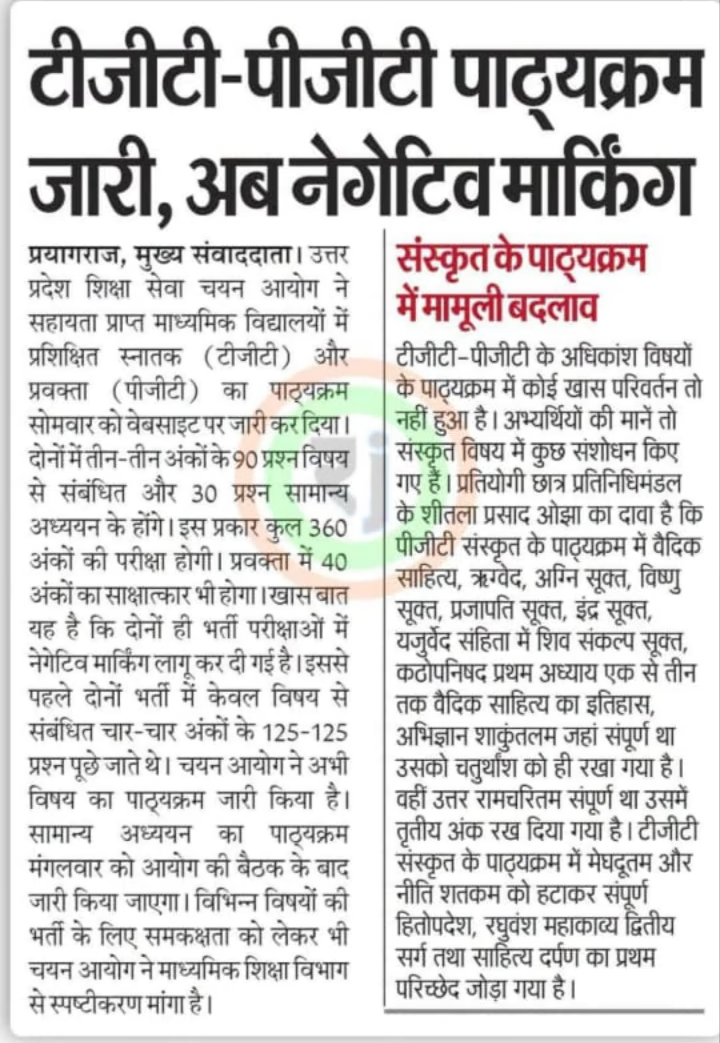

.avif&w=1920&q=75)



.avif)
.avif)
.avif)
.avif)
.avif)
.avif)
 UPESSC
 PGT TGT
 STET/BPSC
 PGT
PGT TGT
TGT UP LT Grade
 IIT JAM Chemistry