Download The Rasayanam App & Accelerate Your Exam Success Journey
📱 Live & Recorded Learning
🎯Complete Exam Preparation
✅Practice Batches & Test Series
📚 Premium Study Materials
👨🏫 Expert Faculty & Doubt Support
📈 Performance Analysis & Progress Tracking
Download App
Best Books for UP PGT Chemistry Preparation: A Complete Booklist
If you're preparing for UP PGT Chemistry, you've probably already asked yourself which books to pick up. Bookstores and online lists throw dozens of titles at you, and it's easy to end up buying more books than you can realistically finish. The truth is, you don't need a mountain of material, you need the right combination of NCERT textbooks, a few standard reference books, and consistent practice.
This post walks you through six books that consistently work for UP PGT Chemistry aspirants, how to use each one, and how to sequence your preparation so you're not just collecting books but actually finishing your syllabus with confidence.
NCERT Chemistry Class 11 & 12
Best for: Building strong Chemistry fundamentals
Every serious UP PGT Chemistry preparation starts with NCERT. These textbooks explain fundamental concepts clearly and are the fastest way to revise important reactions, definitions, properties, and formulas before an exam.
Pay close attention to these topics while going through NCERT:
Atomic structure
Chemical bonding
Thermodynamics
Equilibrium
Electrochemistry
Chemical kinetics
Coordination compounds
Organic Chemistry reactions
Periodic properties
p-block and d-block elements
If your fundamentals in any of these areas feel shaky, resist the urge to jump straight to reference books. Finish the relevant NCERT chapters first, then move to more advanced material. Skipping this step is one of the most common reasons students struggle later with reference books that assume a base level of understanding.
O.P. Tandon: Physical Chemistry
Best for: Physical Chemistry concepts and problem-solving
Physical Chemistry rewards students who combine conceptual clarity with regular numerical practice, and O.P. Tandon's Physical Chemistry is built for exactly that combination.
The book covers:
Atomic structure
States of matter
Thermodynamics
Chemical equilibrium
Ionic equilibrium
Electrochemistry
Chemical kinetics
Solutions
Solid state
Surface chemistry
You don't need to work through every page. Match the chapters to your UP PGT Chemistry syllabus and use the book specifically where you need extra conceptual clarity or more numerical practice than NCERT provides.
R.C. Mukherjee: Numerical Chemistry
Best for: Physical Chemistry numerical practice
If numericals are where you keep losing marks, R.C. Mukherjee's Numerical Chemistry is worth prioritizing. It gives you extensive Physical Chemistry problem sets that sharpen:
Calculation speed
Accuracy
Formula application
Problem-solving approach
Conceptual understanding of numerical topics
The most effective approach is to first understand a topic and its formulas, then attempt questions from that specific chapter, rather than solving the book front to back without a plan. Pick questions according to what's actually in the UP PGT Chemistry syllabus instead of attempting everything randomly.
O.P. Tandon: Inorganic Chemistry
Best for: Inorganic Chemistry preparation
Inorganic Chemistry mixes conceptual understanding with a large amount of factual recall, which makes systematic revision essential. O.P. Tandon's Inorganic Chemistry is a solid resource for:
Periodic properties
Chemical bonding
s-block elements
p-block elements
Transition elements
Coordination compounds
Metallurgy
Qualitative analysis
Important inorganic compounds and reactions
While studying this section, maintain short notes on reactions, exceptions, trends, and properties as you go. These notes become extremely valuable during your final revision, when you won't have time to reread full chapters.
If topics like Inorganic Chemistry trends and exceptions feel hard to retain on your own, The Rasayanam app has structured video lectures and topic-wise practice tests for UP PGT Chemistry that break these patterns down step by step, available on Google Play and via the Classplus app.
Morrison & Boyd: Organic Chemistry
Best for: Organic Chemistry concepts and reaction mechanisms
Organic Chemistry gets difficult fast if you try to memorize reactions without understanding why they happen. Morrison & Boyd is the standard reference for building that deeper understanding of mechanisms and reasoning.
It's useful for:
Hydrocarbons
Aromatic compounds
Alcohols and phenols
Aldehydes and ketones
Carboxylic acids
Amines
Stereochemistry
Reaction mechanisms
Important organic reactions
You don't need to read this book cover to cover for UP PGT preparation. Focus on the chapters relevant to your syllabus, and spend extra time on the mechanisms rather than just the final products of reactions, mechanism-based questions are where many candidates lose marks despite knowing the reactions themselves.
J.D. Lee: Concise Inorganic Chemistry
Best for: Deeper understanding of Inorganic Chemistry
J.D. Lee's Concise Inorganic Chemistry works well once you want to go beyond O.P. Tandon for a particular topic. It helps with:
Periodic trends
Chemical bonding
Coordination chemistry
Transition elements
Main-group chemistry
Organometallic chemistry
Inorganic reactions
Treat this as a reference book rather than something to memorize completely. Use it selectively when a concept from O.P. Tandon or NCERT needs more depth or a clearer explanation.
Which books should you prioritize?
You don't need to study all six books cover to cover. A practical way to divide your effort:
Purpose
Recommended Book
Basic concepts
NCERT Chemistry Class 11 & 12
Physical Chemistry
O.P. Tandon
Physical Chemistry numericals
R.C. Mukherjee
Inorganic Chemistry
O.P. Tandon
Organic Chemistry
Morrison & Boyd
Advanced Inorganic reference
J.D. Lee
NCERT should remain your foundation throughout. The other five books come in as targeted support based on your individual strengths and weaknesses — not as a fixed list everyone must finish equally.
Other resources you should use along with these books
Books alone won't get you through UP PGT Chemistry. Along with the recommended titles, build these two habits into your preparation:
Previous-Year question papers (PYQs)
Previous-year questions show you the exact pattern, weightage, and difficulty level of the exam. Use them to identify:
Frequently tested concepts and high-yield topics
Your individual weak areas
Time management and pacing issues
Solve topic-wise previous-year questions right after finishing a chapter rather than saving them all for the end.
Once you've covered a major portion of the syllabus, start taking full-length timed mock tests. After each test, categorize your errors into four buckets:
Conceptual mistakes: You need to re-read and understand the core concept.
Memory mistakes: You forgot a specific formula, named reaction, or periodic trend.
Calculation mistakes: The concept was correct, but numerical execution failed.
Careless mistakes: You misread the question or options under pressure.
Reviewing your performance this way highlights exact preparation gaps far better than endlessly attempting tests without analysis.
How to use these books for UP PGT chemistry preparation
Step 1: Start with the UP PGT Chemistry syllabus. Before picking chapters from any reference book, go through the syllabus carefully and mark what you're already comfortable with versus what needs more work.
Step 2: Build your foundation with NCERT. Read the relevant chapters and make short notes containing formulas, reactions, definitions, trends, and exceptions.
Step 3: Use reference books for difficult topics only. If you understand Chemical Equilibrium from NCERT but struggle with the numericals, go to O.P. Tandon or R.C. Mukherjee for that specific gap, not the entire book.
Step 4: Practice previous-year questions after each topic. This tests whether you can apply what you've studied, not just recall it.
Step 5: Revise regularly. Chemistry, especially Organic and Inorganic, needs repeated revision. Keep your notes short enough to go through multiple times before the exam.
Step 6: Take mock tests once most of the syllabus is done. Track your score over time and pay attention to topics where mistakes repeat.
Final booklist for UP PGT chemistry
If you want a short answer to which books matter most for UP PGT Chemistry preparation, start here:
NCERT Chemistry Class 11 & 12 — for fundamentals
O.P. Tandon — Physical Chemistry — for concepts and practice
R.C. Mukherjee — Numerical Chemistry — for numerical problems
O.P. Tandon — Inorganic Chemistry — for Inorganic Chemistry
Morrison & Boyd — Organic Chemistry — for Organic Chemistry
J.D. Lee — Concise Inorganic Chemistry — for deeper Inorganic Chemistry concepts
Add previous-year question papers, practice sets, and mock tests around these six books, and your preparation strategy is complete.
Final takeaway
Completing more books does not automatically mean better preparation. Start with NCERT, use standard reference books to strengthen the specific topics where you're weak, practice questions consistently, and revise multiple times before your exam. Focus on one goal: understanding the UP PGT Chemistry syllabus well enough to solve questions accurately and confidently on exam day.
If you'd like structured guidance while working through this booklist — video lectures mapped to the syllabus, topic-wise tests, and doubt support from faculty who've cleared these exams themselves — The Rasayanam offers dedicated UP PGT Chemistry batches designed around exactly this kind of preparation. You can explore the courses and faculty athttps://www.therasayanam.com/
📱 WhatsApp/Call: +91-8285162819 ✉️ The Rasayanam: therasayanam@gmail.com ▶️ YouTube: @therasayanam 📲 App: Available on Google Play (Android) and via the Classplus app (iOS)
Which YouTube Channel Is Best for UP PGT Chemistry Preparation?
If you're preparing for UP PGT Chemistry, you've probably already discovered the problem: YouTube has too many Chemistry channels, and not all of them are built for your exam. Full syllabus lectures, one-shot revisions, PYQ marathons, mock test walkthroughs, the content is everywhere, but not all of it is exam-specific.
This post breaks down which channels actually serve UP PGT Chemistry aspirants and how to use them without wasting your revision time.
Why isn't subscriber count the right filter?
It's tempting to pick the channel with the biggest numbers, but subscriber count tells you nothing about syllabus alignment. For UP PGT Chemistry specifically, you need three things from a channel: content mapped to the actual UP PGT/GIC syllabus, sufficient MCQ and PYQ practice, and a teaching pace that matches how the exam is structured.
A channel with lakhs of subscribers teaching generic NET-level Chemistry won't help you the way a smaller, exam-focused channel will.
Quick Comparison of YouTube Channel for UP PGT Chemistry
Channel
What You'll Find
The Rasayanam
UP PGT Chemistry strategy, PYQs, practice, revision
MadChem Classes
UP PGT Chemistry classes, MCQs, PYQs, model papers
CY Competition Classes
PYQs, solved papers, test series
Chemophilic Academy
Conceptual Chemistry lectures, prep guidance
TCS Academy
Prep strategy, general competitive Chemistry content
Don't try to follow all five at once. Pick one as your primary channel and use the rest only when you need a second explanation of a specific topic.
Studying for UP PGT Chemistry but Still Forgetting What You Studied? Here's Why
You revise Coordination Chemistry for three hours, feel confident, move on to Chemical Kinetics, and a week later, half of what you studied has quietly disappeared. If this sounds familiar, you're not doing anything unusual.
Most UP PGT Chemistry aspirants hit this wall at some point, and the reason is rarely "I'm just bad at remembering things." It's almost always a mismatch between how you're studying and how memory for a subject like Chemistry actually works.
Let's break down the real causes and what to do about each one.
Reason 1: You're reading, not recalling
The biggest mistake when preparing for PGT Chemistry is confusing understanding something with actually knowing it. When you read a topic like Crystal Field Theory, it makes sense in the moment, so your brain tricks you into thinking, "I know this." But recognizing an answer in a book is very different from recalling it on your own during an exam months later.
Students who only highlight and re-read their notes usually perform worse than those who test themselves from memory. Re-reading trains recognition, but the exam tests recall.
Passive reading creates a false sense of confidence without building the strong memory pathways needed for exam day.
The Fix: After finishing a topic, close your book and write down everything you remember on a blank page. Then check your notes to see what you missed. This simple switch to active recall is the single best way to boost long-term retention in Chemistry.
Reason 2: You study physical, organic, & inorganic chemistry separately & never connect them
The PGT exam does not keep subjects completely separate. A single question might link Inorganic Chemistry (like crystal field theory) with Physical Chemistry (like bonding or magnetic properties). If you study each branch on its own, your brain fails to build the connections needed to remember the material.
Isolated facts fade fast. Connected facts, where one idea reminds you of three others, are much harder to forget.
The Fix: After finishing a topic, ask yourself: "Where else have I seen this idea?" For example, after learning hybridization in Inorganic Chemistry, link it back to bond angles in Organic Chemistry (like in benzene).
Reason 3: No revision, you study once & expect it to stick
Most students study Organic Chemistry in July, feel good about it, move to Physical Chemistry in August, and do not look at Organic Chemistry again until right before the exam. By then, they have forgotten most of it and have to relearn everything under stress.
Memory fades quickly if you do not review what you learn. Toppers retain more simply because they schedule regular revisions.
The Fix: Revise using a simple timeline:
1 day after studying
3 days later
10 days later
30 days later Track these dates in a notebook. Forcing your brain to recall information at spaced intervals keeps it fresh.
Reason 4: You are not solving enough previous year question papers
Reading theory is passive; solving Previous Year Questions (PYQs) forces your brain to retrieve and apply what you learned. PGT questions often test how you apply a concept rather than asking for direct definitions.
The Fix: Start solving PYQs as soon as you finish a topic, not at the very end of your preparation. Use them as a daily learning tool.
If you are also preparing for combined science paper requirements or testing your problem-solving speed under exam conditions, practicing with aUP PGT Physics Mock Test can help refine your overall exam strategy and time management.
Reason 5: You are learning passively. Watching instead of doing
Watching a lecture on video feels productive, but listening alone creates weak memories. This is especially true for math-heavy topics like Thermodynamics or Electrochemistry, where watching someone solve a problem is very different from solving it yourself.
The Fix: For every hour you spend watching a class or reading, spend 30–40 minutes doing:
Solve problems on your own.
Write summaries from memory.
Teach the concept out loud to an imaginary student.
Reason 6: Lack of sleep & rest keeps your brain from storing information
Your brain converts short-term memories into long-term retention while you sleep. Cutting sleep to study more actually harms your memory and leads to lower retention per hour spent.
The Fix:
Get 6 to 7 hours of sleep every night.
Study in focused 45–50 minute blocks, taking short breaks in between to keep your mind fresh.
Ready to transform your prep?
Forgetting what you study for UP PGT Chemistry is rarely a matter of hard work—most students put in long hours. It is simply a matter of strategy.
Passive reading, studying topics in isolation, skipping spaced revision, and avoiding PYQs will hurt your retention, no matter how many hours you sit at your desk. Fixing these common mistakes will dramatically improve how much information you actually remember on exam day using the exact same amount of study time.
Future teachers, secure your selection with The Rasayanam
If you want a structured, hassle-free system to crack the UP PGT Chemistry exam, The Rasayanam is built for you. Our specialized courses eliminate the guesswork by providing:
Built-in spaced revision: Expert schedules designed to automate your review cycles.
Topic-wise PYQ practice: Tests that train you to handle complex, application-based questions.
UP PGT Chemistry 2022 Question Paper: Full Breakdown, Download PDF
The UP PGT Chemistry 2022 paper is a different animal from the TGT Science paper we broke down earlier. Where TGT Science splits its 125 questions between Physics and Chemistry at a foundation level, this is a 125-question, Chemistry-only paper written at postgraduate depth.
Quantum chemistry, statistical thermodynamics, coordination chemistry, and bioinorganic chemistry all show up here alongside the usual organic and physical chemistry staples. Our faculty went through it question by question to map out exactly where the difficulty sits.
Bilingual (Hindi + English), all 125 questions, official format — available via The Rasayanam app.
Paper Snapshot: What Candidates Actually Faced
Particular
Detail
Subject
Chemistry only (no Physics/Biology)
Exam Year
2022
Total Questions
125 MCQs
Booklet Length
36 pages
Question Format
Bilingual, 4 options each, sequential 1–125
Unlike the TGT paper, there's no subject-mixing here to worry about — every single question is Chemistry. What replaces that complexity is depth.
This paper draws comfortably from an M.Sc. syllabus, not just NCERT-plus.
Numerical questions expect real constants plugged into real formulas — NMR field strengths, mass defects, osmotic pressure.
Conceptual questions lean hard on the assertion-reason format, which separates rote learners from candidates who understand the mechanism behind the fact.
Where the Marks Actually Were
Going through all 125 questions, the paper splits almost evenly across the three core branches — no single branch dominates the way Chemistry did in the TGT Science paper.
Branch
Approx. Share
Representative Topics Asked
Physical Chemistry
~33%
NMR field-strength calculation, mass defect and binding energy per nucleon, osmotic pressure and colligative properties, Langmuir adsorption isotherm, Gibbs–Duhem and Gibbs–Helmholtz equations, statistical thermodynamics (partition function), Debye–Hückel limiting law, quantum yield in photochemistry, kinetic theory and mean free path, Bragg's equation
Inorganic Chemistry
~33%
Crystal field theory (CFSE, spectrochemical series), EAN calculation for coordination complexes, lanthanide/actinide magnetic moments and oxidation states, periodic trends (Allred–Rochow electronegativity, ionization enthalpy of transition series), anomalous behaviour of beryllium, bioinorganic chemistry (oxidation states of iron in hemoglobin, myoglobin, methemoglobin), Born–Haber cycle, silicate classification
Organic Chemistry & Biochemistry
~33%
Aromaticity of heterocycles (furan, thiophene, pyrrole vs. benzene), reaction mechanisms (benzyne intermediate, Grignard + CO₂, hyperconjugation, resonance stability), carbohydrate chemistry (epimerization, Kiliani–Fischer, Ruff/Wohl degradation), essential amino acids, vitamins and hormones (nomenclature and pairing), medicinal chemistry (primaquine, PAS, DDT, chloroquine), named reactions and dye synthesis (alizarin, malachite green, fluorescein)
A Few Questions Worth Flagging
A few questions we'd flag as genuinely postgraduate-level rather than routine recall:
A quantitative NMR question. Candidates had to calculate the magnetic field strength needed to observe the ¹⁹F resonance at 60 MHz, given the nuclear g-factor and nuclear magneton. Not a definition question — a direct application of the resonance condition equation, the kind of calculation you'd expect in an M.Sc. spectroscopy lab, not a school-level exam.
An applied colligative-properties question. How many grams of glucose per litre are needed to match blood's osmotic pressure for an IV injection? Dressed up as clinical chemistry, but really testing whether candidates can invert the van't Hoff equation correctly under exam pressure.
An assertion-reason question on actinide oxidation states. It pairs the observation that actinides show a wider range of oxidation states with the reasoning that their 5f, 6d, and 7s orbitals are of comparable energy. This rewards candidates who understand why actinide chemistry behaves differently from lanthanide chemistry, not just that it does.
A cluster of bioinorganic questions on hemoglobin, myoglobin, and methemoglobin. Candidates had to track the spin state and oxidation state of iron across oxy-, deoxy-, and met- forms — genuinely advanced content that blends inorganic coordination chemistry with physiology, tested more than once in this paper.
Why This Matters More Than a Generic Score Calculation
For a PGT-level paper, the gap between "knows the topic" and "can apply it under exam conditions" is wider than at TGT level. It tends to show up in a few specific ways:
Formula recall without derivation confidence. Questions like the NMR field-strength or mass-defect calculations aren't hard once you know the formula — but candidates who've only memorised the formula without practising the algebra under time pressure lose these marks routinely.
Assertion-reason questions dominate the conceptual half of this paper. Getting both statements right individually but misjudging whether the reason actually explains the assertion (rather than just being a true, unrelated statement) is the single most common way strong candidates drop marks on questions they technically "knew."
Bioinorganic and biochemistry content is often under-revised. Candidates preparing heavily from classical inorganic/organic texts sometimes treat hemoglobin, vitamins, and hormone chemistry as a low-priority afterthought — this paper treats it as a full, separately testable block.
Cross-branch integration. Several questions (the bioinorganic set, the drug-chemistry set) don't fit neatly into "pure" Physical, Inorganic, or Organic — they require connecting concepts across branches, exactly the kind of synthesis a postgraduate-level exam is designed to test.
How to Analyse Your Own Copy of This Paper
Separate your score by branch, not by question number. Given how evenly split this paper is, a candidate weak in one branch can still post a mediocre overall score while being completely blind to where the actual gap is.
Flag every assertion-reason question separately and re-check why you got it right or wrong. This format punishes partial understanding more than any other question type in this paper.
Re-derive every numerical answer from scratch rather than just matching it to the answer key. If you can't reproduce the NMR field-strength or mass-defect calculation without looking, that's a revision gap, not a "silly mistake."
Treat bioinorganic/biochemistry as its own study block. Don't let it hide inside your Organic or Inorganic revision — the hemoglobin/vitamin/hormone questions in this paper show it's tested with real specificity.
File objections only with a standard reference. J.D. Lee for inorganic, Atkins or McQuarrie for physical/quantum, Morrison & Boyd or Clayden for organic, and Lehninger for the biochemistry-adjacent questions. Commissions reject unreferenced objections outright.
The Rasayanam's Take
This paper confirmed what we've been telling our PGT Chemistry batches for a while now: at this level, the exam stops rewarding memorised facts and starts rewarding the ability to apply core principles — quantum mechanical reasoning, thermodynamic derivations, coordination chemistry theory — under time pressure.
The even three-way split across Physical, Inorganic, and Organic Chemistry (with Biochemistry woven through the last of these) means there's no branch you can afford to deprioritise.
Our faculty run a live, question-by-question discussion of every major Chemistry teaching exam paper, working through the reasoning behind each answer rather than just confirming the correct option.
Faculty: Dr. Avdhesh Sir (IIT BHU), Dr. Shailesh Sir (Founder — CSIR-NET/GATE/IIT-JAM qualified), Dr. Sudhakar Sir (IIT Bombay), Priyanka Ma'am, and N.K. Sir (former BARC/ONGC Scientist).
📍 In front of DJ Hostel, Church Ln, Tagore Town, Prayagraj, UP 211002 📱 WhatsApp/Call: +91-8285162819 ✉️ therasayanam@gmail.com ▶️ YouTube: @therasayanam 📲 App: Available on Google Play (Android) and via the Classplus app (iOS)
UP PGT Chemistry Syllabus 2026 and Exam Pattern
Are you preparing for UP PGT Chemistry? Especially in chemistry? Then you're probably already aware of the latest news about Uttar Pradesh's new teaching selection board. If not, read about it here.
This blog will break down the UP PGT Chemistry Syllabus 2026 and the exam pattern in detail, and provide some helpful preparation tips to ensure you're ready for the big day. Once you know the full syllabus, structured revision becomes much easier.
UP PGT Chemistry Exam Overview
The UP PGT exam will be conducted by Uttar Pradesh's new teacher selection board. Chemistry requires a solid understanding of both theoretical concepts and practical applications at the graduate and postgraduate levels. Before diving into preparation, it's essential to get familiar with the complete syllabus so you know exactly what to study and how to structure your revision. Let's dive into what you need to know.
What is the UP PGT Chemistry Syllabus 2026?
The UP PGT Chemistry Syllabus 2026 is divided into three core areas:
Inorganic Chemistry
Organic Chemistry
Physical Chemistry
Here's a quick rundown of what you'll be studying under each branch:
Branch of Chemistry
Topics
Inorganic Chemistry
Atomic Structure, Chemical Bonding, Elements of S-block, Elements of P-block, Elements of D-block, Chemistry of Coordination Compounds, Elements of F-block, Organometallic Chemistry, Bio-Inorganic Chemistry
Organic Chemistry
General Organic Chemistry, Reaction Mechanism, Aromatic Compounds, Stereochemistry, Organic Synthesis, Polymers, Carbohydrates, Heterocyclic Compounds, Alicyclic Compounds, Reactive Intermediates, Chemistry in Everyday Life (Drugs and Medicines), Vitamins and Hormones
Physical Chemistry
Thermodynamics and Thermochemistry, Electrochemistry, Chemical Kinetics, Surface Chemistry/Adsorption, Gaseous State, Liquid State, Solid State, Colloidal State, Molecular Structure and Spectroscopy, Molecular/Statistical Thermodynamics, Physical Photochemistry, Solution, Nuclear Chemistry, Chemical Equilibrium, Phase Equilibrium, Ionic Equilibrium
Get detailed info about the UP PGT Physics Syllabus and the Chemistry syllabus in English.
Once you understand the exam pattern, try the Free Mock Test to check your preparation.
UP PGT Chemistry Exam Pattern 2026
The exam is split into a written test, an interview, and additional qualification-based weightage. You'll need to perform well across all three to secure a teaching position.
Written Examination
Mode: Offline (Pen and Paper)
Type of Questions: Multiple Choice Questions (MCQs)
Total Marks: 500 (425 for the written exam, 50 for the interview, and 25 for extra weightage like B.Ed and PhD)
Number of Questions: 125 questions, each carrying 3.4 marks
Duration: 2 hours
Negative Marking: None, so make sure to attempt all questions.
Tips for Preparing for the UP PGT Chemistry Exam
Understand the Syllabus: Break it into smaller sections and create a study plan with dedicated revision time.
Use Standard Textbooks: Reference reliable books like J.D. Lee for Inorganic Chemistry and Morrison and Boyd for Organic Chemistry.
Practice Past Papers: Solving previous years' papers will familiarize you with the exam pattern and improve time management.
Focus on Concepts: Prioritize understanding over memorization, especially in Physical and Organic Chemistry.
Regular Revision: Consistently review key topics such as reaction mechanisms and periodic trends.
Take Mock Tests: Mock tests will help you assess your preparation and highlight areas for improvement.
Stay Updated on Current Affairs: Keep up with general knowledge, particularly in education and science.
Also, download ourbrochure for more details on the program and contact us with any queries.
Download the Syllabus
Before working on the mock tests, ensure you know the entire syllabus inside out. Understanding the topics in detail will help you prioritize your studies and focus on the areas that carry more weight.
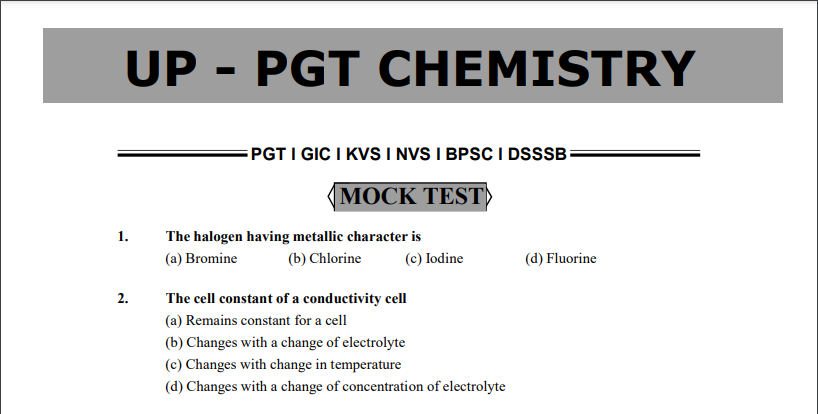
Mock test papers are a powerful resource in your UP PGT Chemistry preparation. They give you valuable practice, help build confidence, and improve your exam-taking strategy. Regularly solving these tests, alongside a thorough understanding of the syllabus, will give you a strong command over the subject and help you overcome the challenges of time management and accuracy during the real exam.
Now you can get all the latest news about UP teaching selection examinations like UP PGT TGT, syllabus, previous year question papers, and all the latest updates atThe Rasayanam, India's best coaching center for TGT, PGT, LT, GIC, KVS, NVS, DSSSB, STET, BPSC, IIT-JAM, CSIR-NET, JRF, CUET (PG), and other competitive exams.
Start practicing today and get closer to your goal of clearing the UP PGT Chemistry exam!
Good luck!
UP PGT Chemistry 2026: Everything You Need to Know About It
What is UP PGT Chemistry?
UP PGT Chemistry refers to the examination and recruitment process for Post Graduate Teachers in the subject of chemistry in Uttar Pradesh (UP) government schools. A PGT teacher holds the responsibility of teaching higher secondary students (Classes 11 and 12), focusing on advanced concepts.
PGT teachers not only educate but also prepare students for competitive exams such as the Joint Entrance Examination (JEE) and National Eligibility cum Entrance Test (NEET), which require a deep understanding of chemistry.
The PGT role is highly sought after, as it offers job stability, a good salary, and opportunities for growth in the government education sector. Candidates who qualify for the exam get appointed to various UP government schools under the new selection board, called, Uttar Pradesh Shiksha Chayan Aayog
Key Responsibilities of a PGT Teacher
Teaching Chemistry: Delivering lessons on various branches of chemistry, including organic, inorganic, and physical chemistry, following the syllabus prescribed by the UP board.
Student Evaluation: Preparing tests, evaluating students’ academic performance, and helping them grasp complex concepts.
Guiding Projects and Lab Work: Supervising practical work in the lab, ensuring safety procedures are followed, and guiding students through chemistry experiments.
Mentoring Students: Offering academic counseling, especially for those preparing for competitive exams in science-related fields.
Other requirements, such as knowledge of Hindi, may also apply. For a detailed breakdown of eligibility, please check our dedicated blogon UP PGT Chemistry Eligibility Criteria.
For more detailed insights into the exam pattern and marking scheme, visit our comprehensive blogon the UP PGT Chemistry Exam Pattern.
Candidates need to be well-versed in both theoretical concepts and problem-solving techniques across these areas.
Once you clear the exam and secure a position, you will enjoy numerous benefits as a government school teacher. The role offers:
Job Security: With a permanent government job, you gain stability and numerous benefits like pension, health insurance, and paid leave.
Good Salary: PGT Chemistry teachers receive competitive salaries, with opportunities for regular increments based on performance and seniority.
Professional Growth: Teaching senior secondary students allows you to engage with advanced chemistry topics, contributing to both your professional and personal growth.
If you’re curious about the long-term career trajectory and salary details, we’ve got you covered in our blogon Career Prospects for UP PGT Chemistry Teachers.
UP TGT Science & PGT Chemistry Test Series – Your Complete Practice Guide!
Welcome to the UP TGT Science & PGT Chemistry Test Series playlist – your one-stop solution for acing the Uttar Pradesh Teacher Recruitment Exams! This test series is specially designed to help you practice important questions, revise key concepts, and boost your confidence before the big day. Whether you’re preparing for TGT Science or PGT Chemistry, this playlist covers a wide range of topics to enhance your subject knowledge and exam strategy.
Playlist: UP TGT SCIENCE & PGT CHEMISTRY TEST
What’s Inside?
Chapter-wise Practice Tests Previous Years’ Questions Detailed Solutions & Explanations Tips & Tricks for Fast Problem-Solving Regular Updates with New Practice Papers
Perfect for aspirants aiming to secure a teaching position in government schools, this test series will help you stay ahead of the competition and achieve your dream job!
Prepare, Practice & Perform!
Subscribe now and start your preparation journey with us. Don’t forget to hit the bell icon for regular updates on new tests and important exam tips. Let’s crack it together!
Get Enrolled in Our 45-Day TGT & PGT Training Program!
Are you ready to supercharge your preparation for the UP TGT & PGT exams? Join our 45-day Intensive Training Program and gain the skills, knowledge, and confidence to crack these competitive exams!
UP TGT Science l PGT Chemistry Aspirants के लिए 45 दिन का Training Program l The Rasayanam
Pre-Registration Link:
Why Choose This Program?
Comprehensive Syllabus Coverage Daily Live Classes & Recorded Sessions Expert Guidance from Experienced Educators Mock Tests, Quizzes & Real-time Practice Personalized Doubt-Solving Sessions
This program is designed for aspirants of all levels, ensuring you master the concepts and excel in your exams. Whether you’re just starting or need a finishing touch to your preparation, this training program has got you covered!
Limited Seats Available – Enroll Now!
Don’t miss this opportunity to take your preparation to the next level. Secure your spot today and join the journey to success in the UP TGT & PGT recruitment exams!
Download The Rasayanam App
Batch Join करने के लिए Playstore से The Rasayanam App Download करे। App लिंक –
Also, download our brochurefor more details on the program and contact us with any queries.
Conclusion
Becoming a PGT teacher in Uttar Pradesh is a prestigious career option for those with a love for chemistry and education. With a strong academic background, dedication, and the right preparation, you can successfully pass the exam and make a significant impact on students’ lives.
To help you along the way, make sure to check out our detailed blogs on eligibility, syllabus, and preparation strategies. And stay updated with the latest information on the exam.
Now you can get all the latest news about UP teaching selection examinations like UP PGT TGT, syllabus, previous year question paper, and all latest news about them at The Rasayanam India’s best coaching center for TGT, PGT, LT, GIC, KVS, NVS, DSSSB, STET, BPSC, IIT-JAM, CSIR-NET, JRF, CUET (PG) and other competitive exams.
Comprehensive Recorded Sessions – Covering key topics like Atomic Structure, IUPAC Nomenclature, and Radioactive Solutions. Daily Practice Problems (DPPs) – Improve your accuracy with topic-wise practice questions. Concept Clarity & Exam Readiness – Strengthen fundamentals and boost confidence for the exam. Flexible Learning – Access recorded content anytime, anywhere.
UP PGT Chemistry Mock Test 2026: Free Test Series & Syllabus
The UP PGT Chemistry exam is known for its extensive syllabus and challenging questions.
One of the most efficient ways to enhance your preparation is by solving UP PGT Chemistry mock test 2026 papers. These not only simulate the actual exam but also allow you to assess your strengths and weaknesses, helping you fine-tune your strategy.
In this blog, we will discuss the importance of mock test papers and how they can boost your preparation for the UP PGT Chemistry exam.
How to Make the Most of UP PGT Chemistry Mock Test Papers
Practice Regularly: Make it a habit to solve mock test papers consistently throughout your preparation. Starting early allows you to cover the entire syllabus and practice each topic thoroughly.
Simulate Real Exam Conditions: Try to recreate exam conditions when solving a mock test. This means finding a quiet place, setting a timer, and sticking to the exam duration to simulate the pressure and environment of the real test.
Analyze Performance: After completing each mock test, spend time reviewing your performance. Identify the areas where you made mistakes, go back to those topics, and revise them thoroughly.
Keep Track of Progress: Maintain a log of your scores and review how they improve over time. Monitoring your progress helps you stay motivated and also points out areas that need extra attention.
Download UP PGT Chemistry Mock Test 2026 Papers FREE
Download the mock test papers below to start practicing:
To help you gear up for the exam, we’ve prepared a selection of UP PGT Chemistry mock test 2026 papers. These papers are designed to cover all major portions of the syllabus, ensuring comprehensive practice across topics like:
Organic Chemistry
Inorganic Chemistry
Physical Chemistry
Chemical Bonding
Atomic Structure
Thermodynamics
Electrochemistry and more…
Get Enrolled in Our 45-Day TGT & PGT Training Program!
Are you ready to supercharge your preparation for the UP TGT & PGT exams? Join our 45-day Intensive Training Program and gain the skills, knowledge, and confidence to crack these competitive exams!
Pre-Registration Link:
Why Choose This Program?
Comprehensive Syllabus Coverage Daily Live Classes & Recorded Sessions Expert Guidance from Experienced Educators Mock Tests, Quizzes & Real-time Practice Personalized Doubt-Solving Sessions
This program is designed for aspirants of all levels, ensuring you master the concepts and excel in your exams. Whether you’re just starting or need a finishing touch to your preparation, this training program has got you covered!
Limited Seats Available – Enroll Now!
Don’t miss this opportunity to take your preparation to the next level. Secure your spot today and join the journey to success in the UP TGT & PGT recruitment exams!
Download The Rasayanam App
Batch Join करने के लिए Playstore से The Rasayanam App Download करे। App लिंक –
Also, download our brochurefor more details on the program and contact us with any queries.
Download UP PGT Chemistry Syllabus
Before working on the mock tests, ensure you know the entire UP PGT Chemistry syllabus. Understanding the topics in detail will help you prioritize your studies and focus on the areas that carry more weight.
Conclusion
Mock test papers are a powerful resource in your UP PGT Chemistry preparation. They provide you with valuable practice help build confidence and improve your exam-taking strategy. Regularly solving these tests will give you a strong command over the subject and help you overcome the challenges of time management and accuracy during the real exam.
Now you can get all the latest news about UP teaching selection examinations like UP PGT TGT, syllabus, previous year question paper, and all latest news about them at The Rasayanam, India’s best coaching center for TGT, PGT, LT, GIC, KVS, NVS, DSSSB, STET, BPSC, IIT-JAM, CSIR-NET, JRF, CUET (PG) and other competitive exams.
Start practicing today and get closer to your goal of taking the UP PGT Chemistry exam!
Free PGT Chemistry and TGT Science Mock Test Paper
Are you preparing for TGT Science, PGT Chemistry, or BPSC PGT exams? Success in competitive exams depends not just on theoretical knowledge but also on consistent practice and familiarity with the exam format.
The Rasayanam offers an excellent solution: free PGT chemistry and TGT science mock test paper specifically designed to help you ace these exams. Let’s dive into what makes this mock test collection an indispensable tool for your preparation.
Get Your Free Mock Test Papers – Download Now!
Step 1: First, download the Rasayanam Mobile App for seamless access to all mock tests and additional study materials.
Mock tests simulate the real exam environment, enabling you to:
Enhance Time Management: Learn to complete the paper within the given time frame. Identify Weaknesses: Highlight areas where you need to focus more. Minimize Errors: Practice filling OMR sheets and avoid common mistakes. Build Confidence: Familiarity with the exam format reduces stress and boosts confidence on exam day.
The Rasayanam’s Unique Approach to Mock Tests
The Rasayanam takes mock test preparation a step further with its offline-focused methodology, which is perfectly aligned with the actual exam mode.
1. Full-Length Test Papers
Each set contains 125 questions, meticulously designed to match the syllabus and exam pattern. Available in both Hindi & English, making them accessible to a wide range of aspirants.
2. Offline Practice Mode
As most TGT and PGT exams are conducted offline, practicing in a similar environment is essential. The Rasayanam provides:
Hard Copy Test Papers: Delivered to your home via courier. OMR Sheets: Included with every test for hands-on practice.
3. Comprehensive Solutions & Self-Analysis
After completing a test, aspirants can access detailed solutions and explanations, enabling effective self-analysis and addressing any doubts.
Flexible Testing Options
Not everyone can visit a test center, and The Rasayanam understands that.
Weekend Test Centers: Attend offline tests on Saturdays at selected locations. Online Access via App: Get digital copies of mock tests for online practice.
Vijay Yatra Batch – The Ultimate Preparation Package
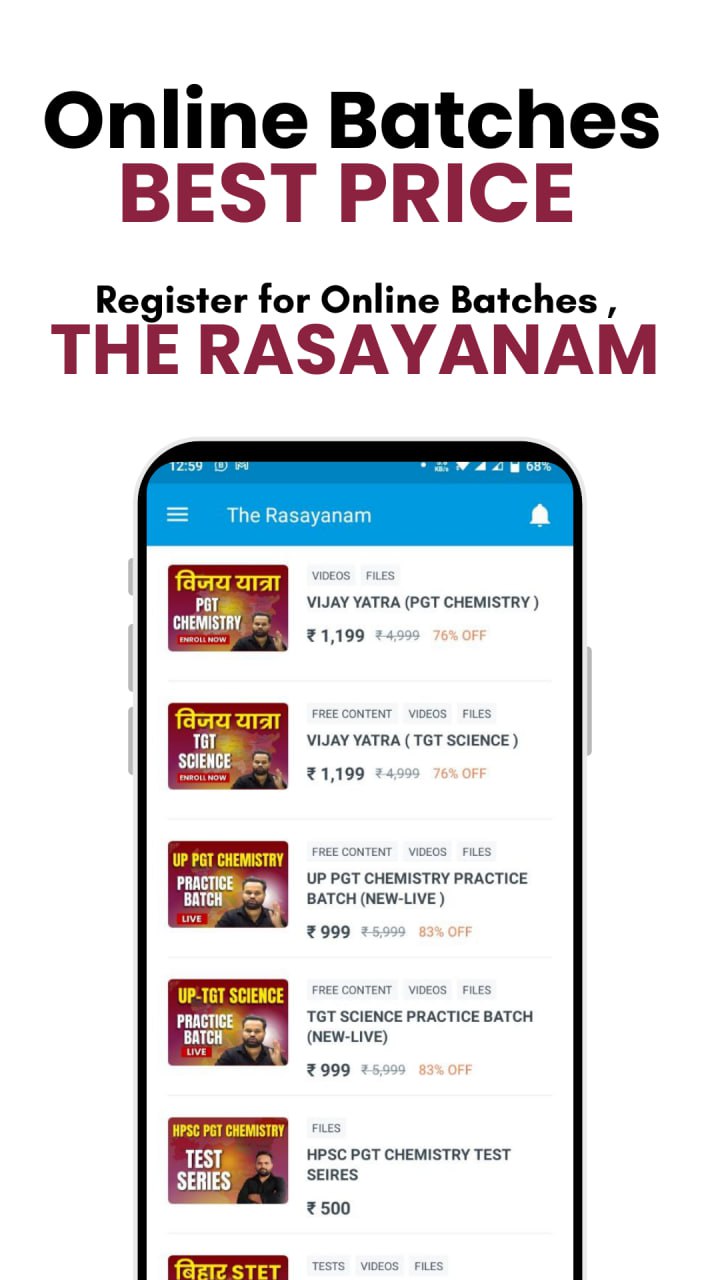
For aspirants looking for comprehensive preparation, The Rasayanam’s Vijay Yatra Batch offers:
30+ Full-Length Mock Tests for extensive practice. A 5000+ Question Bank covering all important topics. Personalized Performance Analysis to track progress.
Watch the Vijay Yatra Batch Discussion Here:
How to Get Started?
Step 1:Download the Rasayanam App(Insert app link here.) Step 2: Choose between hard copies (home delivery) or digital mock test PDFs. Step 3:Take the tests, evaluate performance, and improve steadily!
Why Choose The Rasayanam?
Expertly designed content tailored to TGT/PGT exam patterns. Focus on offline practice, mirroring the real exam experience. Bilingual options (English & Hindi) for a wider reach. Affordable premium options for advanced preparation.
Final Thoughts
Preparing for TGT and PGT exams can be challenging, but with The Rasayanam’s free mock test collection, you get the best practice resources to boost your score.
UP PGT Chemistry Eligibility Criteria 2025: Who Can Apply?
The Uttar Pradesh Post Graduate Teacher (UP PGT) Chemistry position is a coveted teaching role that offers a secure and rewarding career in government schools. If you’re aspiring to become a Chemistry teacher for higher secondary classes (Classes 11 and 12), understanding the UP PGT Chemistry eligibility criteria is the first step toward your goal.
This blog will break down the necessary qualifications and other requirements for applying to the UP PGT Chemistry post.
1. Educational Qualifications for UP PGT Chemistry Eligibility
To apply for the UP PGT Chemistry exam, candidates must meet specific educational qualifications. These are designed to ensure that applicants possess in-depth subject knowledge and the necessary pedagogical skills to teach senior secondary students effectively. The primary educational requirements are as follows:
Post-Graduate Degree in Chemistry: The most essential criterion is having a Master’s degree in Chemistry or a related field (such as Applied Chemistry, Industrial Chemistry, or Organic Chemistry) from a recognized university. Candidates must have obtained at least 50-55% marks in their postgraduate degree, depending on the requirements specified by UP’s new teaching selection board which is known as Uttar Pradesh Shiksha Chayan Aayog
Equivalent Qualifications: In some cases, candidates with degrees equivalent to a Master’s in Chemistry may also be eligible, provided their education aligns with the subject requirements. However, for UP PGT/GIC, having a B.Ed is not compulsory. But in the future, the chances may arise. So, it is important to verify the specific guidelines issued before applying
2. Age Limit or UP PGT Chemistry
There is no upper age limit specified for the post of PGT in UP government schools, making it an excellent career opportunity for both young and experienced teachers. However, candidates must check for any additional rules or updates in age relaxation as per the latest notifications from Uttar Pradesh Shiksha Chayan Aayog, especially for reserved categories like SC/ST, OBC, and PwD (Persons with Disabilities).
3. Nationality
Only Indian citizens are eligible to apply for the UP PGT Chemistry post. Candidates from Uttar Pradesh are usually given preference, but candidates from other states may also apply, provided they meet the eligibility criteria.
4. Reservation Criteria
Uttar Pradesh follows reservation policies as per government norms. Candidates belonging to reserved categories, such as Scheduled Castes (SC), Scheduled Tribes (ST), Other Backward Classes (OBC), and Economically Weaker Sections (EWS), are eligible for age relaxation and reserved seats, provided they submit the necessary caste and category certificates during the application process.
Important Points to Keep in Mind
Hindi Language Proficiency: Since the medium of instruction in most UP government schools is Hindi, candidates are expected to be proficient in the Hindi language. Though fluency in English may be beneficial, the ability to teach and communicate in Hindi is crucial.
Document Verification: After qualifying for the written examination, candidates must provide proof of their educational qualifications and category (if applicable) during the document verification process. Make sure all your documents are accurate and up to date.
Experience: While prior teaching experience is not a mandatory requirement for the UP PGT Chemistry post, having relevant teaching experience can be an added advantage during the selection process.
UP TGT Science & PGT Chemistry Test Series – Your Complete Practice Guide!
Welcome to the UP TGT Science & PGT Chemistry Test Series playlist – your one-stop solution for acing the Uttar Pradesh Teacher Recruitment Exams! This test series is specially designed to help you practice important questions, revise key concepts, and boost your confidence before the big day. Whether you’re preparing for TGT Science or PGT Chemistry, this playlist covers a wide range of topics to enhance your subject knowledge and exam strategy.
Chapter-wise Practice Tests Previous Years’ Questions Detailed Solutions & Explanations Tips & Tricks for Fast Problem-Solving Regular Updates with New Practice Papers
Perfect for aspirants aiming to secure a teaching position in government schools, this test series will help you stay ahead of the competition and achieve your dream job!
Prepare, Practice & Perform!
Subscribe now and start your preparation journey with us. Don’t forget to hit the bell icon for regular updates on new tests and important exam tips. Let’s crack it together!
Get Enrolled in Our 45-Day TGT & PGT Training Program!
Are you ready to supercharge your preparation for the UP TGT & PGT exams? Join our 45-day Intensive Training Program and gain the skills, knowledge, and confidence to crack these competitive exams!
UP TGT Science l PGT Chemistry Aspirants के लिए 45 दिन का Training Program l The Rasayanam: Watch here
Pre-Registration Link:
Why Choose This Program?
Comprehensive Syllabus Coverage Daily Live Classes & Recorded Sessions Expert Guidance from Experienced Educators Mock Tests, Quizzes & Real-time Practice Personalized Doubt-Solving Sessions
This program is designed for aspirants of all levels, ensuring you master the concepts and excel in your exams. Whether you’re just starting or need a finishing touch to your preparation, this training program has got you covered!
Limited Seats Available – Enroll Now!
Don’t miss this opportunity to take your preparation to the next level. Secure your spot today and join the journey to success in the UP TGT & PGT recruitment exams!
.svg)

.png)
.avif&w=1920&q=75)
.avif&w=1920&q=75)
.avif&w=1920&q=75)
.avif&w=1920&q=75)

 UP TGT Science & PGT Chemistry Test Series – Your Complete Practice Guide!
 This test series is specially designed to help you practice important questions, revise key concepts, and boost your confidence before the big day. Whether you’re preparing for TGT Science or PGT Chemistry, this playlist covers a wide range of topics to enhance your subject knowledge and exam strategy.
 What’s Inside?
 Chapter-wise Practice Tests


 Prepare, Practice & Perform!
 for regular updates on new tests and important exam tips. Let’s crack it together!
 Get Enrolled in Our 45-Day TGT & PGT Training Program!
 Why Choose This Program?
 Limited Seats Available – Enroll Now!
 Download The Rasayanam App
 Batch Join करने के लिए Playstore से The Rasayanam App Download करे। App लिंक –
  Related Articles to Read:

 Download The Rasayanam App
 Step 1: First, download the Rasayanam Mobile App for seamless access to all mock tests and additional study materials.
 Once installed, access full-length mock test PDFs for:
 Hard Copy Test Papers: Delivered to your home via courier.
 OMR Sheets: Included with every test for hands-on practice.
 Weekend Test Centers: Attend offline tests on Saturdays at selected locations.
 A 5000+ Question Bank covering all important topics.
 Personalized Performance Analysis to track progress.
 Watch the Vijay Yatra Batch Discussion Here:
 UP TGT Science & PGT Chemistry Test Series – Your Complete Practice Guide!
 This test series is specially designed to help you practice important questions, revise key concepts, and boost your confidence before the big day. Whether you’re preparing for TGT Science or PGT Chemistry, this playlist covers a wide range of topics to enhance your subject knowledge and exam strategy.
 What’s Inside?
 Chapter-wise Practice Tests


 Prepare, Practice & Perform!
 for regular updates on new tests and important exam tips. Let’s crack it together!
 Get Enrolled in Our 45-Day TGT & PGT Training Program!
 Why Choose This Program?
 Limited Seats Available – Enroll Now!
.avif)
.avif)
.avif)
.avif)
.avif)
.avif)
 UPESSC
 PGT TGT
 STET/BPSC
 PGT
PGT TGT
TGT UP LT Grade
 IIT JAM Chemistry