If you're preparing for the UP TGT (Trained Graduate Teacher) Science exam, there's important news you can't afford to miss. The Uttar Pradesh Education Service Selection Commission (UPESSC), Prayagraj has officially released a revised syllabus for 2026, and it comes with changes that will directly affect how you plan your preparation, especially if Chemistry is your core subject.
At The Rasayanam, we've gone through the official syllabus document released by UPESSC, and here's a breakdown of what's changed, what's stayed the same, and what it means for your strategy.
What's New in the 2026 Syllabus?
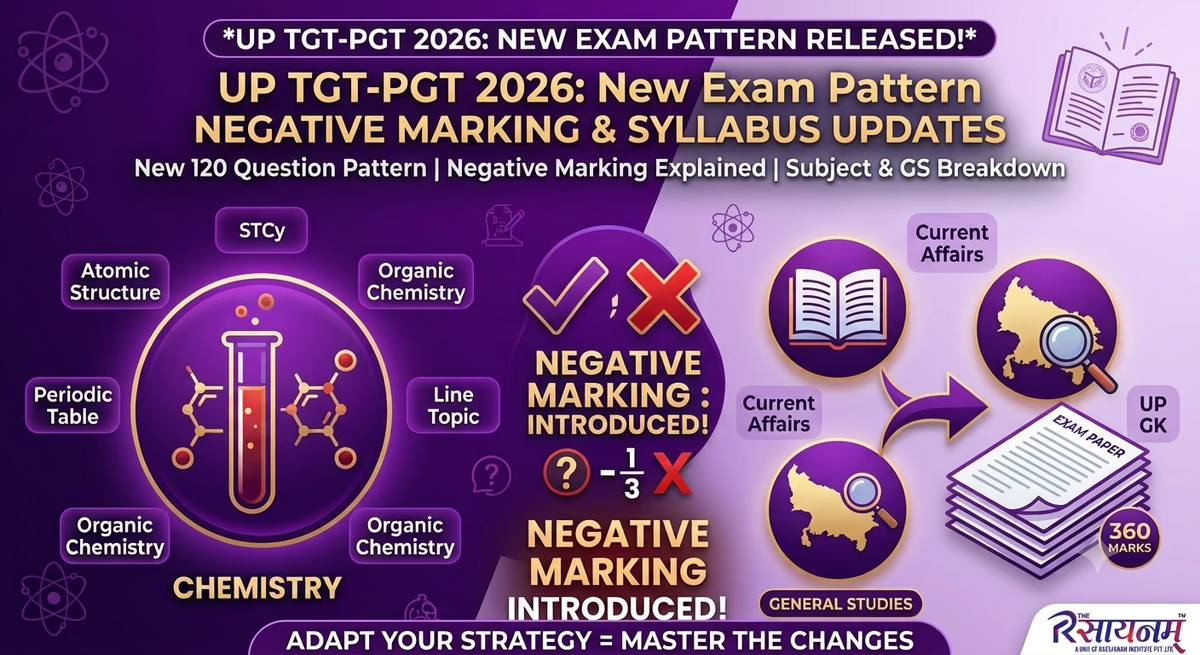
UPESSC has updated the UP TGT exam pattern, and one of the biggest changes is the introduction of General Studies as part of the written exam. Candidates will now face:
- 90 questions from their core subject (Science: Physics & Chemistry).
- 30 questions from General Studies.
This adds up to 120 questions worth a total of 360 marks. The most critical update for many is the introduction of Negative Marking for the first time in TGT recruitment. PGT candidates who clear the written exam will additionally sit for a 40-mark interview.
This is a meaningful shift from previous cycles, where the paper was purely subject-based with no penalty for wrong answers. Going forward, accuracy matters as much as speed. A working knowledge of general awareness, UP-specific GK, current affairs, and basic scientific literacy is now non-negotiable, even for subject specialists.
The revised syllabus isn't limited to Science. UPESSC has released it across all TGT subjects, including Hindi, Sanskrit, Urdu, English, Mathematics, Science, Social Science, Home Science, Physical Education, Commerce, Agriculture, and the Arts, each with its own dedicated subject-wise PDF.
The Science Syllabus: Physics, Chemistry & Beyond
The UP TGT Science syllabus is designed to test not just subject knowledge but also scientific aptitude and analytical ability. It spans Physics, Chemistry, Biology, and Environmental Science. Based on the official document, here's what the Chemistry and Physics sections look like:
Chemistry (Subject Code – 05) covers a wide arc, from the fundamentals of matter, atomic structure, and laws of chemical combination, through chemical bonding, hybridization, and electrochemistry, all the way to periodic classification, transition (3d-block) elements, and general organic chemistry (including inductive, mesomeric, and electromeric effects). Isomerism and the preparation methods of key organic compounds like alkanes, alkenes, alkynes, and benzene round out the syllabus.
Physics is equally comprehensive, spanning Mechanics, Heat & Thermodynamics, Waves & Oscillations, Optics, Electricity & Magnetism, and Modern Physics, including topics like the photoelectric effect, Compton effect, Schrödinger's equation, semiconductors, and logic gates.
The good news for serious aspirants: the core conceptual foundation of the syllabus hasn't been diluted. If anything, it reinforces that a strong grip on fundamentals, not just rote memorization, is what the exam is built to test.
Why the Update Matters
It's tempting to assume a "syllabus update" just means a few topics got shuffled around. In reality, this revision changes the shape of the exam itself. With General Studies now carrying 30 marks and negative marking in play, candidates who previously relied purely on deep subject mastery will need to:
- Broaden their prep: Include current affairs and general awareness.
- Increase accuracy: Be much more careful about guesswork on the subject paper.
For Chemistry aspirants specifically, this means:
- Don't neglect General Studies: Even 30 marks can be the difference between qualifying and missing out.
- Practice with negative marking in mind: Attempt only what you're reasonably confident about.
- Stick to NCERT + standard reference books: The core topic list for Chemistry and Physics remains largely unchanged from previous cycles.
- Track the official UPESSC notification regularly: Exam patterns and syllabi can be revised again before the final notification is out.
Final Word
While most core technical topics in the UP TGT syllabus tend to stay similar year to year, candidates should always verify against the latest official notification, since the Commission can revise the syllabus or exam pattern for a given cycle. The 2026 revision is a good reminder that a smart aspirant treats the syllabus as a living document, not a one-time download.
At The Rasayanam, our Chemistry faculty, led by IIT and CSIR-NET/GATE qualified educators, are already recalibrating our TGT Chemistry batches to reflect this updated pattern, with dedicated focus on both the core subject and the newly added General Studies component. If you're preparing for UP TGT Science 2026, now is the time to align your study plan with the revised structure, not after the exam date is announced.
Stay connected with The Rasayanam on our app, YouTube channel, and website for the latest updates, demo classes, and structured batches for UP TGT, PGT, LT Grade, and other Chemistry-based teaching exams.
.avif)
.svg)

.png)