Download The Rasayanam App & Accelerate Your Exam Success Journey
- Live & Recorded Learning
- Complete Exam Preparation
- Practice Batches & Test Series
- Premium Study Materials
- Expert Faculty & Doubt Support
- Performance Analysis & Progress Tracking
.svg)

Loading blogs…
.png)

The S-block elements hold a significant position in the BPSC PGT Chemistry syllabus, making them a must-study for aspiring candidates. These elements, belonging to Group 1 (alkali metals) and Group 2 (alkaline earth metals), exhibit fascinating properties and reactions.
This blog dives into the detailed explanation of S-block elements, key trends, and their applications, while also providing essential resources for better learning.
| Group | Element Symbol | Name | Atomic Number | Electronic Configuration | Key Properties |
| Group 1 | Li | Lithium | 3 | 1s22s11s^2 2s^11s22s1 | Lightest metal forms LiOH\text{LiOH}LiOH with water, used in batteries. |
| Na | Sodium | 11 | 1s22s22p63s11s^2 2s^2 2p^6 3s^11s22s22p63s1 | Highly reactive, golden-yellow flame, used in table salt (NaCl\text{NaCl}NaCl). | |
| K | Potassium | 19 | 1s22s22p63s23p64s11s^2 2s^2 2p^6 3s^2 3p^6 4s^11s22s22p63s23p64s1 | Reacts vigorously with water, lilac flame, used in fertilizers. | |
| Rb | Rubidium | 37 | [Kr]5s1[Kr] 5s^1[Kr]5s1 | Extremely reactive, used in atomic clocks. | |
| Cs | Cesium | 55 | [Xe]6s1[Xe] 6s^1[Xe]6s1 | Soft metal, explosive with water, used in drilling fluids. | |
| Fr | Francium | 87 | [Rn]7s1[Rn] 7s^1[Rn]7s1 | Highly radioactive, rare, least studied. | |
| Group 2 | Be | Beryllium | 4 | 1s22s21s^2 2s^21s22s2 | Hard metal, forms covalent compounds, used in aerospace materials. |
| Mg | Magnesium | 12 | 1s22s22p63s21s^2 2s^2 2p^6 3s^21s22s22p63s2 | Lightweight, burns with a bright white flame, used in alloys and fireworks. | |
| Ca | Calcium | 20 | [Ar]4s2[Ar] 4s^2[Ar]4s2 | Essential for bones, brick-red flame, used in cement and plaster. | |
| Sr | Strontium | 38 | [Kr]5s2[Kr] 5s^2[Kr]5s2 | Crimson red flame, used in fireworks and signal flares. | |
| Ba | Barium | 56 | [Xe]6s2[Xe] 6s^2[Xe]6s2 | Apple green flame, used in X-ray contrast agents and glass manufacturing. | |
| Ra | Radium | 88 | [Rn]7s2[Rn] 7s^2[Rn]7s2 | Radioactive, glows in the dark, historically used in luminescent paints. |
To master the S-block in detail, consider purchasing this course designed for BPSC PGT Chemistry aspirants:
Explore this YouTube playlist to understand the S-block elements thoroughly. The playlist includes 10 lectures that break down every concept simply and effectively:
 Lecture Wise Links
 Batch Join करने के लिए Playstore से The Rasayanam App Download करे। App लिंक – http://on-app.in/app/home?orgCode=wnoqi
Also, download our brochure for more details on the program and contact us with any queries.
S-block elements, which include alkali and alkaline earth metals, are fundamental to various chemical and industrial processes. Their unique properties, such as high reactivity and excellent conductivity, make them crucial in fields ranging from medicine to construction. A thorough understanding of these elements is essential for excelling in chemistry, especially for competitive exams like BPSC PGT Chemistry.
For better guidance, in-depth lectures, and expert preparation strategies, The Rasayanam is the best coaching institute for BPSC PGT Chemistry. Their specialized courses and experienced faculty provide the right direction to help you succeed. If you’re serious about mastering chemistry and cracking your exams, The Rasayanam is your go-to choice!
Practicing today and get closer to your goal of taking the UP PGT Chemistry exam!
Good luck!

The lead storage battery, also known as a lead-acid battery, is one of the most widely used rechargeable batteries in the world. Due to its durability, reliability, and cost-effectiveness, it is commonly found in vehicles, backup power systems, and renewable energy setups. In this blog, we will explore the basics and how it works, its components, and its applications. Also, watch our detailed lecture on Lead Storage battery session by our expert for detailed understanding.
A lead storage battery is an electrochemical device that converts chemical energy into electrical energy. It is capable of undergoing multiple charge and discharge cycles, making it an ideal choice for applications requiring a rechargeable energy source.
It consists of the following components:
The lead storage battery operates on the principle of reversible chemical reactions. Here’s how it works during discharge and charge cycles:
To help you strengthen your understanding, we’ve put together a PDF with additional support material, including detailed notes and a practice set.
This resource will serve as a quick revision guide, reinforcing key concepts like construction, working principles, and chemical reactions. Plus, the practice questions will test your knowledge and boost your confidence for exams.
 Comprehensive Notes – Covering the structure, working mechanism, reactions, and real-world applications of lead storage batteries. Practice Questions – A mix of conceptual and numerical problems to sharpen your problem-solving skills.
Whether you’re a student or an enthusiast, this resource will help you master the topic effortlessly. Download the PDF and start learning today!
 Get Enrolled in Our 45-Day TGT & PGT Training Program!
 Are you ready to supercharge your preparation for the UP TGT & PGT exams?  Join our 45-day Intensive Training Program and gain the skills, knowledge, and confidence to crack these competitive exams!
Pre-Registration Link: https://forms.gle/NMdggQUc1zsuLDBr7
 Why Choose This Program?
 Comprehensive Syllabus Coverage Daily Live Classes & Recorded Sessions Expert Guidance from Experienced Educators Mock Tests, Quizzes & Real-time Practice Personalized Doubt-Solving Sessions
This program is designed for aspirants of all levels, ensuring you master the concepts and excel in your exams. Whether you’re just starting or need a finishing touch to your preparation, this training program has got you covered! 

 Limited Seats Available – Enroll Now!
Don’t miss this opportunity to take your preparation to the next level. Secure your spot today and join the journey to success in the UP TGT & PGT recruitment exams! 


 Download The Rasayanam App
Batch Join करने के लिए Playstore से The Rasayanam App Download करे। App लिंक – http://on-app.in/app/home?orgCode=wnoqi
Also, download our brochure for more details on the program and contact us with any queries.
The lead storage battery has been a cornerstone of energy storage for decades, thanks to its reliability and cost-effectiveness. Understanding its basic working principles, components, and applications can help users make the most of this versatile battery technology. Whether in vehicles, homes, or industries, the lead storage battery continues to power the world efficiently.
Have questions? Drop them in the comments below!
Stay updated with the latest UP TGT notifications!
Now you can get all the latest news about UP teaching selection examinations like UP PGT TGT, syllabus, previous year question paper, and all latest news about them at The Rasayanam, India’s best coaching center for TGT, PGT, LT, GIC, KVS, NVS, DSSSB, STET, BPSC, IIT-JAM, CSIR-NET, JRF, CUET (PG) and other competitive exams.
Start practicing today and get closer to your goal of taking the UP PGT Chemistry exam!
Good luck!
UP PGT Chemistry Mock Test 2024: Free Test Series & Syllabus UP PGT Chemistry Syllabus 2024 and Exam Pattern UP PGT Chemistry: Everything You Need to Know About It BPSC PGT Chemistry: Mastering S-Block Elements with Explanatory Videos + Course BPSC PGT Chemistry: Mastering S-Block Elements with Explanatory Videos + Course Basics of Lead Storage Battery: Electrochemistry Free PGT Chemistry and TGT Science Mock Test Paper UP PGT Chemistry 2024 Live Practice Batch Announcement Career Prospects for UP PGT Chemistry Teachers
Are you preparing for the Bihar Public Service Commission (BPSC) PGT Chemistry Exam? If so, then reviewing the previous year’s question papers is a crucial step in your preparation.
Understanding the exam pattern, difficulty level, and types of questions asked can give you an edge over other candidates.
In this blog, we provide you with the BPSC PGT Chemistry previous year’s question papers from 2023 and 2024, along with a detailed analysis and an exclusive YouTube session to help you ace the exam.
 Download BPSC PGT Chemistry Previous Year Question Papers (PDFs)
We have compiled the BPSC PGT Chemistry Question Papers for 2023 and 2024. You can download them below:
 BPSC PGT Chemistry Question Paper Analysis (2023 & 2024)
 Exam Pattern Overview
 Key Topics Covered in Chemistry
 Difficulty Level Comparison
 BPSC PGT Chemistry Topic Wise Live Discussion & Solutions
| Topics | Solution Videos |
| Coordination Chemistry | Link |
| Coordination Chemistry TRE.3 | Link |
| Surface Chemistry TRE.4 | Link |
| Atomic Structure TRE.4 | Link |
| Topics | Solution PDF |
| Test One: Inorganic Chemistry TRE.4 | Link |
| Test Two: Atomic Structure TRE.4 | Link |
| Test Three: Coordination Chemistry TRE.4 | Link |
To make your preparation even easier, check out this detailed discussion & solution session on YouTube
In this session, expert educators analyze the previous year’s question papers, discuss important topics, and share preparation strategies. Also, have a look at BPSC PGT Chemistry TRE 3.0 Video explanation for better preparation.
Why Solve Previous Year Question Papers? Tips to Ace the BPSC PGT Chemistry Exam Solve Previous Year Papers Regularly: Attempt at least one weekly paper. Revise NCERT & Standard Books: Focus on fundamental concepts. Take Mock Tests: Simulate exam conditions to improve accuracy & speed. Make Short Notes: Prepare quick revision notes for formulas & key concepts. Follow the YouTube Discussion: Understand expert strategies & shortcuts.
Other YouTube Video Explanations for BPSC PGT ChemistryExplore this YouTube playlist to understand the S-block elements thoroughly. The playlist includes 10 lectures that break down every concept simply and effectively:
Also, Watch BPSC PGT Chemistry Lecture Playlist Here
Lecture Wise Links
Also read our blog BPSC PGT Chemistry: S-Block
Download The Rasayanam App
Batch Join करने के लिए Playstore से The Rasayanam App Download करे। App लिंक – http://on-app.in/app/home?orgCode=wnoqi
Also, download our brochure for more details on the program and contact us with any queries.
 Conclusion
Practicing with BPSC PGT Chemistry previous year papers is a game-changer for your preparation. Download the PDFs, watch the YouTube session, and follow a structured study plan. With dedication and the right resources, you can crack the exam!
Now you can get all the latest news about UP teaching selection examinations like UP PGT TGT, syllabus, previous year question paper, and all latest news about them at The Rasayanam, India’s best coaching center for TGT, PGT, LT, GIC, KVS, NVS, DSSSB, STET, BPSC, IIT-JAM, CSIR-NET, JRF, CUET (PG) and other competitive exams.
 Stay Updated: Keep visiting for more study materials, mock tests, and expert guidance.
Download Now & Start Practicing!
Related Courses:
Course Highlights:
Daily Live Lectures – Covering essential BPSC PGT Chemistry concepts in detail. Exam-Focused Questions – Targeted practice based on previous and expected exam patterns. Conceptual Problem-Solving – Strengthening understanding and application of key topics. Efficient Question-Solving Techniques – Learn time-saving methods to solve problems. Bilingual Course – Available in both Hindi & English. Non-Refundable Fee – Ensure commitment to your preparation.
 Contact: 8787070842 / 8303338258 (Call/WhatsApp).
Course Highlights:
Live Quick Revision Sessions – Daily live sessions covering key BPSC TRE-4.0 PGT Chemistry concepts. NCERT & Bihar SCERT-Based Theory – Comprehensive revision aligned with the syllabus. Downloadable PDFs – Access board notes from live classes. Bilingual Course – Available in both Hindi & English. Affordable Pricing – ₹499 (pre-booking till Jan 12, ₹1999 after). 6-Month Validity – Flexible learning for exam preparation.
Contact: 8787070842 / 8303338258 (Call/WhatsApp).

The BPSC PGT Chemistry exam is a highly competitive test that requires a thorough understanding of various topics in chemistry. Among the three primary sections—Physical, Organic, and Inorganic Chemistry—Inorganic Chemistry holds significant weight in the exam.
The BPSC PGT Chemistry Mock Test is a crucial tool for candidates preparing for the BPSC TRE 4.0 PGT Chemistry exam. Practicing with mock tests helps improve accuracy, speed, and confidence. The test covers key topics from the syllabus, including:
Mock tests not only reinforce conceptual understanding but also enhance problem-solving skills, ensuring better performance in the actual exam.
Our Live Discussion Session focused on key questions from previous years, offering insights into important topics, solving strategies, and tips for better retention. Here are some of the takeaways from the session:
For a comprehensive resource on all three TRE papers, including free downloadable PDFs of previous year’s question papers, visit our detailed blog: BPSC PGT Chemistry PYQs Download.
Inorganic Chemistry may seem challenging, but with the right strategy and consistent practice, success in the BPSC TRE 4.0 PGT Chemistry exam is achievable. Make sure to watch the Live Discussion on PYQs and refer to our blog for structured preparation. Stay tuned for more insightful sessions and study materials!
Now you can get all the latest news about UP teaching selection examinations like UP PGT TGT, syllabus, previous year question paper, and all latest news about them at The Rasayanam, India’s best coaching center for TGT, PGT, LT, GIC, KVS, NVS, DSSSB, STET, BPSC, IIT-JAM, CSIR-NET, JRF, CUET (PG) and other competitive exams.
Stay Updated: Keep visiting for more study materials, mock tests, and expert guidance.
Download Now & Start Practicing!
Batch Join करने के लिए Playstore से The Rasayanam App Download करे। App लिंक – http://on-app.in/app/home?orgCode=wnoqi
Also, download our brochure for more details on the program and contact us with any queries.

The Bihar Public Service Commission (BPSC) Post Graduate Teacher (PGT) Chemistry exam is a crucial recruitment process for hiring Chemistry teachers in government schools and colleges across Bihar.
If you are an aspiring teacher looking to secure a government teaching job in Bihar, this guide will provide you with all the essential details about BPSC PGT Chemistry.
BPSC conducts the Post Graduate Teacher (PGT) examination under the Teacher Recruitment Exam to recruit qualified candidates for teaching positions in higher secondary schools and colleges.
The exam assesses candidates’ subject knowledge, teaching aptitude, and general awareness to ensure they are well-equipped to teach at an advanced level.
To apply for the BPSC TRE 4.0 PGT Chemistry exam, candidates must fulfill the following eligibility criteria:
| Category | Maximum Age Limit |
| General (Male) | 37 years |
| General (Female) / BC / OBC | 40 years |
| SC / ST | 42 years |
The BPSC TRE 4.0 PGT Chemistry examination consists of two major stages:
The written exam comprises two papers:
| Paper | Subjects Covered | Total Marks |
| Paper 1 (General Studies & Teaching Aptitude) | General Knowledge, Current Affairs, Teaching Methodology, Logical Reasoning | 100 |
| Paper 2 (Chemistry Subject-Specific Questions) | Organic Chemistry, Inorganic Chemistry, Physical Chemistry, Analytical Chemistry | 200 |
Candidates who clear the written examination are called for an interview round, which carries 50 marks. The interview assesses teaching skills, subject expertise, and communication ability.
The syllabus for Paper 2 (Chemistry Subject) is based on postgraduate-level Chemistry topics. Some important topics include:
| Branch of Chemistry | Topics Covered |
| Organic Chemistry | Reaction mechanisms, spectroscopy, biomolecules |
| Inorganic Chemistry | Coordination compounds, periodic properties, transition metals |
| Physical Chemistry | Thermodynamics, kinetics, quantum chemistry |
| Analytical Chemistry | Chromatography, electrochemistry, spectroscopy techniques |
| Topics | Solution PDF |
| Test One: Inorganic Chemistry TRE.4 | Link |
| Test Two: Atomic Structure TRE.4 | Link |
| Test Three: Coordination Chemistry TRE.4 | Link |
Download BPSC PGT Chemistry Previous Year Question Papers (PDFs)We have compiled the BPSC PGT Chemistry Question Papers for 2023 and 2024. You can download them below:
Other YouTube Video Explanations for BPSC PGT ChemistryExplore this YouTube playlist to understand the S-block elements thoroughly. The playlist includes 10 lectures that break down every concept simply and effectively:
Lecture Wise Links
Also read our blog BPSC PGT Chemistry: S-Block
Download The Rasayanam App
Batch Join करने के लिए Playstore से The Rasayanam App Download करे। App लिंक – http://on-app.in/app/home?orgCode=wnoqi
Also, download our brochure for more details on the program and contact us with any queries.
The BPSC TRE 4.0 PGT Chemistry exam is an excellent opportunity for Chemistry postgraduates who aspire to become government teachers in Bihar. With proper preparation, dedication, and strategic planning, candidates can successfully clear the exam and secure a prestigious teaching position.
If you are preparing for the BPSC TRE 4.0 PGT Chemistry exam, start your preparation early, follow a structured study plan, and stay focused on your goal. Choose The Rasayanam Coaching for expert guidance and structured learning to enhance your chances of success.
Stay updated with the latest notifications from BPSC to ensure you don’t miss any important updates regarding the examination process. Good luck with your preparation!
Related Courses:
Course Highlights:
Daily Live Lectures – Covering essential BPSC PGT Chemistry concepts in detail. Exam-Focused Questions – Targeted practice based on previous and expected exam patterns. Conceptual Problem-Solving – Strengthening understanding and application of key topics. Efficient Question-Solving Techniques – Learn time-saving methods to solve problems. Bilingual Course – Available in both Hindi & English. Non-Refundable Fee – Ensure commitment to your preparation.
Contact: 8787070842 / 8303338258 (Call/WhatsApp).
Course Highlights:
Live Quick Revision Sessions – Daily live sessions covering key BPSC TRE-4.0 PGT Chemistry concepts. NCERT & Bihar SCERT-Based Theory – Comprehensive revision aligned with the syllabus. Downloadable PDFs – Access board notes from live classes. Bilingual Course – Available in both Hindi & English. Affordable Pricing – ₹499 (pre-booking till Jan 12, ₹1999 after). 6-Month Validity – Flexible learning for exam preparation.
Contact: 8787070842 / 8303338258 (Call/WhatsApp).

The Bihar Public Service Commission (BPSC) conducts the Teacher Recruitment Examination (TRE) to recruit postgraduate teachers (PGTs) in various subjects, including chemistry.
If you aspire to become a PGT in Bihar, it is essential to understand the BPSC PGT eligibility criteria before applying for the exam. This blog provides a detailed breakdown of the educational qualifications, age limits, and other essential requirements for BPSC TRE 4.0 PGT Chemistry.
To apply for the BPSC TRE 4.0 PGT Chemistry exam, candidates must meet one of the following educational criteria:
The age limit for BPSC TRE 4.0 PGT Chemistry varies based on the candidate’s category:
| Category | Minimum Age | Maximum Age |
| General (Male) | 21 years | 37 years |
| General (Female) / BC / OBC | 21 years | 40 years |
| SC / ST | 21 years | 42 years |
Candidates must ensure they fall within the specified age limits as per their category to be eligible for the exam.
Understanding the eligibility criteria is the first step toward preparing for the BPSC TRE 4.0 PGT Chemistry exam. Candidates should ensure they meet the necessary educational qualifications, age limits, and nationality requirements before applying. Meeting these criteria is crucial for a successful application process and eligibility for selection as a PGT in Bihar.
If you are preparing for the BPSC TRE 4.0 PGT Chemistry exam, start your preparation early, follow a structured study plan, and stay focused on your goal. Choose The Rasayanam Coaching for expert guidance and structured learning to enhance your chances of success.
Stay updated with the latest notifications from BPSC to ensure you don’t miss any important updates regarding the examination process. Good luck with your preparation!
Related Courses:Course Highlights:
Daily Live Lectures – Covering essential BPSC PGT Chemistry concepts in detail. Exam-Focused Questions – Targeted practice based on previous and expected exam patterns. Conceptual Problem-Solving – Strengthening understanding and application of key topics. Efficient Question-Solving Techniques – Learn time-saving methods to solve problems. Bilingual Course – Available in both Hindi & English. Non-Refundable Fee – Ensure commitment to your preparation.
Contact: 8787070842 / 8303338258 (Call/WhatsApp).
Course Highlights:
Live Quick Revision Sessions – Daily live sessions covering key BPSC TRE-4.0 PGT Chemistry concepts. NCERT & Bihar SCERT-Based Theory – Comprehensive revision aligned with the syllabus. Downloadable PDFs – Access board notes from live classes. Bilingual Course – Available in both Hindi & English. Affordable Pricing – ₹499 (pre-booking till Jan 12, ₹1999 after). 6-Month Validity – Flexible learning for exam preparation.
Contact: 8787070842 / 8303338258 (Call/WhatsApp).
Course Highlights:
Weekly Video Uploads – 4-5 comprehensive weekly videos covering key topics.
Exam-Based Assignments – Assignments tailored to the exam pattern to enhance preparation.
Chapter-Wise Tests & DPPs – Regular assessments and Daily Practice Problems to reinforce learning.
Previous Year Question Discussions – In-depth analysis of past exam questions for better understanding.
Short Notes Preparation – Guidance on creating effective short notes for efficient revision.
Dedicated Doubt Sessions – Separate sessions with faculty to clarify doubts and strengthen concepts.
Note: The course fee is non-refundable.
Contact: 8787070842 / 8303338258 (Call/WhatsApp).

The Bihar Public Service Commission (BPSC) offers competitive salaries for state postgraduate teachers (PGTs). As of the latest updates, the structure for BPSC PGT Teacher Salary is as follows:
Basic Pay: ₹32,960 per month
Allowances:
Gross BPSC PGT Teacher Salary: Approximately ₹52,008 per month
Net BPSC PGT Teacher Salary: After standard deductions, the net salary is around ₹47,114per month
In addition to the attractive salary, BPSC PGTs enjoy various benefits, including job security, retirement benefits, and opportunities for career advancement. The role involves teaching specialized subjects to senior secondary students, preparing lesson plans, assessing student performance, and contributing to curriculum development.
For those aspiring to become a BPSC PGT, thorough preparation is essential due to the competitive nature of the selection process. Enrolling in a reputable coaching institute can provide the guidance and resources needed to excel.
If you’re seeking quality coaching for BPSC PGT examinations in Prayagraj (Allahabad), consider The Rasayanam. Located in Tagore Town, Prayagraj, The Rasayanam specializes in coaching for TGT, PGT, LT, GIC, KVS, NVS, DSSSB, STET, BPSC, IIT-JAM, CSIR-NET, JRF, and CUET (PG) exams. With experienced educators, flexible online classes, and comprehensive study materials, The Rasayanam is dedicated to helping you achieve your teaching career goals.
For more information, visit their official website: therasayanam.in
Embark on your journey to becoming a successful BPSC PGT with the right preparation and support.

The Bihar Public Service Commission (BPSC) recruits postgraduate teachers (PGT) in various subjects, including chemistry. As a PGT Chemistry teacher in Bihar, you have access to numerous career opportunities that provide stability, growth, and prestige in the education sector.
Let’s explore the career prospects, benefits, and pathways available for BPSC PGT Chemistry teachers.
One of the primary advantages of being a BPSC PGT Chemistry teacher is job security. As a government-appointed teacher, you receive a permanent position with benefits such as:
BPSC PGT Chemistry teachers have multiple opportunities for professional growth. Promotions can be achieved through seniority, additional qualifications, and departmental exams. The career progression is typically as follows:
BPSC PGT Chemistry teachers can pursue higher studies like:
Many government teachers take up private tutoring after school hours to earn additional income. Coaching centers preparing students for JEE, NEET, and other competitive exams highly value experienced Chemistry teachers. This provides an excellent opportunity to enhance income and gain recognition in the field.
PGT Chemistry teachers can transition into administrative roles within the education sector, such as:
With the rise of online education platforms, experienced Chemistry teachers can explore roles in content creation, online tutoring, and educational consulting. Platforms like:
Experienced PGT Chemistry teachers can apply for international school teaching jobs in countries like UAE, Singapore, the USA, and Canada. Many countries recognize Indian teaching experience, and teachers can apply for certifications such as TEFL or IB Training to qualify for global teaching roles.
A career as a BPSC PGT Chemistry teacher is a rewarding and secure choice with multiple avenues for growth. Whether through government promotions, private coaching, research, or online teaching, the career prospects are vast and fulfilling.
With dedication and continuous learning, Chemistry teachers can make a significant impact in the education sector and beyond.
Now you can get all the latest news about UP teaching selection examinations like UP PGT TGT, syllabus, previous year question paper, and all latest news about them at The Rasayanam, India’s best coaching center for TGT, PGT, LT, GIC, KVS, NVS, DSSSB, STET, BPSC, IIT-JAM, CSIR-NET, JRF, CUET (PG) and other competitive exams.

1. Enantiomers are same as diastereomers.
a) true
b) false
Answer: b
Explanation: In optical isomerism, enantiomers are non-superimposable mirror images of each other, while diastereomers are also non-superimposable but are not mirror images. Diastereomers differ from each other in both physical and chemical properties.
2. Optical isomerism is a type of ____________
a) metamerism
b) stereoisomerism
c) geometrical isomerism
d) tautomerism
Answer: b
Explanation: Compounds with the same molecular formula but different spatial arrangements of atoms or groups are called stereoisomers, and this property is known as stereoisomerism. It is classified into three types: optical isomerism, geometrical isomerism, and conformational isomerism.
3. The d-form is also known as ____________
a) rotatory
b) laevorotatory
c) dextrorotatory
d) l-form
Answer: c
Explanation: An isomer that rotates the plane of polarized light to the right (clockwise) is called dextrorotatory (d-form), while one that rotates it to the left (anticlockwise) is called laevorotatory (l-form).
4. 2-chloropropane and 1-chloropropane exhibit ____________ isomerism.
a) chain
b) position
c) functional
d) metamerism
Answer: b
Explanation: Compounds that share the same molecular formula but differ in the position of a functional group or substituent are called positional isomers, and this phenomenon is known as position isomerism. For example, 1-chloropropane and 2-chloropropane differ in the position of the chlorine atom, hence they are positional isomers.
5. Which of the following is not a type of structural isomerism?
a) geometric isomerism
b) chain isomerism
c) metamerism
d) tautomerism
Answer: a
Explanation: Structural isomerism occurs when compounds have the same molecular formula but different structures. It is further classified into chain isomerism, position isomerism, functional isomerism, metamerism, and tautomerism. Hence, geometrical isomerism does not fall under structural isomerism.
6. If a compound has 3 chiral carbons What is the number of optically active isomers?
a) 9
b) 3
c) 4
d) 8
Answer: d
Explanation: The number of optically active isomers of a compound is calculated using the formula 2ⁿ, where n is the number of chiral carbons. Since this compound has 3 chiral carbons (n = 3), the total number of optically active isomers is 2³ = 8.
7. How many planes of symmetry does a meso compound have?
a) 2
b) 1
c) 3
d) 4
Answer: b
Explanation: A meso compound is one in which one half of the molecule is a mirror image of the other half. Such compounds usually contain two or more chiral centers and possess a plane of symmetry. Meso compounds are optically inactive because of internal compensation.
8. What is the specific rotation if its observed rotation is given as 3x, its length is given as x and density is given as 3/y?
a) 2y
b) 3y
c) y
d) 4y
Answer: c
Explanation: The formula for specific rotation is:
[α]=Observed rotationlength × density[\alpha] = \frac{\text{Observed rotation}}{\text{length × density}}
Here, the observed rotation = 3x, length = x, and density = 3/y.
So,
[α]=3xx×(3/y)=y[\alpha] = \frac{3x}{x \times (3/y)} = y
Thus, the specific rotation equals y.
9. Acetaldehyde and ethenol show ____________
a) stereoisomerism
b) metamerism
c) positional isomerism
d) tautomerism
Answer: d
Explanation: Acetaldehyde and ethenol show tautomerism, a special type of functional isomerism found in carbonyl compounds with an α-hydrogen atom. It involves the interconversion between the keto form and the enol form.
10. A compound with the same molecular formula exists in two forms one is alcohol and the other is Ether, what type of isomerism does it show?
Answer: c
Explanation: Functional isomerism occurs when compounds have the same molecular formula but different functional groups. For example, C₃H₆O can exist as an aldehyde or a ketone. Similarly, the given compound can exist as an alcohol or an ether, showing functional isomerism.
BPSC PGT Chemistry: p-Block Elements Important Questions
BPSC PGT Chemistry Important Question: Uses of Boron and Aluminium and their Compounds
BPSC PGT Chemistry: Trends and Anomalous Properties of Boron Important Questions
BPSC PGT Chemistry: p-Block Elements Important Questions
Silicon & P-Block Elements: Understanding Their Properties and Applications
Boric Acid & P-Block Element: Understanding Their Properties and Applications

This collection of BPSC PGT Chemistry MCQs focuses on “p-Block Elements – Important Trends and Anomalous Properties of Boron”, covering key concepts for exam preparation.
Answer: (b)
Explanation: Group 13 elements do not react directly with hydrogen to form hydrides; instead, their hydrides are synthesized through indirect methods. For example, diborane (B₂H₆) is produced when boron fluoride (BF₃) reacts with lithium aluminum hydride (LiAlH₄) in the presence of dry ether.
Answer: (d)
Explanation: As we move down the group in Group 13, the oxides and hydroxides transition from acidic to amphoteric and eventually basic in nature. Among them, only boric acid is soluble in water, while the hydroxides of other elements remain insoluble.
Answer: (b)
Explanation: All boron halides exist as trihalides (BX₃). Boron chloride (BCl₃) and boron bromide (BBr₃) are colorless, fuming liquids, while boron fluoride (BF₃) is a colorless gas, and boron iodide (BI₃) is a white solid at room temperature. All these trihalides act as Lewis acids.
Answer: (a)
Explanation: The halides of Group 13 elements act as Lewis acids, with their acidic character decreasing in the order: Boron > Aluminium > Gallium > Indium. Here, halide refers to chlorides, bromides, and iodides. However, thallium trichloride (TlCl₃) primarily acts as an oxidizing agent as it readily decomposes.
Answer: (b)
Explanation: When 2 moles of aluminum (Al) react with 2 moles of sodium hydroxide (NaOH) in the presence of 6 moles of water (H₂O), it forms 2 moles of sodium tetrahydroxoaluminate(III) [Na[Al(OH)₄]] along with 3 moles of hydrogen gas (H₂).
Answer: (d)
Explanation: Boron has a significantly higher melting point than other Group 13 elements due to its three-dimensional network structure, where boron atoms are strongly bonded by covalent bonds. This strong bonding also results in a higher boiling point compared to the rest of the group.
Answer: (d)
Explanation: Boron reacts with concentrated nitric acid, forming boric acid and nitrous oxide. In contrast, aluminum becomes passive in nitric acid due to the formation of a protective oxide layer on its surface, preventing further oxidation.
Answer: (b)
Explanation: Boron exhibits anomalous behavior compared to other Group 13 elements due to its smallest atomic size, highest ionization energy, highest electronegativity, absence of vacant d-orbitals, and presence of allotropes, which are not observed in the other group members.
Answer: (c)
Explanation: Boron (B) exhibits a diagonal relationship with magnesium (Mg) in the periodic table. This similarity arises due to their comparable charge densities, electronegativities, and atomic/ionic radii, which is a common trend for diagonally adjacent elements in the periodic table.
Answer: (a)
Explanation: Both boron and silicon form covalent hydrides, known as boranes and silanes, respectively. They react with electropositive metals to produce binary compounds, which yield a mixture of boranes and silanes upon hydrolysis.
Answer: (a)
Explanation: Boron of group 13 and silicon of group 14 share a diagonal relationship and have many similarities. Both boron and silicon are non-metals, semiconductors and they also form covalent hydrides, therefore, they are not metals.
Answer: (a)
Explanation: Both boron of group 13 and silicon of group 14 form covalent and volatile halides, which fume in moisture air due to the release of HCl gas. They react with water in order to form boric acid and silicon hydroxide along with hydrochloric gas which is volatile in nature.
Answer: (d)
Explanation: Crystalline boron is unreactive, whereas amorphous boron is highly reactive. When heated to 700°C in air, boron reacts separately with oxygen and nitrogen, forming boron oxide and boron nitride, respectively.
Answer: (a)
Explanation: Boron and aluminium do not react with water under normal conditions. However, amalgamated aluminium reacts with water, releasing hydrogen gas. Gallium and indium remain unreactive with both cold and hot water, whereas thallium forms an oxide layer on its surface.
Answer: (c)
Explanation: Thallium is more reactive than gallium and indium due to its tendency to form a stable unipositive ion (Tl⁺). It readily reacts with oxygen in the air to form thallium(I) oxide (Tl₂O), which is more stable than thallium(III) oxide (Tl₂O₃) due to the inert pair effect.

This set of BPSC PGT Chemistry Multiple Choice Questions (MCQs) is designed to cover the topic “p-Block Elements – Important Compounds of Boron.” It includes essential questions that help in understanding the properties, structure, and applications of various boron compounds, aiding in effective exam preparation.
Answer: (d)
Explanation: When orthoboric acid is heated to 273 K, it forms metaboric acid. Further heating metaboric acid to 473 K yields tetraboric acid. When tetraboric acid is heated to red-hot temperatures, it decomposes into boron trioxide (boric anhydride) as the final product.
Answer: (b)
Explanation: One of the key uses of diborane is as a propellant in rockets. Its complete combustion releases a significant amount of energy, making it highly exothermic. However, achieving complete combustion in rockets is challenging due to the formation of boron monoxide.
Answer: (a)
Explanation: Boron does not exist in its free state; instead, it is found in compounds such as borax, kernite, and orthoboric acid. Elemental boron can be obtained through various methods, including the reduction of boric oxide with highly electropositive metals or the reaction of boron halides with hydrogen.
Answer: (b)
Explanation: The chemical name of borax is sodium tetraborate decahydrate, with the formula Na₂B₄O₇·10H₂O. It consists of two sodium atoms, four boron atoms, seven oxygen atoms, and ten water molecules.
Answer: (b)
Explanation: Borane does not exist in its monomeric form; instead, it forms a dimer known as diborane. Diborane has a complex structure with sp³ hybridization. It features unique banana bonds, which are three-center, two-electron bonds.
Answer: (c)
Explanation: The borax bead test is used to detect colored basic radicals. When borax is heated, it decomposes into sodium metaborate and boric anhydride, forming a glassy bead. This bead reacts with basic radicals to produce characteristic colors. For example, chromium imparts a green color.
Answer: (d)
Explanation: Tincal, also known as the natural and pure form of borax, has the chemical formula Na₂B₄O₇·10H₂O. Since boron does not exist in its free state, tincal serves as an important ore of boron, occurring as hydrated sodium borate.
Answer: (a)
Explanation: When one mole of orthoboric acid reacts with two moles of water, it forms a boron hydroxide anion and one hydronium ion. This reaction confirms that orthoboric acid is a weak monobasic acid as well as a Lewis acid, making the statement valid.
Answer: (c)
Explanation: The chemical formula of colemanite is Ca₂B₆O₁₁·5H₂O. Borax naturally occurs as tincal in dried-up lakes. It can also be obtained by boiling colemanite with a sodium carbonate solution.
Answer: (b)
Explanation: When cobalt sulfate is heated, it decomposes into cobalt oxide and sulfur trioxide. The cobalt oxide then reacts with boric anhydride, forming cobalt metaborate, which produces a blue-colored bead. The bead test colors for other metals are: iron (green), chromium (green), and nickel (brown).
Answer: (d)
Explanation: Borazole, also known as borazine or inorganic benzene, has the chemical formula B₃N₃H₆. It is a colorless liquid with a six-membered ring consisting of alternating boron and nitrogen atoms, resembling the structure of benzene, which is why it is referred to as inorganic benzene.
Answer: (b)
Explanation: Borazine is synthesized from diborane. When three moles of diborane react with six moles of ammonia upon heating, the reaction produces two moles of borazine (inorganic benzene) and twelve moles of hydrogen gas. This indicates that diborane and ammonia react in a 1:2 ratio.
Answer: (a)
Explanation: Yes, inorganic benzene (B₃N₃H₆), also known as borazine or borazole, is more reactive than benzene. This increased reactivity is due to the partial localization of electron pairs within the borazine ring, making it less stable compared to benzene.

This set of BPSC PGT Chemistry Multiple Choice Questions & Answers (MCQs) focuses on “p-Block Elements – Uses of Boron and Aluminium and Their Compounds.”
Answer: d
Explanation: Aluminum sulphate (Al₂(SO₄)₃) is used to make fireproof clothing and as a firefighting foam. It also serves as an antiseptic, astringent, and mordant in textile dyeing.
Answer: b
Explanation: A mixture of aluminum powder and ammonium nitrate, known as ammonal, is used in explosives with a 5:95 ratio. In this mixture, aluminum serves as the fuel, while ammonium nitrate acts as the oxidizer. It was first used by the British near mines in 1916.
Answer: b
Explanation: Boron is used as a semiconductor and in boron steel rods for controlling nuclear reactions. It serves as a dopant for semiconductors like silicon and germanium. Pure boron is a black, lustrous semiconductor.
Answer: a
Explanation: Boron has various applications, including heat-resistant glass, glass wool, fiberglass, and flux for soldering metals. It is also used for heat, scratch, and stain-resistant glazed coatings on ceramics, as a component in medical soaps, and in the production of boron fibers and bulletproof vests. Additionally, boron plays a role in nuclear reactions by absorbing neutrons.
Answer: c
Explanation: Friedel-Crafts reactions involve the addition of substituents to aromatic rings and are classified into two types: alkylation and acylation. Anhydrous aluminum chloride serves as a catalyst in these reactions.
Answer: a
Explanation: Orthoboric acid (H₃BO₃) is used as an antiseptic and eye lotion, commonly known as boric lotion. It is also used as a food preservative. Boric lotion is a 4% saturated solution of boric acid in water.
Answer: b
Explanation: Alumina, also known as aluminum oxide, has the chemical formula Al₂O₃, while anhydrous aluminum chloride is represented as AlCl₃. Anhydrous aluminum chloride is produced by heating a mixture of alumina and carbon in a stream of dry chlorine.
Answer: a
Explanation: The term alum is given to double sulphates of the type X2SO4.Y2(SO4)3.24H2O where, X represents a monovalent cation such as sodium ion, potassium ion and ammonium while why is a trivalent cation such as aluminium 3 +, chromium 3 +, ferrous 3 + and Cobalt 3 +. Lithium-ion does not form alum.
Answer: a
Explanation: K2SO4.Al2(SO4)3.24H2O, Na2SO4.Al2(SO4)3.24H2O, (NH4)2SO4.Al2(SO4)3.24H2O and (NH4)2SO4.Fe2(SO4)3.24H2O are respective chemical formulae of Potash alum, sodium alum, ammonium alum and ferric alum.
Answer: b
Explanation: Alumina, also known as aluminum oxide, is the most stable compound of aluminum. It naturally occurs as colorless corundum and in various colored forms such as ruby, topaz, sapphire, and emerald, which are used as precious gemstones.
BPSC PGT Chemistry: Trends and Anomalous Properties of Boron Important QuestionsBPSC PGT Chemistry: p-Block Elements Important QuestionsSilicon & P-Block Elements: Understanding Their Properties and ApplicationsBoric Acid & P-Block Element: Understanding Their Properties and ApplicationsBPSC PGT Chemistry: Important Compounds of Boron Download The Rasayanam App
Batch Join करने के लिए Playstore से The Rasayanam App Download करे। App लिंक – http://on-app.in/app/home?orgCode=wnoqi
Also, download our brochure for more details on the program and contact us with any queries.
If you’re preparing for BPSC PGT Chemistry, The Rasayanam provides structured courses, expert mentorship, and top-quality study resources to help you excel.
Boost your preparation with The Rasayanam today!
For inquiries, contact: 8787070842 / 8303338258 (Call/WhatsApp)

This set of Multiple Choice Questions & Answers (MCQs) focuses on “p-Block Elements”. These MCQs are created based on the latest CBSE syllabus and the NCERT curriculum, offering valuable assistance for exam preparation.
Answer: d
Explanation: While boron and aluminium display only the +3 oxidation state, gallium, indium, and thallium can exhibit both +1 and +3 oxidation states. The stability of the +3 state decreases down the group because of the inert pair effect, making the +1 oxidation state more prominent in heavier elements.
Answer: c
Explanation: Elements of the boron family tend to form complexes more readily than S-block elements. This is because they have a smaller atomic size and a higher charge, which enhances their ability to attract and bond with ligands making complex formation more likely compared to alkali and alkaline earth metals.
Answer: b
Explanation: The reducing nature of elements in the boron family diminishes from aluminium to thallium as we move down the group. This is due to the rising electrode potential values for the M³⁺/M pair. Hence, the correct decreasing order of reducing character is: aluminium > gallium > indium > thallium.
Answer: a
Explanation: In p-block elements, the last electron enters the outermost p-orbital. Groups 13 to 18 are entirely composed of p-block elements. Group 13, specifically known as the boron family, consists of the elements boron, aluminium, gallium, indium, and thallium.
Answer: d
Explanation: Gallium has a low melting point because it exists as Ga₂ molecules. Interestingly, it remains in the liquid state up to 2276 K, which makes it suitable for use in high-tem perature thermometers. The chemical symbol for gallium is Ga, and its atomic number is 31.
Answer: d
Explanation: Boron and aluminium exclusively exhibit the +3 oxidation state, whereas gallium, indium, and thallium can show both +1 and +3 oxidation states. As we move down the group, the likelihood of showing the +3 oxidation state decreases. This trend is attributed to the inert pair effect.
Answer: c
Explanation: Group 13 elements possess smaller atomic and ionic radii compared to alkali and alkaline earth metals because of their higher effective nuclear charge. As we move down the group, the atomic radii generally increase; however, gallium shows an irregularity in this trend.
Answer: b
Explanation: Although atomic radius generally increase down a group, gallium shows an unexpected decrease in size. This is due to the presence of electrons in inner orbitals that provide poor shielding, allowing the nucleus to exert a stronger pull on the outer electrons. As a result, gallium has a smaller atomic radius than aluminium.
Answer: d
Explanation: As we move down the group from boron to aluminium, the ionization enthalpy decreases. However, gallium shows a slightly higher ionization enthalpy than aluminium because of the poor shielding effect of the intervening d-electrons. Following this, ionization enthalpy increases in indium and then decreases again in thallium.
Answer: a
Explanation: The correct order of increasing stability of the +1 oxidation state among gallium, indium, and thallium is: gallium < indium < thallium. This means that the +1 oxidation state is least stable in gallium, more stable in indium, and most stable in thallium.
Answer: d
Explanation: Two moles of boron react with six moles of sodium hydroxide (commonly known as caustic soda) to produce two moles of sodium borate and three moles of hydrogen gas.
Answer: a
Explanation: The elements of the Boron family are less electropositive than the alkaline earth metals due to their smaller size and higher ionization enthalpies. On moving down the group, the electropositive character first increases from Boron to aluminium and then decreases from gallium so thallium due to the presence of d and f orbitals which causes poor shielding.
Answer: b
Explanation: Upon heating, 4 moles of aluminium atoms react with 3 moles of carbon atoms to produce aluminium carbide. This compound is ionic in nature and reacts with water to release methane gas. The chemical formula of aluminium carbide is AlC₃.
Answer: d
Explanation: When heated, two moles of boron atoms react with one mole of nitrogen molecules to produce two moles of boron nitride. Similarly, aluminium also reacts with nitrogen upon heating to form aluminium nitride in a comparable manner.
Answer: d
Explanation: Two moles of boron react with six moles of sodium hydroxide (also known as caustic soda) to produce two moles of sodium borate and three moles of hydrogen gas.
BPSC PGT Chemistry: p-Block Elements Question Bank – Carbon FamilyBPSC PGT Chemistry Important Question: Uses of Boron and Aluminium and their CompoundsBPSC PGT Chemistry: Trends and Anomalous Properties of Boron Important QuestionsBPSC PGT Chemistry: p-Block Elements Important QuestionsSilicon & P-Block Elements: Understanding Their Properties and ApplicationsBoric Acid & P-Block Element: Understanding Their Properties and ApplicationsBPSC PGT Chemistry: Important Compounds of BoronDownload The Rasayanam AppBatch Join करने के लिए Playstore से The Rasayanam App Download करे। App लिंक – http://on-app.in/app/home?orgCode=wnoqi
Also, download our brochure for more details on the program and contact us with any queries.
If you’re preparing for BPSC PGT Chemistry, The Rasayanam provides structured courses, expert mentorship, and top-quality study resources to help you excel.
Boost your preparation with The Rasayanam today!
For inquiries, contact: 8787070842 / 8303338258 (Call/WhatsApp)

This set of BPSC PGT Chemistry Multiple Choice Questions (MCQs) focuses on “p-Block Elements – Group 14 Elements: Carbon Family.”
a) true
b) false
Answer: a
Explanation: For carbon, promoting a 2s electron to the 2p orbital requires 406 kJ/mol of energy. This energy is compensated by the formation of two additional covalent bonds. As a result, all group 14 elements exhibit tetravalency, making the given statement true.
a) silanes
b) germanes
c) stannum
d) plumbane
Answer: b
Explanation: The hydrides of carbon are known as hydrocarbons and include alkanes, alkenes, and alkynes. In contrast, the hydrides of silicon are called silanes, while those of germanium are known as germanes. The only known hydrides of tin (stannum) and lead (plumbum) are stannane and plumbane, respectively.
a) metallic
b) ionic
c) covalent
d) both covalent and ionic
Answer: c
Explanation: All group 14 elements form covalent hydrides. However, both the number of hydrides formed and the ease with which they are produced decrease as we move down the group. Additionally, their thermal stability also decreases, while their reducing nature increases down the group.
a) true
b) false
Answer: b
Explanation: As we move down the group, density increases due to the rise in mass per unit volume. Ionization enthalpy generally decreases from carbon to tin (stannum); however, for lead (plumbum), it is slightly higher than that of tin. Therefore, the given statement is incorrect and considered false.
a) aluminium
b) silicon
c) plumbum
d) stannum
Answer: a
Explanation: The carbon family consists of the group 14 elements, which include carbon, silicon, germanium, tin (stannum), and lead (plumbum). These elements have a valence shell electronic configuration of ns²np² and typically exhibit a valency of four. In contrast, aluminium belongs to group 13 and is not part of the carbon family.
a) blue
b) silver
c) black
d) light brown
Answer: d
Explanation: A key physical property of group 14 elements is their distinct colors. Carbon appears black, silicon is light brown, germanium has a greyish tone, while both tin (stannum) and lead (plumbum) exhibit a silvery white color.
a) electronegativity
b) ionic compounds
c) Oxidation State
d) covalent compounds
Answer: c
Explanation: According to Fajan’s rule, compounds in the +2 oxidation state tend to be ionic, while those in the +4 oxidation state are typically covalent. Thus, Fajan’s rule relates to the oxidation states of elements and the corresponding nature (ionic or covalent) of their compounds.
a) Stannum
b) Carbon
c) Germanium
d) Silicon
Answer: a
Explanation: The carbon family, also known as group 14, consists of five main elements: carbon, silicon, germanium, tin (stannum), and lead (plumbum). Among them, carbon and silicon are non-metals, germanium is a metalloid, while tin and lead are classified as metals.
a) Yes
b) Maybe
c) No
d) Cannot say
Answer: a
Explanation: Yes, carbon can form pπ-pπ multiple bonds with itself as well as with elements like sulfur, nitrogen, and oxygen. In contrast, other group 14 elements show very little tendency to form such bonds due to their larger atomic size. Instead, they are more likely to form dπ-pπ multiple bonds.
a) SnCl2.5HO
b) SnCl2.H2O
c) SnCl.5H2O
d) SnCl2.5H2O
Answer: d
Explanation: The compound stannous chloride, when combined with 5 moles of water, is known as bitter of tin. It is used as a mordant in dyeing because it helps produce bright colors. Its chemical formula is SnCl₂·5H₂O, and it appears as a white crystalline solid.
a) Yes
b) Maybe
c) No
d) Cannot say
Answer: a
Explanation: Catenation refers to the ability of an element to form long chains composed of repeated atoms of the same kind. This tendency is directly related to the strength of the element’s bonds. In the carbon family, the catenation ability decreases in the following order: carbon > silicon > germanium ≈ tin (stannum) > lead (plumbum).
a) CX4 > Si X4 > Ge X4 < Sn X4 > Pb X4
b) CX4 > Si X4 > Ge X4 > Sn X4 > Pb X4
c) CX4 > Si X4 > Ge X4 > Sn X4 < Pb X4
d) CX4 < Si X4 > Ge X4 > Sn X4 > Pb X4
Answer: b
Explanation: All the elements of the carbon family form tetrahedral, covalent halides of the type MX₄. The thermal stability of these halides decreases in the following order: CX₄ > SiX₄ > GeX₄ > SnX₄ > PbX₄, for the group 14 elements.
a) 9
b) 4
c) 3
d) 2
Answer: d
Explanation: The carbon family can form two types of oxides. One type is mono-oxides, such as carbon monoxide (CO) and silicon monoxide (SiO), which are basic in nature. The second type is dioxides, like carbon dioxide (CO₂) and silicon dioxide (SiO₂), which are acidic. The dioxides of germanium, silicon, and lead (plumbum) are amphoteric.
a) +1, +5
b) +5, +2
c) +2, +4
d) +3, +5
Answer: c
Explanation: The elements of the carbon family show +2 and +4 oxidation states. Compounds of lead (plumbum) in the +4 oxidation state act as powerful oxidizing agents because the +2 oxidation state of lead is more stable, primarily due to the inert pair effect.
a) solid carbon dioxide
b) liquid carbon dioxide
c) gaseous carbon dioxide
d) plasma carbon dioxide
Answer: a
Explanation: Carbon dioxide is a linear gas at normal temperatures, but at low temperatures, it exists in a solid form, commonly known as dry ice or drikold. It is used for storing frozen substances at temperatures lower than that of water and is also employed for cooling purposes.
BPSC PGT Chemistry: p-Block Elements Important QuestionsBPSC PGT Chemistry Important Question: Uses of Boron and Aluminium and their CompoundsBPSC PGT Chemistry: Trends and Anomalous Properties of Boron Important QuestionsBPSC PGT Chemistry: p-Block Elements Important QuestionsSilicon & P-Block Elements: Understanding Their Properties and ApplicationsBoric Acid & P-Block Element: Understanding Their Properties and ApplicationsBPSC PGT Chemistry: Important Compounds of Boron Download The Rasayanam App
Batch Join करने के लिए Playstore से The Rasayanam App Download करे। App लिंक – http://on-app.in/app/home?orgCode=wnoqi
Also, download our brochure for more details on the program and contact us with any queries.
If you’re preparing for BPSC PGT Chemistry, The Rasayanam provides structured courses, expert mentorship, and top-quality study resources to help you excel.
Boost your preparation with The Rasayanam today!
For inquiries, contact: 8787070842 / 8303338258 (Call/WhatsApp)

The Bihar Public Service Commission (BPSC) conducts the Teacher Recruitment Examination (TRE) to recruit postgraduate teachers (PGTs) in various subjects, including chemistry.
If you aspire to become a PGT in Bihar, it is essential to understand the BPSC PGT eligibility criteria 2025 before applying for the exam. This blog provides a detailed breakdown of the educational qualifications, age limits, and other essential requirements for BPSC TRE 4.0 PGT Chemistry.
To apply for the BPSC TRE 4.0 PGT Chemistry exam, candidates must meet one of the following educational criteria:
The age limit for BPSC TRE 4.0 PGT Chemistry varies based on the candidate’s category:
| Category | Minimum Age | Maximum Age |
| General (Male) | 21 years | 37 years |
| General (Female) / BC / OBC | 21 years | 40 years |
| SC / ST | 21 years | 42 years |
Candidates must ensure they fall within the specified age limits as per their category to be eligible for the exam.
Understanding the eligibility criteria is the first step toward preparing for the BPSC TRE 4.0 PGT Chemistry exam. Candidates should ensure they meet the necessary educational qualifications, age limits, and nationality requirements before applying. Meeting these criteria is crucial for a successful application process and eligibility for selection as a PGT in Bihar.
If you are preparing for the BPSC TRE 4.0 PGT Chemistry exam, start your preparation early, follow a structured study plan, and stay focused on your goal. Choose The Rasayanam Coaching for expert guidance and structured learning to enhance your chances of success.
Stay updated with the latest notifications from BPSC to ensure you don’t miss any important updates regarding the examination process. Good luck with your preparation!
 Related Courses:
Course Highlights:
 Daily Live Lectures – Covering essential BPSC PGT Chemistry concepts in detail. Exam-Focused Questions – Targeted practice based on previous and expected exam patterns. Conceptual Problem-Solving – Strengthening understanding and application of key topics. Efficient Question-Solving Techniques – Learn time-saving methods to solve problems. Bilingual Course – Available in both Hindi & English. Non-Refundable Fee – Ensure commitment to your preparation.
 Contact: 8787070842 / 8303338258 (Call/WhatsApp).
Course Highlights:
Live Quick Revision Sessions – Daily live sessions covering key BPSC TRE-4.0 PGT Chemistry concepts. NCERT & Bihar SCERT-Based Theory – Comprehensive revision aligned with the syllabus. Downloadable PDFs – Access board notes from live classes. Bilingual Course – Available in both Hindi & English. Affordable Pricing – ₹499 (pre-booking till Jan 12, ₹1999 after). 6-Month Validity – Flexible learning for exam preparation.
Contact: 8787070842 / 8303338258 (Call/WhatsApp).
Course Highlights:
Weekly Video Uploads – 4-5 comprehensive weekly videos covering key topics.
Exam-Based Assignments – Assignments tailored to the exam pattern to enhance preparation.
Chapter-Wise Tests & DPPs – Regular assessments and Daily Practice Problems to reinforce learning.
Previous Year Question Discussions – In-depth analysis of past exam questions for better understanding.
Short Notes Preparation – Guidance on creating effective short notes for efficient revision.
Dedicated Doubt Sessions – Separate sessions with faculty to clarify doubts and strengthen concepts.
Note: The course fee is non-refundable.
Contact: 8787070842 / 8303338258 (Call/WhatsApp).

The BPSC PGT Chemistry exam demands strong conceptual clarity, consistent revision, and expert guidance. If you’re searching for the best coaching for BPSC PGT Chemistry, look no further—The Rasayanam is the trusted name that has helped thousands of aspirants secure top ranks.
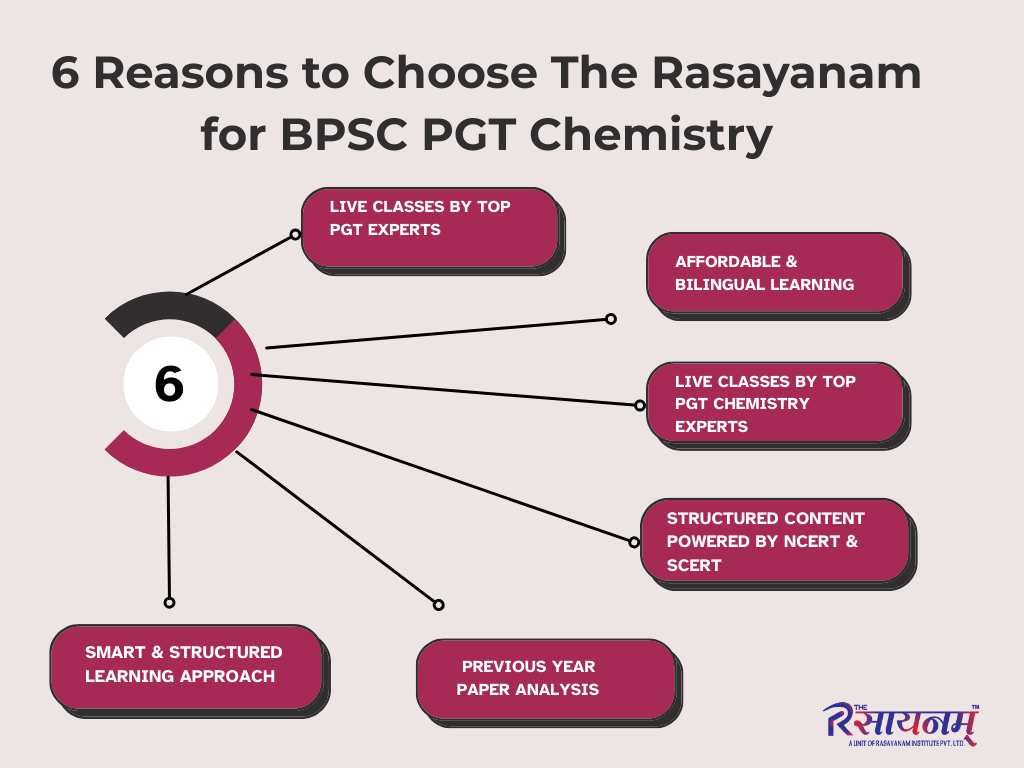
30+ courses covering various competitive exams 200+ mock test series for effective practice 10,000+ students enrolled and growing 2,000+ toppers across different fields
Attend live interactive lectures delivered by experienced faculty members who specialize in PGT Chemistry. These sessions focus on concept clarity, question-solving techniques, and exam strategy—everything you’d expect from the best coaching for BPSC PGT Chemistry.
Watch our expert faculty in action
Our study material strictly follows the BPSC PGT Chemistry syllabus, including core concepts from NCERT and Bihar SCERT textbooks. The curriculum is systematically structured to help students cover every topic efficiently—another reason why The Rasayanam is trusted as the best coaching for BPSC PGT Chemistry.
We offer deep dive analysis of BPSC PGT Chemistry previous year papers to help aspirants identify key trends and recurring topics.
Download Free PYQs + Analysis
This strategic focus is what gives The Rasayanam an edge in BPSC PGT coaching.
Our concept-first methodology focuses on real understanding, not just memorization. With:
Chapter-wise short notes
Mini assessments
Daily practice tests
You’ll always know where you stand. That’s the signature of the best coaching for BPSC PGT Chemistry.
Whether it’s exam stress, conceptual confusion, or study strategy, our one-on-one mentorship system ensures no student is left behind. This personalized learning model is another key factor that makes us the best coaching for BPSC PGT Chemistry.

Our courses are designed to be affordable, inclusive, and bilingual (Hindi + English) so that students from all backgrounds can benefit equally. Accessible education meets quality delivery—exactly what you want in the best coaching for BPSC PGT Chemistry.

Are you preparing for BPSC PGT Chemistry TRE 4.0? Don’t miss our exclusive Revision Batch designed to help you revise effectively and boost your confidence before the exam!
What do you get in this batch? Structured revision plan Important topics & concepts Expert guidance Exam-oriented approach
Watch the full video here to get started
Stay ahead in your preparation and ace the exam!
Course Snapshot – BPSC PGT Chemistry Target Batch| Feature | Details |
|---|---|
| Course Mode | Online (Live + Recorded) |
| Language | Hindi + English (Bilingual) |
| Key Components | Daily Live Lectures, Chapter-wise Practice |
| Study Resources | Theory Notes, PYQs, Mock Tests |
| Doubt Solving | Live Sessions + Chat Support |
| Fee | Affordable |
| Refund Policy | Non-refundable |

1. Which of the following is the chemical formula of fullerenes?
a) C0
b) C6
c) C
d) C60
Answer: d
Explanation: Fullerene represents a crystalline allotrope of carbon and the only pure form of carbon. A C60 molecule forms fullerene, and scientists use it in microscopic ball bearings, lightweight batteries, and in the synthesis of new plastics and drugs.
2. Which of the following is known as the Black lead?
a) Charcoal
b) Diamond
c) Graphite
d) Fullerenes
Answer: c
Explanation: Graphite is also a crystalline form of allotropic carbon, which is dark grey in color, it has hexagonal plates, the hybridization of carbon is sp2 and it is a good conductor of heat and electricity due to the presence of electrons. People know it as black lead, and they also use it as a very good lubricant.
3. Carbon black is the same as coke.
a) False
b) True
Answer: a
Explanation: Manufacturers produce coke by destructively distilling coal, while they form carbon black by burning natural gas in a limited supply of air. They then mix carbon black with rubber to make automobile tires. Though both represent amorphous allotropes of carbon, they remain different substances.
4. Wood Charcoal is an allotrope of _____________
a) carbon
b) silicon
c) nitrogen
d) germanium
Answer: a
Explanation: We obtain wood charcoal by heating wood strongly in the absence of air. When we heat it with steam, it becomes more activated, and we use it to remove coloring matter and foul-smelling gases. It represents an amorphous allotrope of carbon.
5. Bituminous is a common type of _____________
a) calcium
b) borax
c) coal
d) Coke
Answer: c
Explanation: The different types of coal are
6. What do we call the suspension of graphite in water?
a) Gaseous bag
b) Aqua Dag
c) Oil Dag
d) Liquid Dag
Answer: b
Explanation: Graphite is a crystalline allotrope of carbon. When graphite is mixed in water, it forms Aquadag, and when mixed in oil, it forms Oildag. People commonly use aquadag as a coating in cathode ray tubes.
7. Half many five-membered rings are there in fullerenes?
a) 34
b) 15
c) 12
d) 10
Answer: c
Explanation: Fullerenes (C₆₀) are made up of 12 five-membered rings and 20 six-membered rings.Each five-membered ring joins with six-membered rings; furthermore, the six-membered rings connect with both five- and six-membered rings.
8. Wood Charcoal is an allotrope of _____________
a) carbon
b) silicon
c) nitrogen
d) germanium
Answer: a
Explanation: Manufacturers make wood charcoal by heating wood strongly without air. Therefore, when they treat it with steam, it becomes activated, and they use it to remove colors and unpleasant gases. It represents an amorphous allotrope of carbon.
9. Which of the following is an amorphous allotrope of carbon?
a) Diamond
b) Fullerenes
c) Graphite
d) Lampblack
Answer: d
Explanation: Diamond, graphite, and fullerenes are crystalline allotropes of carbon, while lampblack is an amorphous form. Manufacturers make lampblack by burning vegetable oils with limited air, and they use it to make printing ink, black paint, varnish, and carbon paper.
10. Manufacturers use bone black to manufacture pyridine.
a) True
b) False
Answer: a
Explanation: We get bone black (animal charcoal) by heating bones in an iron retort (destructive distillation). Moreover, this process also gives bone oil and pyridine. We use bone black as an adsorbent. On burning, it forms bone ash (calcium phosphate), which industries use to make phosphorus and phosphoric acid.
BPSC PGT Chemistry: p-Block Elements Important Questions
BPSC PGT Chemistry Important Question: Uses of Boron and Aluminium and their Compounds
BPSC PGT Chemistry: Trends and Anomalous Properties of Boron Important Questions
Silicon & P-Block Elements: Understanding Their Properties and Applications
Silicon & P-Block Elements: Understanding Their Properties and Applications
Boric Acid & P-Block Element: Understanding Their Properties and Applications

1. What is the full form of LPG?
a) liquefied phenolic gas
b) liquefied pentane gas
c) liquefied petroleum gas
d) liquid petroleum gas
Answer: c
Explanation: LPG stands for Liquefied Petroleum Gas, which mainly contains n-butane and isobutane. It is widely used as a domestic fuel and is commonly employed in households for cooking purposes.
2. Which of the following mixtures is known as producer gas?
a) carbon dioxide and hydrogen
b) carbon monoxide and hydrogen
c) carbon monoxide and nitrogen
d) carbon dioxide and nitrogen
Answer: c
Explanation: When carbon reacts at around 1273 K, it doesn’t just stay quiet — it teams up with oxygen and nitrogen to create a special fuel mixture called producer gas (mainly carbon monoxide and nitrogen). On the other hand, when carbon monoxide unites with hydrogen, the result is another important fuel mixture known as water gas.
3. Which of the following is not a property of carbon monoxide?
a) odourless
b) colourless
c) water-insoluble
d) oxidising agent
Answer: d
Explanation: Carbon monoxide is a sneaky gas — you can’t see it, you can’t smell it, and it barely dissolves in water. Yet, despite being invisible and odourless, it’s incredibly powerful as a reducing agent. In fact, this gas plays a key role in metallurgy, helping extract metals like iron (from ferrous oxide) and zinc (from zinc oxide) by reducing their oxides to pure metal.
4. The cross-linked polymer compounds containing silicone which are linear and the cyclic are called ___________
a) coal
b) silicones
c) silicate
d) silicanes
5. Carbon dioxide forms carbonic acid with water.
a) true
b) false
Answer: a
Explanation: Carbon dioxide, represented as CO₂, is a colourless and odourless gas. When it dissolves in water, it doesn’t stay idle — it reacts to form carbonic acid (H₂CO₃). This weak acid further breaks down in water, giving rise to bicarbonate (HCO₃⁻) and hydronium (H₃O⁺) ions, as shown in the balanced equation:
H₂CO₃(aq) + H₂O → HCO₃⁻ + H₃O⁺
6. What is the chemical formula of beryl?
a) Be3Al2Si6O18
b) Be3AlSi6O18
c) Be3Al2Si6O
d) BeAl2Si6O18
Answer: a
Explanation: Beryl has the chemical formula Be₃Al₂Si₆O₁₈. It belongs to the group of cyclic silicates, where two oxygen atoms are shared. Its fundamental structural unit is Si₆O₁₈¹²⁻, and it is commonly called beryllium aluminium cyclosilicate.
7. When aluminium ions replace silicon ions and silicon dioxide what is it called?
a) silicanes
b) silicates
c) silicons
d) zeolites
Answer: d
Explanation: When some aluminium ions replace silicon ions in the three-dimensional network of silicon dioxide, the resulting structure is called an aluminosilicate. To balance the negative charge, cations such as sodium, potassium, or calcium are required. Common examples include zeolites and feldspar.
8. Talcum powder has a slippery touch.
a) True
b) False
Answer: a
Explanation: Talc is made up of flat sheets that can easily slide over each other because of weak attractive forces. This property makes talc the main ingredient of talcum powder, giving it a smooth and slippery feel. Hence, the statement is true.
9. What is the second hardest material known?
a) Coke
b) Carborundum
c) Graphite
d) Diamond
Answer: b
Explanation: Carborundum is the second hardest material known and has a formula of silicon carbide that is SiC. It is used as a semiconductor at high-temperature and also in transistor diode rectifiers. Diamond is the first hardest material known.
10. Which of the following is not a component of glass?
a) Sodium chloride
b) Calcium carbonate
c) Silica
d) Sodium carbonate
Answer: a
Explanation: Glass is a transparent or translucent amorphous substance, which is obtained by fusion of sodium carbonate or sodium sulphate, calcium carbonate and sand (which is also known as silica), the general formula of glass is Na2O.CaO.6SiO2
11. which of the following is not a part of the composition of natural gas?
a) hydrocarbons
b) methane
c) ethane
d) benzene
Answer: d
Explanation: Natural gas occurs underground along with petroleum and mainly consists of methane, with smaller amounts of ethane, propane, and higher hydrocarbons. It is widely used as a fuel, and its combustion produces carbon black, which serves as a reinforcing material in rubber.
12. What is the basic structural unit of a silicate?
a) Si4–
b) SiO–
c) SiO4
d) SiO44-
Answer: d
Explanation: Silicates are basically metal salts of silicic acid (H₂SiO₃). They are usually made by fusing metal oxides or carbonates with sand. At their core, all silicates are built from the same fundamental block — the silicate ion (SiO₄⁴⁻). A common example of this family is Zircon (ZrSiO₄), a well-known silicate mineral.
BPSC PGT Chemistry: p-Block Elements Important Questions
BPSC PGT Chemistry Important Question: Uses of Boron and Aluminium and their Compounds
BPSC PGT Chemistry: Trends and Anomalous Properties of Boron Important Questions
BPSC PGT Chemistry: p-Block Elements Important Questions
Silicon & P-Block Elements: Understanding Their Properties and Applications
Boric Acid & P-Block Element: Understanding Their Properties and Applications

1. The successive members of a homologous series differ by an unit of which of the following?
a) –CH3
b) CH3CH3
c) –CH2
d) –CH2CH3
Answer: c
Explanation: In a homologous series, each successive member differs by a –CH₂– unit. For example, methanol (CH₃OH), ethanol (CH₃CH₂OH), and propanol (CH₃CH₂CH₂OH) clearly show that each compound in the series varies from the next by one CH₂ group.
2. Tropolone is a benzenoid compound.
a) True
b) False
Answer: b
Explanation: Tropolone is classified as a non-benzenoid compound because it lacks a benzene ring. In contrast, benzenoid compounds are those that contain one or more benzene rings, such as benzene, aniline, and naphthalene.
3. What is the other name for acyclic compounds?
a) Aliphatic
b) Aromatic
c) Heterocyclic
d) Alicyclic
Answer: a
Explanation: Acyclic or open-chain compounds are known as aliphatic compounds, consisting of straight or branched chains. On the other hand, aromatic, heterocyclic, and alicyclic compounds are closed-chain or ring structures.
4. Which of these is not an aliphatic compound?
a) Acetic acid
b) Acetaldehyde
c) Ethane
d) Tetrahydrofuran
Answer: d
Explanation: Tetrahydrofuran (CH₂)₄O is a closed-chain (ring) compound, whereas acetic acid, acetaldehyde, and ethane are open-chain compounds and thus classified as aliphatic.
5. Pick out the option that is not a functional group from the following.
a) Hydroxyl group
b) Benzene group
c) Aldehyde group
d) Carboxylic acid group

1. σ bonds are stronger than π bonds.
a) True
b) False
2. How many σ and π bonds are present in the following molecule?
N≡C-CH-C≡N
a) σ = 5; π = 4
b) σ = 6; π = 3
c) σ = 4; π = 2
d) σ = 3; π = 5
3. Arrange the following in the increasing order of electronegativity.
a) sp2 < sp < sp3
b) sp3 < sp2 < sp
c) sp < sp2 < sp3
d) sp3 < sp < sp2
Answer: b
Explanation: The greater the s-character in hybrid orbitals, the higher the electronegativity. Among them, sp orbitals have 50% s-character, making them the most electronegative. In comparison, sp² orbitals have 33% s-character and sp³ orbitals only 25%, hence sp shows the highest electronegativity.
4. What is the hybridization of CH3CH2CH2CN?
a) sp, sp3
b) sp2, sp3
c) sp
d) sp, sp2
Answer: a
Explanation:
5. What is the valency of carbon?
a) Pentavalent
b) Divalent
c) Trivalent
d) Tetravalent
BPSC PGT Chemistry: p-Block Elements Important Questions
BPSC PGT Chemistry Important Question: Uses of Boron and Aluminium and their Compounds
BPSC PGT Chemistry: Trends and Anomalous Properties of Boron Important Questions
BPSC PGT Chemistry: p-Block Elements Important Questions
Silicon & P-Block Elements: Understanding Their Properties and Applications
Boric Acid & P-Block Element: Understanding Their Properties and Applications

1. Which of the following is true regarding the boiling point?
a) cannot say
b) n-Octane is greater than isooctane
c) n-Octane is less than isooctane
d) n-Octane is equal to isooctane
Answer: b
Explanation: The boiling point of alkanes decreases with branching because it reduces surface area and weakens van der Waals forces. Since boiling point increases with molecular mass and surface area, n-octane has a higher boiling point than isooctane.
2. Methane cannot be prepared by the reduction of alkenes or alkynes.
a) true
b) false
Answer: a
Explanation: Methane cannot be obtained by reducing alkenes or alkynes, since these reactions require compounds with at least two carbon atoms, while methane contains only one. It also cannot be prepared by Kolbe’s electrolysis or the Wurtz reaction.
3. In the combustion reaction of alkanes, if Ethane is used, how many moles of oxygen are required?
a) 3
b) 4
c) 7
d) 3.5
Answer: d
Explanation: The combustion reaction of alkanes has a standard reaction that is CnH2n+2 + (3n/2 + 1/2)O2 → nCO2 + (n + 1)H2O. In the case of combustion of ethane, n = 2. That means the number of moles of oxygen required is 3(2)/2 + 1/2 = 3.5
4. Which of the following is not a process of halogenation of alkanes?
a) acylation
b) chlorination
c) bromination
d) iodination
Answer: a
Explanation: Halogenation of alkanes includes chlorination, bromination, and iodination. The reaction follows a free radical mechanism, where halogen free radicals act as the attacking species, making it a chain reaction.
5. Alkynes are __________ in nature and first four members are __________ gases.
a) polar, white
b) nonpolar, colourless
c) polar, colourless
d) nonpolar, white
Answer: b
Explanation: Alkanes are nonpolar, so they dissolve in nonpolar solvents but are insoluble in polar solvents like water. The first four alkanes are colourless gases, the next thirteen are colourless liquids, and the higher members are colourless solids. This trend is due to the increasing strength of intermolecular forces with molecular size.
6. Corey-House synthesis is used for alkanes having __________ number of carbon atoms.
a) 6
b) 3
c) 2
d) 4
Answer: b
Explanation: The Corey–House synthesis is used to prepare alkanes, particularly those with an odd number of carbon atoms. Since 6, 2, and 4 are even, only the compound containing three carbon atoms can be formed.
7. Which of the following reactions is used to increase the length of the carbon chain?
a) Wolff Kishnn’s reaction
b) Clemmensen reduction
c) Kolbe’s electrolysis
d) Wurtz reaction
Answer: d
Explanation: The Wurtz reaction is used to extend the carbon chain. Kolbe’s electrolysis helps in preparing alkanes with an even number of carbon atoms, while Clemmensen reduction and Wolff–Kishner reduction are employed for the removal of oxygen (as in reducing carbonyl groups).
8. How many carbons are there in the product of a decarboxylation reaction when compared with the reactant?
a) two carbons more
b) one carbon more
c) one carbon less
d) an equal number of carbons
Answer: c
Explanation: The decarboxylation of sodium or potassium salts of fatty acids is a decarboxylation reaction. It is used for descending the series, since the alkane formed contains one carbon less than the parent acid. Quicklime is added because it is more hygroscopic than sodium hydroxide and helps keep it dry.
9. Is of hydrogenation is __________ on steric crowding.
a) may be related to
b) dependent
c) independent
d) not related to
Answer: b
Explanation: The ease of hydrogenation depends on steric hindrance around the multiple bond — greater crowding reduces reactivity. This principle is applied in preparing alkanes by hydrogenating alkenes and alkynes.
10. Alkanes are also known as __________
a) alkenes
b) paraffin
c) aromatic
d) alicyclic
Answer: b
Explanation: Alkanes are saturated open-chain hydrocarbons containing only carbon–carbon single bonds. Being chemically inert under normal conditions, they do not react with acids, bases, or most reagents. They were earlier called paraffins (from Latin parum = little and affinis = affinity), meaning “little affinity.”
BPSC PGT Chemistry: p-Block Elements Important Questions
BPSC PGT Chemistry Important Question: Uses of Boron and Aluminium and their Compounds
BPSC PGT Chemistry: Trends and Anomalous Properties of Boron Important Questions
BPSC PGT Chemistry: p-Block Elements Important Questions
Silicon & P-Block Elements: Understanding Their Properties and Applications
Boric Acid & P-Block Element: Understanding Their Properties and Applications

1. 0.350 g of an organic compound gave 100 ml of nitrogen collected at 250 K temperature and 700 mm pressure. Calculate the percentage composition of nitrogen in the compound. Use the Dumas method.
a) 25.70%
b) 35%
c) 35.71%
d) 36.88%
Answer: c
Explanation: Here, p = 700 mm; v = 100 ml; t =250 K
Volume of nitrogen at STP = p * v * 273/ 760 * t
= 700 * 100 * 273/ 760 * 250
= 100.57 ml
22,400 ml of nitrogen at STP weighs = 28 g
Then, 100.57 ml of nitrogen weighs = 28 * 100.57/22400
= 0.125 g
Therefore, percentage of nitrogen = 0.125 * 100/0.350
= 35.71%
So, the percentage of nitrogen in the organic compound is 35.71%.
2. Dumas’ method is a method of estimation of nitrogen.
a) True
b) False
Answer: a
Explanation: In quantitative analysis of nitrogen, one method is the Dumas method. In this process, the nitrogen-containing organic compound is heated with copper oxide in a carbon dioxide atmosphere, producing free nitrogen along with carbon dioxide and water.
3. The amounts of water can be detected by the increase in the mass of __________ during quantitative analysis of hydrogen.
a) potassium hydroxide
b) sodium hydroxide
c) sodium chloride
d) calcium chloride
Answer: d
Explanation: In quantitative analysis of hydrogen, the hydrogen in the compound is oxidized to water. The water formed is passed through a U-tube containing calcium chloride, which absorbs it and shows an increase in mass. This gain in mass corresponds to the amount of water, and thus the hydrogen, present in the organic compound.
4. On complete combustion, 0.500 g of an organic compound gave 0.150 of carbon dioxide. Determine the percentage composition of carbon in the compound.
a) 8.18%
b) 81.8%
c) 0.81%
d) 81%
Answer: a
Explanation: The required equation is:
Percentage of carbon = 12 * m2 * 100/ 44 * m
In this case, m = 0.500
m2 = 0.150
Substituting in the equation → Percentage of carbon = 12 * 0.150 * 100/ 44 * 0.500
= 8.18%
Therefore, the percentage of carbon present in the organic compound is 8.18%.
5. Carbon and hydrogen are detected by heating the compound with ____________ during quantitative analysis.
a) carbon dioxide
b) copper (II) oxide
c) magnesium oxide
d) sulphur dioxide
Answer: b
Explanation: In quantitative analysis, a measured amount of the organic compound is burned with excess oxygen and copper(II) oxide. The carbon is oxidized to carbon dioxide, while the hydrogen is converted into water.
6. In Kjedahl’s method of estimation of nitrogen, the compound containing nitrogen is heated with __________
Answer: b
Explanation: In this method, the nitrogen-containing compound is first heated with concentrated sulphuric acid, converting nitrogen into ammonium sulphate. On further heating with excess sodium hydroxide, ammonia gas is released, which is absorbed in a known amount of standard sulphuric acid. The amount of ammonia formed is then determined by measuring the sulphuric acid consumed.
7. Using the Carius method, find out the percentage of bromine in the compound if 0.450 g of organic compound gave 0.200 g of AgBr. (Given: molar mass of Ag = 108; molar mass of Br = 80)
a) 18%
b) 17%
c) 17.68%
d) 18.91%
Answer: d
Explanation: The molar mass of AgBr = 108 + 80
= 188 g
So, 188 g of AgBr contains 80 g of Br.
Then, 0.200 g of AgBr contains 80 * 0.200/ 188 = 0.085 g bromine
Therefore, percentage of bromine = 0.085 * 100/ 0.450
= 18.91%
Thus, the percentage of bromine (halogen) using Carius method is 18.91%.
8. In the estimation of sulphur, the organic compound is heated with ___________ in a carius tube.
a) sodium hydroxide
b) sodium peroxide
c) potassium hydroxide
d) calcium chloride
Answer: b
Explanation: For sulphur estimation, the organic compound is heated with sodium peroxide, which oxidizes sulphur to sulphuric acid. On adding excess barium chloride solution, sulphuric acid is precipitated as barium sulphate. The percentage of sulphur is then calculated from the mass of barium sulphate formed.
9. Estimation of oxygen can be determined by the Carius method.
a) True
b) False
Answer: b
Explanation: The Carius method is applied for estimating halogens in an organic compound. The percentage of oxygen is calculated either by subtracting the total percentage of other elements from 100 or by determining it from the amount of iodine formed.
10. The elements present in a compound are determined by apparatus called ____________
a) analyzer
b) CHN elemental analyzer
c) chemical analyzer
d) elemental analyzer
Answer: b
Explanation: Carbon, hydrogen, and nitrogen in an organic compound are estimated using a CHN elemental analyzer. This instrument needs only a tiny sample (1–3 mg) and quickly displays the results on a screen.

1. A compound with the same molecular formula exists in two forms, one is alcohol and the other is Ether. What type of isomerism does it show?
a) metamerism
b) positional isomerism
c) functional isomerism
d) chain isomerism
Answer: c
Explanation: Functional isomerism occurs when compounds have the same molecular formula but different functional groups. For example, C₃H₆O can exist as an aldehyde or a ketone. Similarly, the given compound can exist as an alcohol or an ether, showing functional isomerism.
2. What is the specific rotation if its observed rotation is given as 3x, its length is given as x and density is given as 3/y?
a) 2y
b) 3y
c) y
d) 4y
Answer: c
Explanation: The specific rotation is given by the expression observed rotation/length X density, here as observed rotation is given as 3x and its length is given as x, while the density is 3/y, the specific rotation equals 3x/x(y/3) = y.
Thus, the specific rotation equals y.
3. Acetaldehyde and ethenol show ____________
a) stereoisomerism
b) metamerism
c) positional isomerism
d) tautomerism
Answer: d
Explanation: Acetaldehyde and ethenol show tautomerism, a special type of functional isomerism found in carbonyl compounds with an α-hydrogen atom. It involves the interconversion between the keto form and the enol form.
4. If a compound has 3 chiral carbons, what is the number of optically active isomers?
a) 9
b) 3
c) 4
d) 8
Answer: d
Explanation: The number of optically active isomers of a compound is calculated using the formula 2ⁿ, where n is the number of chiral carbons. Since this compound has 3 chiral carbons (n = 3), the total number of optically active isomers is 2³ = 8.
5. How many planes of symmetry does a meso compound have?
a) 2
b) 1
c) 3
d) 4
Answer: b
Explanation: A meso compound is one in which one half of the molecule is a mirror image of the other half. Such compounds usually contain two or more chiral centers and possess a plane of symmetry. Meso compounds are optically inactive because of internal compensation.
6. Enantiomers are the same as diastereomers.
a) true
b) false
Answer: b
Explanation: In optical isomerism, enantiomers are non-superimposable mirror images of each other, while diastereomers are also non-superimposable but are not mirror images. Diastereomers differ from each other in both physical and chemical properties.
7. The d-form is also known as ____________
a) rotatory
b) laevorotatory
c) dextrorotatory
d) l-form
Answer: c
Explanation: An isomer that rotates the plane of polarized light to the right (clockwise) is called dextrorotatory (d-form), while one that rotates it to the left (anticlockwise) is called laevorotatory (l-form).
8. Optical isomerism is a type of ____________
a) metamerism
b) stereoisomerism
c) geometrical isomerism
d) tautomerism
Answer: b
Explanation: Compounds with the same molecular formula but different spatial arrangements of atoms or groups are called stereoisomers, and this property is known as stereoisomerism. It is classified into three types: optical isomerism, geometrical isomerism, and conformational isomerism.
9. Which of the following is not a type of structural isomerism?
a) geometric isomerism
b) chain isomerism
c) metamerism
d) tautomerism
Answer: a
Explanation: Structural isomerism occurs when compounds have the same molecular formula but different structures. It is further classified into chain isomerism, position isomerism, functional isomerism, metamerism, and tautomerism. Hence, geometrical isomerism does not fall under structural isomerism.
10. 2-chloropropane and 1-chloropropane exhibit ____________ isomerism.
a) chain
b) position
c) functional
d) metamerism
Answer: b
Explanation: Compounds that share the same molecular formula but differ in the position of a functional group or substituent are called positional isomers, and this phenomenon is known as position isomerism. For example, 1-chloropropane and 2-chloropropane differ in the position of the chlorine atom; hence, they are positional isomers.
BPSC PGT Chemistry: Trends and Anomalous Properties of Boron Important Questions
BPSC PGT Chemistry: p-Block Elements Important Questions
Silicon & P-Block Elements: Understanding Their Properties and Applications
Boric Acid & P-Block Element: Understanding Their Properties and Applications

1. In fractional distillation, vapors of the low-boiling-point component ascend to the top of the column.
a) True
b) False
Answer: a
Explanation: Fractional distillation, similar to simple distillation, works on the principle of differences in boiling points of liquids. However, it is specifically used when the boiling point differences between the liquids are small. In this process, the higher boiling point liquids condense near the bottom of the distillation column, while the lower boiling point liquids rise and condense toward the top.
2. Gas chromatography can be performed in X, whereas liquid chromatography can be performed in Y. Identify X and Y.
a) X = only plane surfaces, Y = only columns
b) X = only columns, Y = only plane surfaces
c) X = only columns, Y = columns or plane surfaces
d) X = columns or plane surfaces, Y = only plane surfaces
Answer: c
Explanation: Gas chromatography is performed only in columns, as the sample is vaporized and injected at the top of the chromatographic column. Depending on the stationary phase, it may be gas–liquid or gas–solid chromatography. In contrast, liquid chromatography uses a liquid mobile phase in which the sample molecules or ions are dissolved, and it can be carried out either in a column or on a plane.
3. Thin-layer chromatography is used to estimate drugs in a formulation.
a) True
b) False
Answer: b
Explanation: Column chromatography is used for the estimation of drugs in formulations. Thin-layer chromatography (TLC), on the other hand, is employed to detect amino acids by spraying the plate with ninhydrin solution. In TLC, a glass plate known as a chromatoplate is used as the stationary support.
4. What is the basis for the process of distillation?
a) Difference in melting point
b) Difference in temperature
c) Difference in pressure
d) Difference in boiling point
Answer: d
Explanation: Distillation works on the principle of differences in boiling points of liquids, as each liquid vaporizes at its own characteristic temperature. The vapors are then cooled and collected separately as liquids. Crystallization, on the other hand, is used to separate volatile liquids from non-volatile substances.
5. The purification method where solid substances change from solid to vapor state without passing through the liquid state is called as which of the following?
a) Sublimation
b) Crystallization
c) Distillation
d) Differential extraction
Answer: a
Explanation: In sublimation, a solid directly changes into the vapor state without passing through the liquid phase. This method is useful for separating sublimable compounds from non-sublimable ones. In contrast, crystallization, distillation, and differential extraction require a suitable solvent and are mainly applied to liquids rather than solids alone.
6. In crystallization, the compound dissolved in a solvent is more soluble in what temperature?
a) Room temperature
b) Lower temperature
c) Higher temperature
d) Very low temperature
Answer: c
Explanation: The solubility of a compound in water generally increases with temperature. As the temperature rises, the kinetic energy of solvent molecules also increases, enabling them to break the intermolecular forces holding the solute molecules together more effectively. Since these interactions require significant energy to overcome, higher temperatures enhance solubility.
7. Identify an example of compounds separated by the steam distillation method.
a) Glycerol-spent lye mixture in the soap industry
b) Aniline-water mixture
c) Chloroform and aniline mixture
d) Different fractions of crude oil in the petroleum industry
Answer: b
Explanation: Aniline is separated from its mixture with water using steam distillation, as this method is suitable for substances that are steam-volatile and immiscible in water—both conditions met by aniline. In comparison, glycerol–spent lye mixtures are separated by distillation under reduced pressure, chloroform–aniline mixtures by simple distillation, and crude oil by fractional distillation.
8. Which is not used as an absorbent in adsorption chromatography?
a) Silica gel
b) Alumina
c) Potassium permanganate
d) Starch
Answer: c
Explanation: A good adsorbent should have a large surface area, be inexpensive, readily available, thermally stable, and possess high abrasion resistance. Materials like silica, alumina, and starch meet these criteria, whereas potassium permanganate does not, making it unsuitable as an adsorbent.
9. Which of the following is the apparatus for differential extraction?
a) Separatory funnel
b) Porous sheet
c) Packed column
d) Electric motor
Answer: a
Explanation: A separatory funnel is used in differential extraction, which separates an immiscible organic compound from an aqueous solvent. The funnel allows clear layer formation, with the denser solvent settling at the bottom and the lighter one on top. This property makes the separatory funnel the ideal apparatus for the process.
10. In column chromatography, identify the mobile and stationary phases from the following.
a) Solid, Liquid
b) Liquid, Solid
c) Gas, Liquid
d) Solid, Solid
Answer: b
Explanation: In column chromatography, the mobile phase is a liquid or a mixture of liquids that flows down the column, while the stationary phase is a solid adsorbent, such as alumina or silica gel, over which the mobile phase passes.
11. Paper chromatography is a type of chromatography.
a) Column chromatography
b) Thin-layer chromatography
c) Adsorption chromatography
d) Partition chromatography
Answer: d
Explanation: Paper chromatography is a form of partition chromatography because the solutes spend more time in the stationary phase than in the mobile phase, causing them to move slowly up the paper. Partition chromatography separates substances based on their distribution between two liquid phases.
12. Which is the most suitable carrier gas in gas chromatography?
a) Helium
b) Nitrogen
c) Oxygen
d) Carbon dioxide
Answer: a
Explanation: In gas chromatography, the carrier gas must be inert so it does not react with the sample. While gases like nitrogen are also used, helium serves as the carrier gas in about 90% of instruments. Hydrogen is sometimes preferred as it provides better separation efficiency.
13. What is the paper strip developed in partition chromatography called?
a) Chromatograph
b) Chroma
c) Chromatographing strip
d) Chromatogram
Answer: d
Explanation: A paper strip that separates and retains different components based on their partition between two phases is called a chromatogram. The separated colored components appear as spots at varying distances from the initial application point.
14. Which type of chromatography involves the separation of a mixture over a column of adsorbent packed in a glass tube?
a) Thin-layer chromatography
b) Partition chromatography
c) Column chromatography
d) Gas liquid chromatography
Answer: c
Explanation: Column chromatography separates a mixture using a column packed with a solid adsorbent inside a glass tube. The mixture is applied at the top, and the mobile phase is then allowed to pass slowly through the column, enabling separation of the components.
15. The mobile phase in chromatography can comprise of which of the following?
a) Gas or liquid
b) Liquid or solid
c) Solid or gas
d) Liquid only
Answer: a
Explanation: In chromatography, the mobile phase flows over the stationary phase within the packed bed or column. Since only fluids (liquids or gases) can flow, they serve as the mobile phase. Solids cannot be used because they lack fluidity and would hinder proper interaction with the stationary phase.
BPSC PGT Chemistry Important Question: Uses of Boron and Aluminium and their Compounds
BPSC PGT Chemistry: Trends and Anomalous Properties of Boron Important Questions
BPSC PGT Chemistry: p-Block Elements Important Questions
Silicon & P-Block Elements: Understanding Their Properties and Application
Boric Acid & P-Block Element: Understanding Their Properties and Applications

1. If the total number of bonds between two atoms is 3 the total number of resonating structures is 2 what is the bond order?
a) 0.5
b) 1.5
c) 2.5
d) 3.5
Answer: b
Explanation: Bond order is calculated using the formula:
In this case, Bond order=3/2=1.5
Thus, bond order is directly related to resonance, as shown by this equation.
2. Free radicals are formed during homolytic fission.
a) true
b) false
Answer: a
Explanation: Homolytic fission splits a covalent bond evenly, giving one electron to each atom. This produces free radicals, which are neutral, highly reactive, and usually formed in non-polar molecules under sunlight or high temperature.
3. What is the hybridization of singlet carbene?
a) sp
b) sp3
c) sp3d
d) sp2
Answer: d
Explanation: In a singlet carbene, the carbon atom is sp² hybridized. One of the hybrid orbitals holds a pair of electrons, while the unhybridized orbitals remain vacant. Singlet carbenes have a bent structure and are less stable compared to triplet carbenes.
4. In a molecule, when displacement of electron pair is away from the group it is ______________ electromeric effect.
a) zero
b) negative
c) positive
d) no
Answer: c
Explanation: The electromeric effect is the temporary polarization in a molecule with multiple bonds when an attacking reagent approaches. In this effect, the pair of π-electrons is completely shifted to one of the atoms. If the electron pair is displaced away from the atom or group, it is called the +E effect; if it shifts towards the atom or group, it is called the –E effect.
5. Which of the following is false regarding the inductive effect?
a) temporary effect
b) propagates through a carbon chain
c) permanent effect
d) Groups having a higher electron affinity than hydrogen show the negative inductive effect
Answer: a
Explanation: The inductive effect is a permanent effect that transmits through the carbon chain. Atoms or groups with greater electron affinity than hydrogen show the –I effect (electron-withdrawing), while those with lower affinity show the +I effect (electron-releasing). It can be understood as the shifting of shared electron pairs in polar covalent bonds.
6. Nucleophilic reagents behave as ______________
a) water
b) Lewis base
c) lewis acid
d) salt
Answer: b
Explanation: Nucleophilic reagents are electron-rich species and act as Lewis bases. They attack electron-deficient centers. For species with the same nucleophilic site, nucleophilicity generally increases with basicity.
7. Carbocations bear a ______________ charge.
a) no
b) negative
c) positive
d) 0
Answer: c
Explanation: Carbocations are formed during hydrolysis and consist of a carbon atom carrying a positive charge. Being electron-deficient, they have only 6 electrons in their valence shell. Carbocations are planar in shape, sp² hybridized, and possess an empty p-orbital.
8. Baker Nathan effect is related to ______________
a) inductive effect
b) electromeric effect
c) hyperconjugation
d) resonance
Answer: c
Explanation: Hyperconjugation is the delocalization of σ-electrons from a C–H bond of an alkyl group directly attached to an unsaturated system or to an atom with an adjacent π-orbital. This phenomenon is also known as no-bond resonance or the Baker–Nathan effect.
9. Resonating structures are also known as ______________ forms.
a) canonical
b) inductor
c) electromeric
d) nucleophilic
Answer: a
Explanation: When a single structure cannot represent all the properties of a molecule, two or more structures are drawn to describe it. These are called resonating structures or canonical forms, and the actual molecule is considered a resonance hybrid of them.
10. What is obtained by thermolysis of azides?
a) free radicals
b) carbocation
c) arene
d) nitrene
Answer: d
Explanation: Nitrenes are generated by the thermolysis of azides. They are neutral, monovalent nitrogen species in which the nitrogen atom carries two unshared electrons along with a single bond to a monovalent atom or group. Nitrenes are highly reactive, similar to carbenes.
BPSC PGT Chemistry: Trends and Anomalous Properties of Boron Important Question
Silicon & P-Block Elements: Understanding Their Properties and Applications
Boric Acid & P-Block Element: Understanding Their Properties and Applications
BPSC PGT Chemistry: Important Compounds of Boron
.png&w=1920&q=75)
1. Identify the condensed formula of the given compound from the following.
ClCH2CH2CH2CH2CHCH2CH2CH2CHCH2CH3
a) Cl (CH2)2 (CH2)2CH (CH2)2CH2CH2CH3
b) Cl (CH2)3CH2CHCH2CH2CH2CH (CH3) 2
c) Cl (CH2)4CH (CH2)3CH (CH2) CH3
d) Cl (CH2)3CH2CH2CH (CH3)2CH3CHCH2CH3
Answer: c
Explanation: To write the condensed formula, group together all the repeating CH₂ units and ensure that each carbon forms exactly four bonds. In the given structure ClCH₂CH₂CH₂CH₂CHCH₂CH₂CH₂CHCH₂CH₃, there are four consecutive CH₂ groups, which can be written as (CH₂)₄. Applying the same method to the rest of the chain and combining the CH₂ units accordingly, we arrive at the condensed formula of the molecule.
2. Identify the condensed formula of ethane from the following.
a) CH3-CH3
b) HC-H2-C-H3
c) CH2=CH2
d) CH3-CH2
Answer: a
Explanation: In a condensed formula, all atoms are written out, but single bonds are usually not shown. However, double and triple bonds are represented. The formula CH₂=CH₂ does not represent ethane; it represents ethene.
3. Determine the bond-line formula of CH3CH2COCH2CH3.
a) 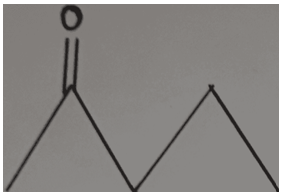
b) 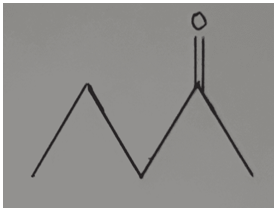
c) 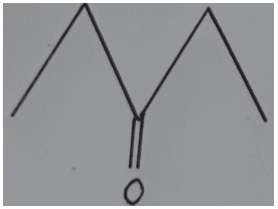
d) 
Answer: c
Explanation: In the compound CH₃CH₂COCH₂CH₃, the ketone group (C=O) is bonded to the third carbon atom. Therefore, the double bond must be shown at the position of the third carbon, that is, at the end of the second line. In all the other options, the ketone group is not located on the third carbon, which makes them incorrect.
4. Which is not a heteroatom?
a) Oxygen
b) Nitrogen
c) Carbon
d) Sulphur

1. Tropolone is a benzenoid compound.
a) True
b) False
Answer: b
Explanation: Tropolone is a non-benzenoid compound because it lacks a benzene ring. On the other hand, benzenoid compounds contain one or more benzene rings, such as benzene, aniline, and naphthalene.
2. What is the other name for acyclic compounds?
a) Aliphatic
b) Aromatic
c) Heterocyclic
d) Alicyclic
Answer: a
Explanation: Acyclic or open-chain compounds are known as aliphatic compounds because they have straight or branched chains. In contrast, aromatic, heterocyclic, and alicyclic compounds are closed-chain or ring structures.
3. Which of these is not an aliphatic compound?
a) Acetic acid
b) Acetaldehyde
c) Ethane
d) Tetrahydrofuran
Answer: d
Explanation: Tetrahydrofuran is a ring (closed-chain) compound, whereas acetic acid, acetaldehyde, and ethane are open-chain compounds and hence classified as aliphatic. Tetrahydrofuran has the molecular formula (CH₂)₄O.
4. The successive members of a homologous series differ by an unit of which of the following?
a) –CH3
b) CH3CH3
c) –CH2
d) –CH2CH3
Answer: c
Explanation: In a homologous series, each successive member differs from the previous one by a CH₂ unit. For example, methanol (CH₃OH), ethanol (CH₃CH₂OH), and propanol (CH₃CH₂CH₂OH) show that the difference between consecutive members is always a CH₂ group.
5. Pick out the option that is not a functional group from the following.
a) Hydroxyl group
b) Benzene group
c) Aldehyde group
d) Carboxylic acid group
Answer: b
Explanation: The benzene group is not considered a functional group. A functional group is an atom or a group of atoms arranged in a specific way that determines the characteristic chemical properties of an organic compound. Examples include the hydroxyl group (–OH), aldehyde group (–CHO), and carboxyl group (–COOH), all of which alter the chemical behavior of hydrocarbons when attached to them.
BPSC PGT Chemistry: p-Block Elements Important Questions
BPSC PGT Chemistry Important Question: Uses of Boron and Aluminium and their Compounds
BPSC PGT Chemistry: Trends and Anomalous Properties of Boron Important Questions
BPSC PGT Chemistry: p-Block Elements Important QuestionsSilicon & P-Block Elements: Understanding Their Properties and Applications
Boric Acid & P-Block Element: Understanding Their Properties and Applications

Preparing for the BPSC PGT Chemistry exam requires strong subject knowledge, smart preparation, and regular practice. The BPSC PGT Chemistry (Target Batch) is specially designed for aspirants who want complete Chemistry preparation through live classes, expert guidance, and exam-oriented learning.
This batch helps students strengthen concepts, improve problem-solving skills, and prepare confidently for competitive teaching exams.
The course focuses on complete syllabus coverage along with strategic preparation methods to help students perform better in the BPSC PGT Chemistry exam.
The batch covers important Chemistry topics including:
Every topic is explained in a simple and easy-to-understand way for better learning and quick revision.
Students receive 1 Year validity, allowing enough time for:
Long-term access helps aspirants prepare comfortably without pressure.
This online Chemistry batch allows students to:
This course is ideal for:
The BPSC PGT Chemistry (Target Batch) is the perfect choice for students looking for structured and result-oriented Chemistry preparation. With expert guidance, live classes, and complete syllabus coverage, this batch helps students maximize their chances of success in teaching exams.
Start your preparation today and move one step closer to your dream government teaching career.

.avif)


 BPSC PGT
 KVS/NVS/PGT
 PGT
PGT PGT/ GIC
 PGT/GIC Chemistry
 TGT Chemistry
 UP TGT Science
 UP GIC
 UP LT Grade
 IIT JAM Chemistry
 UP TGT Physics
 UP TGT Chemistry